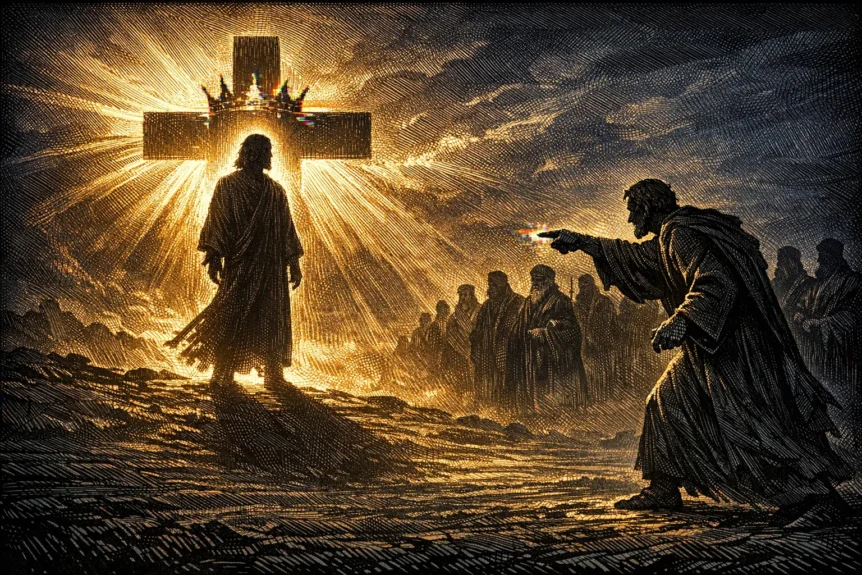
Highlight Reel
Sermon Summary
Jesus corrects His disciples’ misunderstanding of the Messiah by revealing that suffering is central to God’s plan of redemption. He then makes the cost of following Him unmistakably clear: deny yourself, take up your cross, and lose your life for His sake. Though countercultural, this path leads to true life now and glory to come.
Sermon Audio
Shareable Quote graphics



Sermon Text
The Cross Before the Crown
Nate Roten / Mark / Mark 8:31–9:1 / April 19, 2026
Main Idea
Seeing Jesus clearly means embracing His suffering mission and our costly call to follow.
We’ve all had moments when reality collided with our expectations. Perhaps it was a job that looked perfect on paper but proved overwhelming in practice, or a relationship that seemed ideal until real life set in. Or what about discovering that your dream house sits on a sinkhole, or that the “perfect” vacation destination is under construction? Today we’ll see that even Jesus’ closest disciples struggled when His mission didn’t match their expectations—and how their misunderstanding reveals something crucial about what it means to follow Christ today and what it costs us to join it.
Last week, we saw how Jesus opened blind eyes in two stages, culminating in Peter’s great confession: “You are the Christ.” But as we’ll discover today, spiritual sight involves more than recognizing Jesus’ identity—it also requires understanding His mission and ours.
Passage
Mark 8:31–9:1 CSB
31 Then he began to teach them that it was necessary for the Son of Man to suffer many things and be rejected by the elders, chief priests, and scribes, be killed, and rise after three days. 32 He spoke openly about this. Peter took him aside and began to rebuke him. 33 But turning around and looking at his disciples, he rebuked Peter and said, “Get behind me, Satan! You are not thinking about God’s concerns but human concerns.” 34 Calling the crowd along with his disciples, he said to them, “If anyone wants to follow after me, let him deny himself, take up his cross, and follow me. 35 For whoever wants to save his life will lose it, but whoever loses his life because of me and the gospel will save it. 36 For what does it benefit someone to gain the whole world and yet lose his life? 37 What can anyone give in exchange for his life? 38 For whoever is ashamed of me and my words in this adulterous and sinful generation, the Son of Man will also be ashamed of him when he comes in the glory of his Father with the holy angels.” 1 Then he said to them, “Truly I tell you, there are some standing here who will not taste death until they see the kingdom of God come in power.”
I – Misunderstanding the Messiah (vv. 31-33)
Necessary—By using the word (Greek: dei), Jesus was communicating something intentional. This wasn’t going to happen by happenstance but by design. When Jesus says He “must” suffer, He’s declaring that this suffering isn’t a detour from God’s plan—it IS the plan. Scripture had long foretold this very mission—Isaiah’s Suffering Servant and the Psalmist’s pierced and mocked figure—this wasn’t Plan B; this was always Plan A.
The Opposition – The ones who would persecute and reject Jesus were the elders, chief priests, and scribes. The elders were the respected community leaders. The chief priests represented the high-brow priestly elite of the Sadducees, and the scribes were the theological experts of the Pharisees. In essence, Jesus was explaining, in no uncertain terms, that those who should have recognized their Messiah would be the very ones to reject Him—the entire religious establishment would unite against God’s chosen one. Though the Romans would be the ones to physically nail Jesus to the cross, the Sanhedrin would be the ones to bear the weight of guilt. They are responsible.
When you put those two elements together, we see a clear representation of divine sovereignty and human responsibility. The Sanhedrin’s actions that led to Jesus’ murder were a means by which He would bring about the climax of His redemptive plan. The cross is simultaneously the greatest act of human sin and the greatest act of divine salvation. This is why Jesus didn’t stop at explaining His death… He proclaimed His resurrection after three days. Death was not defeat but the pathway to victory.
The disciple’s confusion – Though the text doesn’t unpack this, we need to if we are going to understand Peter’s response. There are specific Jewish expectations about the Messiah and what the resurrection would look like.
A. The Messiah – The Messiah is a divine, kingly ruler. Multiple passages of scripture describe Him as God’s powerful representative on earth who will rule and reign over His people with love and justice while crushing His enemies.
• A Davidic King (2 Samuel 7)
• A righteous ruler (Isaiah 11)
• A victorious deliverer (Psalm 2)
• One who would defeat enemies, not be defeated by them
Therefore, in their minds, He would be a conqueror, not conquered. He would reign, not die. He would restore, not be destroyed.
B. The Resurrection – This event would occur at the end of days (Daniel 12) and is a single event. For Jesus to say He would rise again, the disciples had no framework for multiple resurrection events. In all likelihood, they thought He was speaking in parables.
Peter’s shocking response—hopefully, now you can see why Peter pushes back. A Messiah who suffers isn’t victorious, and one who dies cannot rule. Therefore, he rebukes Jesus! Can you imagine the audacity… correcting the Son of God? This is the same word used in chapter one when Jesus rebuked the demon and cast him out of the man in the synagogue! Yet how often do we do the same thing? When we pray, demanding our agenda; when we question His timing; when we resist His providence—we’re essentially saying, “God, Your plan needs improvement.” May we never approach the omnipotent, sovereign Author of Life and tell Him that we know best.
Jesus’ sharp correction – In response, Jesus rebukes Peter, but much more forcefully… and not only Peter, but the other disciples as well. Given what the Jews anticipated about the Messiah, the second part of Jesus’ rebuke is not difficult to understand, but let me also season that understanding a bit. These men had committed to following Jesus, which meant their fate was tied to His. Their expectation was that Jesus would drive out the Romans, establish God’s kingdom on earth, and rule from Mount Zion. As His loyal disciples, they likely expected positions of prominence, much like Joseph in Egypt. But now their leader is talking about being put to death, which means they might be killed as well. When Jesus threw them a curveball, they started thinking about themselves and what this meant for their movement (human concerns). They weren’t listening with spiritual ears to understand that this was the mission: God’s ultimate plan of redemption. Therefore, Jesus sharply rebukes their misunderstanding.
But Jesus also rebukes Peter directly, saying, “Get behind me, Satan!” What is Jesus doing here? Is He calling Peter Satan? Not exactly. The bigger picture is that Peter was unwittingly doing what Satan was intentionally doing in the wilderness. He was trying to derail the Messiah’s mission. Satan offered Jesus the kingdoms without the cross—glory without suffering. That is exactly what Peter is doing. He wants to bypass the cross and go straight to the crown.
What can we glean from this first section? We need to see that while man can plot evil, God equally intends it for good. It is sound theology to understand His sovereignty and our culpability. We need to be careful about telling God all about our wonderful plans and how much better they are than our current circumstances. The brightest light in this section is that suffering comes before glory. Satan tried to reverse it, and Peter was unwittingly doing the same, but the pathway to the crown goes through the cross. The author of Hebrews tells us that Jesus was perfected in His suffering. If this was true of our sinless Savior, how much more do we need it? Your current suffering is shaping you. Don’t fight it, retreat from it, or try to wish it away. Stop expecting spiritual maturity without spiritual difficulty. Embrace suffering as God’s anvil for shaping your soul.
II – Misunderstanding the Cost of Discipleship (vv. 34-37)
If the first section reveals the real mission of the Messiah, then this section explains the real cost of discipleship. If you misunderstand the Messiah, you will misunderstand what it means to follow Him.
Suffering – The correction was given to the disciples and the gathered crowd, showing that this applies to all believers, not just the apostles. The crowd’s presence indicates interest, but interest isn’t commitment. Many, like Peter, might confess Jesus as Christ while completely misunderstanding what that means for their lives.
As mentioned earlier, suffering was not part of the plan or framework, but Jesus is the Suffering Servant of Isaiah 53, and His followers shouldn’t expect to be treated differently from their teacher and Lord. In another passage of scripture, Jesus said plainly that if the world hates Him, it will hate us as well. Suffering is part of the agreement when you sign up, which means two non-negotiable requirements:
Deny self – This is not a set period when you deny yourself certain pleasures. This isn’t a resolution to refrain from donuts during Lent, nor does it mean we are supposed to sell everything we own and become ‘piously poor.’ This is a ‘dying to self,’ in the sense that you don’t follow Jesus for selfish pursuits or personal gain. You don’t follow Him so that your carnal, financial, or material circumstances can improve. Your daily life becomes the living portrait of baptism. Just as you went under the water to identify with Christ’s death and rose to new life, so you die daily to selfish ambition and live for His glory. To follow Jesus means permanently leaving behind your preconceived notions about what your life will be like and what it will be lived for. You were bought with a price. Your life is no longer your own.
Take up your cross – When Jesus said “take up your cross,” every person in that crowd felt a chill. They had seen condemned criminals carrying their crossbeams to execution sites along Roman roads. Remember, Jesus hadn’t gone to the cross yet, so it wasn’t yet a symbol of salvation—it was purely an instrument of execution. Roman crucifixion was reserved for rebels and slaves. A recent event fresh in their minds was the Spartacus revolt, in which thousands of rebels were crucified along the main roads. As part of this humiliating execution, criminals carried their own instrument of death. In essence, a person who had to take up their cross was a non-citizen outcast who had to carry the symbol of the authority they had defied. In the end, they had to identify with Rome, even though they had rebelled against it.
Upside-down Kingdom mentality – Here’s where Jesus’ followers often get confused. To take up one’s cross ultimately means coming under the authority of Jesus and submitting to His lordship… bearing whatever burden He entrusts to you. You can only do that by denying the life you thought you wanted and submitting to His design for you, which will involve hardship.
That might sound like a terrible way to gain followers. Jesus would never be an Instagram influencer today. But there is an invaluable nugget of wisdom here: hardship is how we grow spiritually, and that life matters far more than the one you dreamed up for yourself. The things of this world feel good at the time, but ultimately, it all leaves you longing for more and kills your spiritual growth because you become the idol you pursue.
The paradox of God’s kingdom is that you can only truly find the life that is meaningful now and eternal when you are willing to lose it for the sake of Jesus and His gospel. If you try to save your life by being self-centered, you’ll lose a life that is worth living. But if you are willing to make Christ the center instead of yourself, you’ll gain the richness of a life lived with Him now and an eternity with Him in heaven. That is the wisdom of the upside-down kingdom Jesus is bringing.
The infinite value of the human soul – What is the exchange rate for the human soul? What is its true value? No pleasure this world offers is worth a single human soul. Not one. Have you ever met someone who has lost their health, family, and integrity while pursuing the almighty dollar or climbing the corporate ladder? Show me the millionaire on his deathbed who says, “I’m glad I missed my children’s childhood for this.” Hearses don’t pull U-Hauls. None of these pleasures travels with us, so why do we make them our priority?
Jesus has put a premium on your eternal soul. It is far more valuable than silver, gold, jets, mansions, or prestigious positions. And if my eternal spirit matures only through hardship, trials, and testing… then isn’t that the investment I should prioritize? This is the danger of the prosperity gospel, which says you’ll be rewarded with earthly pleasures like silver, gold, jets, mansions, or important careers. It promises the rewards of idols that Jesus warned against… and worse, it blinds you to what following Jesus actually costs.
III – The Promise of Future Glory (vv. 8:38-9:1)
Don’t be ashamed of Jesus as He is. Being ashamed of Jesus and His countercultural teachings has eternal consequences. Make no mistake. Jesus’ current lowly position, rejection by the religious elites, and grim future aren’t permanent. As He said, He is the Messiah and will rise in power and full authority three days after His death. When He does, the way you treat Him now is the way He will treat you then. As promised in Daniel, the Son of Man will approach the Ancient of Days to receive His eternal Kingdom. Jesus’ suffering must come before He is fully glorified. But there will come a time when suffering is over, and He will live in a constant state of glorification as the ruling Messiah.
Some will see. And some present in the crowd or among the disciples will see that happen before they die. There is much debate about what this means and when it refers to. Some say it is the Transfiguration (which happens a week later). Others say it is the Resurrection. Still others refer to the power of Pentecost in Acts 2. Still others point to the destruction of Jerusalem in 70 AD as a display of God’s power in judgment over unbelieving Israel. So, what’s the right answer? I say, you have a great selection to choose from!
The real question isn’t which exact event Jesus was referencing. The point is that this present rejection will give way to future, eternal glory! And this Jesus… the real one He is presenting now… is worth every trial, denial, and moment of cross-bearing we will ever endure.
🔥 Application: Do you see Jesus and the mission clearly?
The question for each of us today is simple: Do you see Jesus clearly?
First, are you following the real Jesus or a Jesus of your own making? The real Jesus calls you to costly discipleship, not to a comfortable religion. He promises transformation through trials, not escape from them.
Second, are you counting the cost? Following Jesus means dying to your agenda and embracing His—even when that path leads through suffering to reach glory.
Third, does the promise of future glory sustain you through present trials? The same Jesus who calls you to take up your cross will one day return in power and glory. When He does, will He find you faithful or ashamed?
Let us pray that God would give us clear spiritual sight—to see Jesus as He truly is, to count the cost honestly, and to follow faithfully until He calls us home or comes in glory.
FAQs
1. Why did Jesus have to suffer?
Because it was God’s plan of redemption. Scripture foretold it, and it was necessary to atone for sin and secure salvation.
2. Was Peter wrong to resist Jesus’ suffering?
Yes. Though well-intentioned, he opposed God’s plan by prioritizing human expectations over divine purpose.
3. What does it really mean to deny yourself?
It means surrendering control, laying down personal ambition, and submitting your life fully to Christ’s authority.
4. Does taking up your cross mean constant suffering?
Not constant pain, but a continual posture of surrender, obedience, and willingness to endure hardship for Christ.
5. Is Jesus saying we should reject all joy or success?
No. He is warning against making those things ultimate. When they become your aim, they cost you what matters most.
6. Why is the soul so valuable?
Because it is eternal. No temporary gain can compare to the eternal weight of your soul before God.
7. What does it mean that Jesus will be “ashamed” of someone?
It refers to final judgment. Rejecting Christ now results in being rejected by Him when He returns in glory.
8. How does future glory help us endure present suffering?
It anchors our hope. Knowing the end of the story gives strength to remain faithful in the middle of it.