Highlight Reel
Sermon Summary
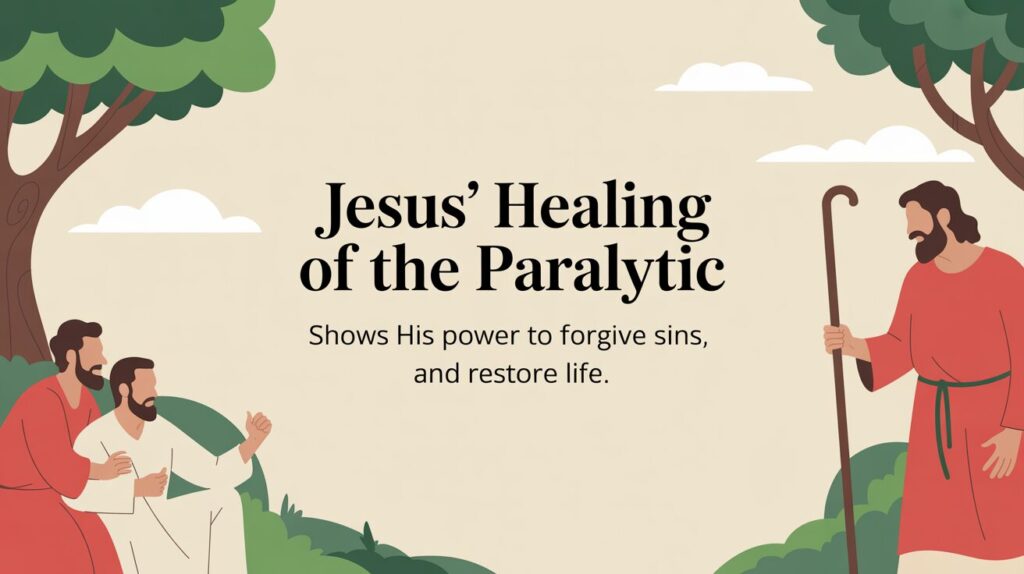
Mark 2:1–12 powerfully illustrates Jesus’ lordship as He heals and forgives the paralytic, revealing His authority over both physical and spiritual brokenness. This sermon encourages us to pursue Christ passionately, to remove obstacles of skepticism and sin, and to accept His sovereign forgiveness with humble faith. Like the healed man, believers are called to rise and walk in the freedom Jesus provides, thereby inspiring awe and praise to God.
Sermon Audio
Shareable Quote graphics

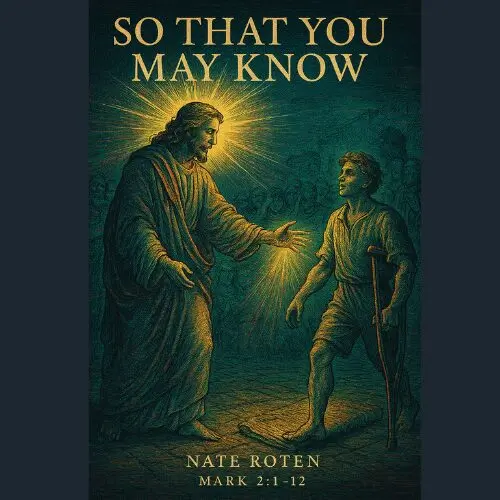
So That You May Know
Nate Roten / Mark / Mark 2:1–12
Main Idea
Everything Jesus does demonstrates His power, authority, and kingly rule.
Have you ever thought about how much credentials matter? Picture being at the airport, and a 20-year-old guy approaches you in surfer shorts and a tank top and confidently says, “Hi! I’m your pilot today.” You wouldn’t just believe them right away. You’d want proof—credentials, a uniform, training, and authority that support their claim. Without those, their words are meaningless, and no one in their right mind would board that plane.
The same can be said of many professions where you wouldn’t readily put aspects of your life into a person’s hands without proof that they are who they say they are: counselors, police officers, teachers, electricians, and so on. One of the reasons you need uniforms, badges, or certificates is so that you can know they are trustworthy and fit for service, and that is precisely what we see in today’s passage. So today, we’ll walk through it, seeing who Jesus is from the vantage point of the actions we should take to pursue Him.
Outline
1. Find
2. Remove
3. Avoid
4. Receive
5. Walk
Passage
Mark 2:1–12 CSB
1 When he entered Capernaum again after some days, it was reported that he was at home. 2 So many people gathered together that there was no more room, not even in the doorway, and he was speaking the word to them. 3 They came to him bringing a paralytic, carried by four of them. 4 Since they were not able to bring him to Jesus because of the crowd, they removed the roof above him, and after digging through it, they lowered the mat on which the paralytic was lying. 5 Seeing their faith, Jesus told the paralytic, “Son, your sins are forgiven.”
6 But some of the scribes were sitting there, questioning in their hearts: 7 “Why does he speak like this? He’s blaspheming! Who can forgive sins but God alone?”
8 Right away Jesus perceived in his spirit that they were thinking like this within themselves and said to them, “Why are you thinking these things in your hearts? 9 Which is easier: to say to the paralytic, ‘Your sins are forgiven,’ or to say, ‘Get up, take your mat, and walk’? 10 But so that you may know that the Son of Man has authority on earth to forgive sins”—he told the paralytic—11 “I tell you: get up, take your mat, and go home.”
12 Immediately he got up, took the mat, and went out in front of everyone. As a result, they were all astounded and gave glory to God, saying, “We have never seen anything like this!”
I – Find Jesus
When He healed the leper, Jesus had gone into the region of Galilee, but now, it has been reported that He was in Capernaum. Interestingly, it says He was home. During His Galilean ministry, Jesus made Capernaum His base of operations, and since Jesus told His disciples that He had no place to lay His head, it is speculated that this was Peter’s house.
Go to where Jesus is. After a report had gone out, another sizable crowd soon gathered not only on Peter’s front porch but throughout the house! They had flocked here for a variety of reasons, many of which we have already seen, such as sickness and demon possession. No doubt many others came to see the miracle-worker perform His wonders. But there were at least five people who knew they had no other hope. Five friends sought Jesus because one of them was paralyzed, and it took the other four to transport him there. They had a clear physical need, but maybe they were unaware of the spiritual need they had, which they would receive when they arrived, because Jesus was doing what He said He came to do—preaching the word… the good news of the arrival of God’s kingdom and the Messiah who would rule over it.
Seek Him out. Clearly, they heard the report, and clearly, one of them had a need. The first lesson to learn is to act with the right motivation. If you have a need that only Jesus can fulfill, don’t expect Him to do all the work. We are told countless times in Scripture that those who seek find, and those who are weary and burdened come to find rest. The real sacrifice God desires is a broken and contrite heart. These all require you to move toward Him in faith, believing He will meet you in that pursuit.
II – Remove the Barriers
The crowd is a barrier. These four friends faced a physical obstacle—a massive crowd. In Mark’s gospel, crowds are often portrayed negatively. They may seek out Jesus and marvel at His miracles, but you don’t see them genuinely repent or transform from seekers into believers. Their main characteristic so far is being an obstacle to Jesus’ presence. Just pause and think about that! Jesus wasn’t afraid to speak hard truths that thinned out the crowd. Yet, when someone talks about their church, what’s one of the first questions you ask? Usually, it’s, “How many people go there?” When you hear about a popular preacher or influencer and check them out on social media, what do you look for first? Typically, it’s the number of followers. Maybe we should take a cue from Mark and realize that large crowds don’t necessarily indicate true success. Instead, what if we judged effectiveness by demonstrations of genuine faith, a passionate pursuit of Christ, and a person’s focus on faithfully preaching the word? After all, isn’t that what God cares about and what Jesus emphasizes? These men had to find a way to reach Jesus despite the crowds.
The roof is a barrier. So, these men got very creative—and a little destructive. Houses in the first century often had exterior staircases leading to the roof, which was made of wooden beams cross-hatched with smaller poles and covered with a mixture of hardened clay and mud that could double as an outdoor living space to enjoy. While going up on a roof seems odd to us today, it was normal then. What wasn’t normal was literally digging through someone else’s roof to get inside. This is where it feels a little wrong to destroy someone else’s property to achieve a mission. It’s strange to imagine Jesus’ powerful preaching being interrupted by chunks of roof and debris falling on people’s heads while they are trying to listen, and a makeshift mat with a person on it being lowered by vandals, probably with a rope or fishing line. It’s weird, right? But Mark’s focus isn’t on the moral debate about property damage. He emphasizes the relentless pursuit of Jesus, knowing He is the only hope this man has. In this light, you do whatever it takes to reach Jesus!
Faithful friends. Before we move on, we also need to recognize the importance of surrounding yourself with the right people. I heard a quote once that you become the average of the five people you surround yourself with. Make sure you find friends who have faith in Jesus and who will stand by you, do whatever it takes, and remove any obstacle to pursue Christ and His word!
Miracle #1. And this brings us to miracle #1 – Jesus knew this man’s sins. He knows the details of this man’s past. Ask yourself… what terrible sin must this man have committed that would result in physical paralysis? Don’t you think it must have been quite dark? Not all disability and sicknesses is directly caused by sin (though all brokenness is a result of sin in the world), but some are linked, and this is a pretty serious physical consequence. And yet, despite the gravity of this man’s sin, Jesus knew about it and was willing to forgive him and make him whole, saying with a loving term of endearment, “Son, your sins are forgiven.”
III – Avoid A Hard Heart
Next, the scene shifts to another subgroup of the crowd… the scribes… the professors of Torah… the ones who are experts in the law and scriptures.
The scribe’s objection. When Jesus told the man that his sins were forgiven, it raised a reasonable question. In the Old Testament, the Messiah was expected to rule. He would be given power, authority, and dominion. He would suffer for the transgressions of His people, but He is never described as being the one to forgive sin. That role is reserved for God Himself (see Exodus 34:6–7, Psalm 103:2–3, Isaiah 43:25). This is why their hearts become twisted in knots, and they think that Jesus is blaspheming. So, we shouldn’t be too hard on these men for questioning His potentially blasphemous words. What we need to focus on is how they respond and interact with the evidence of the claim.
Their improper judgment led us to miracle number two: Jesus knowing their thoughts. This wasn’t a phony psychic or mentalist trick of reading facial expressions or body language. It was Jesus perceiving in his spirit what was in their private, unspoken thoughts. No one else can do that but God alone—just like the forgiveness of sin. Honestly, that would have been a hard pill for any of us to swallow. But what these scribes should have done was wait and see what Jesus did. If it’s true that this man’s condition was caused by sin and Jesus healed him, then it should have made them question their assumptions. Perhaps they should have followed the example of the Berean Christians in Acts, who listened and then returned to the Scriptures for verification. Had they done that, they might have seen all the Scriptures pointing to Jesus as the Messiah. Instead, as we see the Gospel unfold, they hardened their hearts against Jesus so much that they conspired to murder Him. The problem wasn’t that they asked the wrong question—it was that they stopped listening once their assumptions were challenged. Instead of letting the miracle lead them back to the Scriptures with humility, they hardened their hearts in pride. That same danger exists today. Maybe that’s why the author of Hebrews encourages us to refrain from hardening our hearts:
Hebrews 3:15 CSB
15 As it is said: Today, if you hear his voice, do not harden your hearts as in the rebellion.
We can harden our hearts toward various aspects of Jesus. We can shut ourselves off from his authority when he asks us to do something difficult or uncomfortable that takes away our control and preferences. We can become insensitive to his forgiveness, whether we feel we can’t or shouldn’t be forgiven, or think someone else isn’t worthy of it. When we do that, we reject the mercy Jesus died to give us. And if we start to despise God’s grace in forgiving others, we begin to despise the people themselves, and this is where anger, jealousy, bitterness, and arrogance start to destroy any compassion we have for others. If you notice that beginning to take root in your heart, remember the scribes… remember that we are to remove those things from our hearts today. Respond with Mark’s favorite word… immediately!
Every time we hear Christ’s voice and the truth of scripture, we either soften or harden our hearts in response. There’s no neutral ground. How are you responding?
IV – Receive Jesus’ Authoritative Forgiveness
Now, all of this happened before the physical healing occurred. It culminated in a teachable moment for everyone involved. Seeing the man’s condition, observing the faith of his friends, discerning the thoughts of the scribes, and feeling the crowd’s palpable anticipation… Jesus did three things that had a lasting impact.
1-Jesus addresses unbelief. As he often did, Jesus challenged a hard heart or disbelief by asking a question. “Which is easier: to say to the paralytic, ‘Your sins are forgiven,’ or to say, ‘Get up, take your mat, and walk’?” Questions make us think. These men were wrestling with a potentially blasphemous claim. The question was designed to make them consider the consequences for their theological beliefs if Jesus succeeded in healing this man. It’s easy to claim to have the power of forgiveness, but it is much harder to prove it by actually reversing the damage caused by sin.
2-Jesus makes a truth claim about Himself. The scribes weren’t wrong. Only God can forgive sins. Jesus didn’t refute this claim; He reinforced it! The point is that Jesus is God! To emphasize His divinity, He also uses the title ‘Son of Man.’ This title refers to the ‘Son of Man’ in Daniel 7, who approaches the Ancient of Days and is given power, authority, and an everlasting dominion… and the scribes knew it. Some of the Jews’ struggle was with the idea that Daniel 7 suggests two Yahwehs or what they might call the two powers of heaven: The Ancient of Days, who is clearly Yahweh, and the Son of Man, who is human yet God (as seen by His riding on a cloud—which only God does—being given eternal dominion, which only God has, and receiving glory and worship, which only God receives). While the Jews wrestled with this scriptural truth, it’s clear to us that it points to Jesus Christ! And this is what He was hinting at here.
3-Jesus demonstrates His divine authority. He does this in the third and fourth miracles, where He actually forgives the man’s sin, leading to his physical healing from paralysis. Jesus doesn’t just talk a good game. By healing this man, He proves everything He has said about Himself. He is who He says He is… He can do what He claims He can do… and He is fulfilling the mission He said He came to complete. This is His uniform, badge, and certification. Time and again, Jesus shows His ultimate authority over every part of His creation.
The core truth of today’s passage is that Jesus was establishing and validating His authority so that you may know Him firsthand. And the only way you can experience who He is firsthand is through one of the greatest miracles of all: forgiveness.
As Warren Wiersbe writes, “Forgiveness is the greatest miracle that Jesus ever performs. It meets the greatest need; it costs the greatest price; and it brings the greatest blessing and the most lasting results.”
It’s one thing to believe in theory that Jesus can forgive sins; it’s another to let Him speak those words over our own lives. Some of us carry shame that feels heavier than paralysis. We’ve replayed failures, we’ve analyzed our stains, wondering if our sin is beyond His ability to wash clean. But when Jesus says, “Your sins are forgiven,” He has the authority to remove them all.
V – Walk in that Forgiveness
The final truth for us today is to walk in the forgiveness that has been given to us. Jesus spoke words that healed, but the man still had to obey and walk in the new life he was offered. He still had to stand up, take the one thing that represented his broken life, and go home renewed. And his restoration wasn’t just for the one man; it was for everyone watching. The crowd was left in complete amazement and, most importantly, praised God. We must realize that our relationship with God affects not only our own lives, but also the lives of those around us, because we don’t live in isolation. We are in the presence of others, so our faith—whether spoken or lived—will create a ripple effect in the lives of those around us.
🔥 Application:
Our lives should be characterized by forgiveness.
If Christ has forgiven us, we should be different from what we were before because those who are forgiven are free.
If Christ has forgiven us, we cannot withhold forgiveness from others. Holding onto grudges is to deny the very authority of the cross in our own lives. Forgiven people must become forgiving people—because when we forgive, we reveal the very character of Jesus.
Jesus’ healing of the paralytic demonstrated His authority, but it also highlights His priorities. He cares about our bodies, but even more, He cares about our souls. Our greatest need isn’t physical relief; it’s spiritual restoration. And only He alone has the authority to give it.
But like the paralytic, we must stand up and walk in that newness of life > Do you believe that for yourself in your current circumstance?
➤ Reflect: So the application is simple, but challenging: Have you received His forgiveness, rested in it, and extended it to others?
FAQs
1. Why does Jesus forgive the paralytic’s sins before healing his body?
Jesus forgives the paralytic’s sins first to emphasize that spiritual healing and forgiveness take precedence over physical restoration. The man’s paralysis was linked to sin, demonstrating that our greatest need is spiritual cleansing. Jesus, with authority from God, addresses the root cause—sin—before the visible miracle of healing. The forgiveness confirms His divine authority and mission to bring spiritual restoration, not merely physical relief
2. What is the significance of Jesus knowing the scribes’ thoughts?
Jesus perceiving the scribes’ thoughts reveals His divine omniscience, a unique attribute of God alone. This ability authenticates His authority to forgive sins and exposes the hardness of heart in those who reject Him. It challenges skeptics not merely to intellectual debate but to faithful response and repentance, warning against pride and unbelief[Your sermon].
3. How does the crowd function as a barrier in the passage, and what does this teach us?
The crowd represents the obstacle between Jesus and those who need Him. Although large crowds may appear as success, Mark’s gospel often portrays them as hindrances to genuine faith. These four men removed the barrier by creative, persistent action, reminding us that true faith requires effort and determination to reach Jesus despite distractions or opposition[Your sermon].
4. What does the paralysis of the man symbolize in a spiritual sense?
Paralysis here symbolizes spiritual helplessness and the bondage of sin that incapacitates sinners. Just as the man cannot physically move, sin renders the soul immobile and spiritually dead. Jesus’ healing thus vividly illustrates the power of the gospel to renew and empower a person to “walk” in newness of life[Your sermon].
5. How should Christians respond to hard hearts like those of the scribes today?
Christians must guard against hardening their own hearts by remaining humble, open to the Holy Spirit’s convicting work, and sensitive to Scripture’s truth. As Hebrews 3:15 warns, believers should not refuse God’s voice or reject His authority when challenged but should instead receive mercy and grace with faith, lest pride and unbelief take root[Your sermon].
6. Why is forgiveness called the greatest miracle Jesus performs?
Forgiveness is the greatest miracle because it meets the deepest human need—redeeming the soul from sin’s deadly power—at the highest cost, the cross of Christ. It produces the most transformative and lasting effect, far surpassing physical healing. Experiencing Jesus’ forgiveness is essential to truly knowing His authority and kingship[Your sermon; Wiersbe quote].
7. What does it mean to “walk” in Jesus’ forgiveness?
To “walk” means to live consistently in the new life Jesus grants through forgiveness. The paralytic physically rose and took up his mat to show obedience and newness of life; similarly, believers must actively live out their faith, reflecting forgiveness by forgiving others, growing in holiness, and demonstrating the gospel’s power publicly[Your sermon].
8. How do faithful friends contribute to spiritual healing and pursuit of Christ?
The four friends’ determination to bring the paralytic to Jesus illustrates the vital role of Christian community and faithful friendship. Surrounding oneself with believers who remove barriers and encourage faith is essential for spiritual growth and receiving Jesus’ blessings. Believers are called to be such faithful friends to others[Your sermon].