Highlight Reel
Sermon Summary
Jesus of Nazareth begins His mission as the Spirit-anointed and faithful King, inaugurated at His baptism where heaven opens and the Father declares Him beloved. Immediately driven into the wilderness, He triumphs over Satan’s temptations, fulfilling Israel’s failure. With John’s arrest, Jesus proclaims that the kingdom of God has arrived, calling all to repent and believe the gospel. This pivotal moment marks the launch of Christ’s eternal reign and invites all to enter His kingdom by grace through repentance and faith.
Sermon Audio
Shareable Quote graphics
Sermon Text
Go For Launch
Nate Roten / Mark Series / August 17, 2025
Main Idea
Jesus is the Spirit-anointed and faithful King who invites the repentant into His eternal kingdom.
Imagine it’s July 16, 1969. You’re in the control room at Kennedy Space Center. The tension is electric. Every screen is lit, every technician silent, listening for one voice: “Go for launch.”
Outside, the Saturn V rocket—taller than the Statue of Liberty—is groaning under pressure, 6.5 million pounds of thrust ready to be unleashed. Months of calculations, years of planning, and the hopes of an entire nation rest on this moment.
“10… 9… 8…”
This is the moment of ignition… when something shifts from preparation to mission… when theory becomes history… when the crowd in the control room roars with applause as a man leaves Earth to walk on the moon.
Now shift that image. You’re standing by the Jordan River, watching a quiet man from Nazareth walk into the water. No fanfare or cheering crowds. Just a carpenter and a prophet. But don’t be fooled by the silence—this is the launch of a mission.
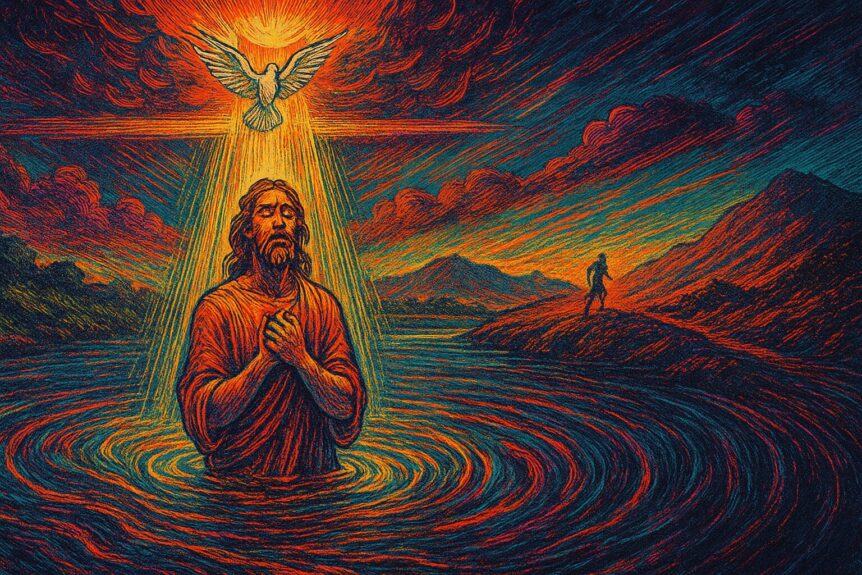
When Jesus comes out of the water, the heavens are torn open. The Spirit descends like a dove. The Father’s voice booms from heaven: “You are my beloved Son; with you I am well-pleased.”
This is no ordinary moment—this is the Father’s signal that we are ‘go for launch.’
And like Apollo 11, Jesus doesn’t stay grounded. He’s immediately driven into the wilderness to face His adversary. Then He begins His mission, proclaiming, “The time is fulfilled, and the kingdom of God has come near. Repent and believe the good news.”
This is the ignition of the gospel mission. And just like with the moon landing, the whole world would never be the same.
Passage
Mark 1:9–15 CSB
9 In those days Jesus came from Nazareth in Galilee and was baptized in the Jordan by John. 10 As soon as he came up out of the water, he saw the heavens being torn open and the Spirit descending on him like a dove. 11 And a voice came from heaven: “You are my beloved Son; with you I am well-pleased.” 12 Immediately the Spirit drove him into the wilderness. 13 He was in the wilderness forty days, being tempted by Satan. He was with the wild animals, and the angels were serving him. 14 After John was arrested, Jesus went to Galilee, proclaiming the good news of God: 15 “The time is fulfilled, and the kingdom of God has come near. Repent and believe the good news!”
I – Baptism in the Spirit
Jesus of Nazareth. Remember, last week, John was preparing the way for the long-anticipated Messiah, but we didn’t get to see him step onto the scene. Now we do. Mark referred to Him as Jesus Christ in the beginning. Here, He is called Jesus of Nazareth. We might expect the great ruling King to come from a significant or notable place, but He didn’t. He came from humble beginnings— a small town that was not on anyone’s tourist map. He was from Nazareth, a tiny village with only a few hundred people—insignificant in every way except for the town’s name and who came from there. Nazareth, meaning ‘branch,’ would supply the branch from the stump of Jesse, who would be the Redeemer of His people.
Baptized by John. Remember how John humbled himself to exalt Jesus? That man had the privilege of baptizing the Messiah. While Mark gets straight to the action to move on quickly, other gospel accounts include more dialogue between Jesus and John… especially the question, “wait a minute, why?”
Matthew 3:13–15 CSB
13 Then Jesus came from Galilee to John at the Jordan, to be baptized by him. 14 But John tried to stop him, saying, “I need to be baptized by you, and yet you come to me?” 15 Jesus answered him, “Allow it for now, because this is the way for us to fulfill all righteousness.” Then John allowed him to be baptized.
Have you ever wondered why Jesus was baptized? John was baptizing people as they confessed and repented of their sins. Jesus clearly didn’t need to do that… yet, Jesus said this was how they would fulfill all righteousness. But how? While John’s baptism was with water, Jesus’ baptism was with the Holy Spirit, and that is what we see next.
Jesus’ baptism symbolizes an inauguration. You might have heard that Jesus was baptized to model this sacrament for us, and that’s true. The body cannot be baptized without the head also being baptized, but there’s more to it than that. In the Old Testament, the Messiah was anointed by God’s Spirit and directly approved by the Father as he was inaugurated as King and Ruler.
Take a look with me at a few of these passages:
Isaiah 11:1–4 CSB
1 Then a shoot will grow from the stump of Jesse, and a branch from his roots will bear fruit. 2 The Spirit of the Lord will rest on him— a Spirit of wisdom and understanding, a Spirit of counsel and strength, a Spirit of knowledge and of the fear of the Lord. 3 His delight will be in the fear of the Lord. He will not judge by what he sees with his eyes, he will not execute justice by what he hears with his ears, 4 but he will judge the poor righteously and execute justice for the oppressed of the land. He will strike the land with a scepter from his mouth, and he will kill the wicked with a command from his lips.
Isaiah 42:1–4 CSB
1 “This is my servant; I strengthen him, this is my chosen one; I delight in him. I have put my Spirit on him; he will bring justice to the nations. 2 He will not cry out or shout or make his voice heard in the streets. 3 He will not break a bruised reed, and he will not put out a smoldering wick; he will faithfully bring justice. 4 He will not grow weak or be discouraged until he has established justice on earth. The coasts and islands will wait for his instruction.”
Psalm 2:6–8 CSB
6 “I have installed my king on Zion, my holy mountain.” 7 I will declare the Lord’s decree. He said to me, “You are my Son; today I have become your Father. 8 Ask of me, and I will make the nations your inheritance and the ends of the earth your possession.
Isaiah 61:1 CSB
1 The Spirit of the Lord God is on me, because the Lord has anointed me to bring good news to the poor. He has sent me to heal the brokenhearted, to proclaim liberty to the captives and freedom to the prisoners;
Jesus did not need repentance. He needed to be publicly confirmed and anointed with the Spirit, just as the scriptures said He would be. This was done based on the testimony of two or three witnesses: the Father and the Spirit were present to confirm Jesus as the prophesied Anointed Messiah. The fullness of the Trinity was present at this monumental moment in history. The heavens literally ‘tore’ open to initiate their eternal mission of redemption! The only two times Mark uses the word ‘tore’ are here and when the temple’s veil tore at Jesus’ death. I believe this was intentional language to show two things:
1. Jesus as the Son of God. That is what God the Father declared here at Jesus’ baptismal inauguration, and it is also what the Roman centurion said (amazingly) at Jesus’ death… and exactly what Mark started his gospel account with.
2. The coming power of Heaven. Mark also describes how permanently heaven tore open to create a way for mankind to be reconciled to the God who made them—first at the Messiah’s inauguration, when the Kingdom and power of God drew near in human history as Jesus began His earthly ministry, and once more when He said, “it is finished,” eternally restoring the only way back to God!
Then immediately…
II – Wilderness Temptation
The Spirit drove Him. When Jesus was inaugurated, His people didn’t throw a big party. There was no confetti, no feast, no music, or celebration. He was not welcomed with open arms and the cheers of the hundreds of thousands of Jews eagerly awaiting His arrival. Instead, He was driven into the wilderness at the Spirit’s deliberate direction, who had just descended on Him. This doesn’t mean Jesus needed to be convinced or was resistant to the Spirit, but rather that He was fully in agreement with what He was about to do. God’s will is unified and perfectly in harmony, especially in His plan and path of salvation.
Into the wilderness. As we saw last week, Jesus’ baptism was rich with imagery of the Israelites traveling through the wilderness to cross the Jordan River and receive their inheritance via Joshua, who was a Jesus-type figure, as we can even see in the similarity of their names. Now, Jesus’ journey into the wilderness is another parallel to Israel’s history, but it carries significant implications.
1. After the exodus from Egypt, the Israelites went into the wilderness, where they would soon receive the Law recorded in the Torah. While on Mount Sinai, Moses spent 40 days and nights without food or water with God, sustained by His presence, and he received the law and came down radiant with God’s glory.
2. As the story unfolds, we learn that Israel wandered in the wilderness for 40 years. Remember that the wilderness symbolizes a place of testing, longing, and refining.
The implication is that where Israel failed, Jesus succeeded! Moses told the people there would be another prophet like him, and Israel should follow him. Now, Jesus goes into the wilderness for the same amount of time Moses spent on the mountaintop communing with the Father, without earthly nourishment—just as Moses did—so that He could fully rely on the sustaining power of His heavenly Father. The parallel couldn’t be any clearer.
Then, Israel continually grumbled and complained during their 40 years of wandering in the wilderness. They failed to fully obey the Lord their God according to the standards He set for them. They constantly fell short, but where they disobeyed, Jesus would perfectly obey. In this wilderness wandering and under constant temptation from Satan, Jesus would do what Israel could not — fully obey God’s law so that He could be the perfect sacrifice for His people. As Paul says in Romans 5, “in Adam all die, but in Christ, all are made alive.” The very first story highlights the failure of the head of the human race in a moment of temptation, while the New Adam would prevail and become the head of a new chosen race and a royal priesthood. In every way, Jesus is triumphant!
Tempted by Satan. Mark doesn’t provide the details of Jesus’ temptation that are found in the other synoptics. The only specifics are who He was tempted by, that angels ministered to Him, and that He was among wild beasts. These details suggest that the power of heaven was with Him as He faced dangerous threats. Interestingly, this setup establishes the core conflict of the story. Every good story has a hero and a villain— a protagonist and an antagonist— and these elements are present because they exist in God’s grand story. In other parts of Scripture, the villain is called the Devil, meaning ‘accuser,’ but Mark calls him Satan, meaning ‘adversary.’ I believe this choice is intentional, especially since Mark does not detail Jesus’ victory over Satan at this point. Jesus was victorious in resisting Satan’s temptation, but it’s almost as if Mark wants us to see the ongoing battle between Jesus (the Anointed Messiah) and Satan (his adversary)—between the kingdom of God and the kingdom of darkness—that continues until Jesus’ ultimate triumph on the cross, where He crushes the head of the serpent. In the wilderness temptation, Jesus won the battle, but on the cross, He won the war.
III – The Handoff
John’s arrest marked a significant moment. At some point, John was taken into custody. When this happened, Jesus traveled north to the region of Galilee. This is the first timing indicator we encounter in this passage. As sad as it is to see John imprisoned, his mission has been accomplished. He has successfully cried out in the wilderness, prepared the way for the Messiah, and baptized him as a public sign of Jesus’ reign. Now, the story shifts from John’s mission to Jesus’ mission, which brings us to the second timing indicator…
The time is fulfilled. You might ask, “What time?” The time of the Messiah’s reign! God is sovereign over human affairs and planned the incarnation, crucifixion, and resurrection of His Son before the world was created. The Old Testament foretold this moment when the Son would step onto the world stage to reign and redeem. As you may recall, Paul expressed the same idea in Galatians.
Galatians 4:4–5 ESV
4 But when the fullness of time had come, God sent forth his Son, born of woman, born under the law, 5 to redeem those who were under the law, so that we might receive adoption as sons.
This is that time. The story of God’s eternal plan of redemption reaches its climax in the earthly life of Jesus Christ. There was a timing to His birth… a timing to His inauguration… and now… a timing to the arrival of His kingdom.
The Kingdom of God has arrived. In this passage, the focus is on the timing of the kingdom of God. Yes, Jesus is our Redeemer, and the main message of Mark’s gospel is moving toward the cross, but right now, he is highlighting Jesus’ rightful kingship. You can’t have a kingdom without a king, and as we saw in the passages from Isaiah and the Psalms, Jesus is the beloved Son who will bring God’s rule and law to the nations. He will establish justice on the earth and proclaim liberty to the captives.
Now, that has happened… He has been established, tested, and proven faithful. Now, the time for Jesus’ active reign has arrived. Throughout His earthly ministry, He will establish kingdom principles. He will describe His kingdom’s ethics and morals in the Sermon on the Mount. He will set His kingdom’s ethos through parables. In everything He does, Jesus — as King — will help His people learn how to be good citizens of this Kingdom, but to become a citizen, one must first…
Repent and believe the good news. There are no green cards in Christ’s kingdom. You are either a permanent resident or you are not. Unlike our process of citizenship in the U.S., it doesn’t take years; it only takes a moment for a dead heart to come alive through repentance and faith, but both of these steps must be taken.
1. Repent. When someone repents, they turn away from something. In this case, the call for every human is to repent from sin. Sin is what separates us from God. He is holy and righteous… we are not. We have all transgressed against His holy nature and the morals He has set for His people. The first step that any human being must take is to recognize their sinful state and repent of it. That was the Baptizer’s call, but he couldn’t remove the stains of sin on a person’s soul. Only Christ can do that. When you see the perfect holiness of God and the contrast between His perfection and your imperfection, it should draw you to your knees in humble repentance, rejecting the sin you once loved.
2. Believe. But that’s only half of the equation. Turning away from sin is part of it, but when you turn away from something, it means you are approaching something else. You should repent from sin, but you must also believe in the one who can remove its stains and consequences. You need to believe the good news that Mark, the Prophets, and John have been declaring… that Jesus is the Son of God, the Lamb who takes away the sin of the world, and the righteous Messiah who reconciles us to God… adopts us as sons and daughters… and draws us into His kingdom to live as citizens under His rule.
One final thought before we end. Notice that Jesus is in Galilee, proclaiming the kingdom and calling for repentance and faith. Also, notice that the region of Galilee is far from Jerusalem, where the temple is. The temple is where sacrifices are offered for the remission of sin and where people worship God. However, Jesus is subtly explaining to the Galileans the same message He told the woman at the well on His journey to Galilee: that the specific location no longer matters (not the mountain in Samaria or Jerusalem), but what matters is worshiping the Father in spirit and in truth. Jesus is distinguishing the need for individuals to be cleansed and draw near in faith (belief) from the physical location where that usually happens. From the beginning of His ministry, Jesus was teaching that people could come to Him to be cleansed, not through the temple sacrifices, because He is the fulfillment of Psalm 2, Isaiah 11, 42, 61… and 53—the suffering servant.
From baptism to wilderness, from proclamation to invitation—Jesus’ ministry begins with a clear purpose: He is the long-awaited King. The Father publicly affirms Him, the Spirit anoints Him, and He proves faithful against Satan’s attacks. Now, with all authority, He brings the kingdom of God near and invites a response—not to watch from afar, but to step in. The time is fulfilled. The King has arrived. And His first royal command remains the same: Repent and believe the good news.
You and I stand where Israel stood—faced with a decision. Will we respond to the King’s invitation? Will we live under His rule, walk in His ways, and point others to His reign? Because once we enter His kingdom by grace, we are sent to proclaim it by faith.
Application:
There are dozens of takeaways we can harvest from this text, but I want you to leave today with the pattern we’ve seen and ensure you apply it to your own circumstances. In the text today, Jesus was baptized, tested, and then fruitfully labored in the power of the Spirit (as Luke described in his gospel).
If this was the pattern set by our Lord, we should expect it to be the same for us.
Submitted. Tested. Sent.
First comes submission to Jesus as Lord. We must repent from sin and believe in Jesus’ atoning death so that the Holy Spirit of God can come and make us new. In that moment, we are citizens and redeemed children. However, from that point onward, as our Heavenly Father prunes us, we must remain submitted (in repentance and faith) as He refines us through trials. That is what strengthens our faith. Then, once that work is done, we are able to walk more fully in the power of the Spirit to be fruitful for His kingdom.
Jesus is King. Worship Him. Follow Him. Obey Him. Turn from sin and trust Jesus fully. Lean into the Spirit’s strength to resist sin, endure testing, and walk faithfully—declaring the good news as a witness to its truth. This is not a one-time event but a daily rhythm of surrender, belief, and Spirit-filled action.
➤ Reflect: Does your life align with this biblical pattern of godly living? If not, which part needs to be adjusted?
FAQs
1. Why was Jesus baptized if He had no sin?
Jesus’ baptism by John was not for repentance or forgiveness of sins—He was sinless. Instead, His baptism symbolized His inauguration as the Messiah and King and served to fulfill all righteousness (Matthew 3:15). It publicly declared Jesus as the beloved Son of God, anointed by the Spirit for His mission (Mark 1:10-11), much like Old Testament kings and prophets who were anointed by the Spirit to execute God’s will (Isaiah 11; Psalm 2). This event also modeled baptism for His followers, connecting their cleansing to His righteousness.
2. What is the significance of the Spirit descending like a dove and the heavens tearing open?
The Spirit descending like a dove represents the anointing of Jesus with the Holy Spirit to empower Him as the Messiah. The heavens “tearing open” show God’s active intervention, signaling that the eternal kingdom mission has begun. This language links Jesus’ baptism to His death, where the temple veil also tears, marking God’s provision of direct access to Himself through Jesus (Mark 1:10-11; Mark 15:38). It symbolizes the breaking in of divine power and presence into human history and foreshadows the new covenant’s way to God.
3. Why was Jesus immediately driven into the wilderness after His baptism?
Just as the Spirit anointed Jesus for mission, He also led Him into the wilderness for forty days of testing and temptation by Satan. This wilderness experience parallels Israel’s wilderness journey and Moses’ time on Sinai but contrasts Israel’s failure with Jesus’ perfect obedience. It was to prove Jesus’ faithfulness as the true Son of God and new Adam, overcoming temptation where Adam and Israel failed. This testing prepared Jesus spiritually to begin His public ministry and demonstrated His victory over Satan’s kingdom (Mark 1:12-13; Romans 5).
4. What does Jesus’ proclamation “The time is fulfilled, and the kingdom of God has come near” mean?
This announcement marks the climactic moment in God’s redemptive plan. The “time fulfilled” means God’s sovereign plan, foretold in the Old Testament, has reached its appointed moment. The “kingdom of God has come near” means the long-awaited reign of God, through Jesus the King, is breaking into history. Jesus calls for repentance and faith because entering the kingdom requires turning from sin and trusting Him as Lord. It signals the kingdom’s presence in Jesus’ person and ministry, inviting people to enter now by grace.
5. What is required to enter the kingdom of God?
Jesus commands two things: repent and believe the good news. Repentance means a genuine turning away from sin—acknowledging one’s guilt before a holy God. Belief means trusting in Jesus Christ’s person and work—the good news that He is the Son of God who saves from sin. Both are essential; turning from sin without trusting Christ and trusting Christ without repentance are incomplete. Entrance into the kingdom is by grace through repentance and faith, not by works or heritage.
6. Why does Jesus minister in Galilee instead of Jerusalem and the temple?
While the temple and Jerusalem were the center of Jewish worship and sacrifices, Jesus points to a new way of worship. He proclaims the kingdom and calls for personal repentance and faith regardless of location, emphasizing worship “in spirit and truth” rather than a particular place. This foreshadows the New Testament teaching that Christ Himself is the ultimate sacrifice and that believers worship God through Him anywhere. Jesus’ Galilean ministry signals the inauguration of the new covenant kingdom, superseding the old geographical boundaries.
7. How should believers today apply the pattern of Jesus’ baptism, testing, and proclamation?
Believers are called to follow a similar pattern of submission, testing, and Spirit-empowered fruitfulness. First, submit to Jesus as Lord through repentance and faith (baptism). Then, expect to face trials and testing that refine faith and reliance on the Spirit. Finally, walk in the power of the Holy Spirit to bear fruit by living for God’s kingdom and proclaiming the gospel witness daily. This is not a one-time event but a lifelong rhythm of surrender, obedience, and fruitful ministry.
8. What should be the believer’s response to Jesus as the Spirit-anointed King?
Recognize Jesus as the long-awaited, faithful King who invites you into His eternal kingdom by grace. Worship Him wholeheartedly, obey His commands, turn from sin, lean on the Spirit’s strength to resist temptation, and actively proclaim the gospel. Living as a citizen of His kingdom means daily repentance, faith, and Spirit-led service, reflecting the King’s holiness and mission in the world.