Highlight Reel
Sermon Summary
What do you actually see when you look at Jesus? In Mark 8, a blind man’s gradual healing mirrors our own journey from confusion to clarity. This sermon walks through how God opens our eyes, draws out faith, and leads us to a defining question: Who do you say Jesus is
Sermon Audio
Shareable Quote graphics



Sermon Text
Seeing Clearly
Nate Roten / Mark / Mark 8:22–30 / April 12, 2026
Main Idea
When God opens our eyes to see Jesus clearly, we cannot help but confess Him boldly.
Have you ever had your vision corrected?
Maybe it was the first time you put on glasses or contacts. You didn’t realize how blurry everything was until suddenly… it wasn’t. Street signs became readable. Faces became clear. Details you didn’t even know you were missing came into focus.
I’m old enough to have had LASIK surgery… twice. Both times, I vividly remember how crisp everything was. I walked out of the doctor’s office seeing better, but the following morning, I was struck by the level of detail I could see in leaves on treetops swaying in the wind. I couldn’t believe how much precision I had been missing in my vision.
Today, we have two complementary stories about sight. One is physical… the other is spiritual… and both require divine correction to see Jesus clearly.
And there is one question Jesus asks that will expose the difference between blurry vision and true sight…
I – High-level Recap
Let me set the scene with three crucial details:
First, the location – Recently, Jesus has been traveling with His disciples outside of Herod’s and the Pharisees’ jurisdictions and into Gentile territory. But now, they’re returning to hostile territory—back where religious leaders want Jesus dead.
Second, is the gospel’s structure – Chapters 1-8 have mostly followed Jesus’ ministry in Galilee. Chapters 8-10 serve as a linchpin to Chapters 10-16, which is where Jesus turns from Galilee to Jerusalem, and the final seven chapters all describe events during Passion Week in Jerusalem.
Third, the pattern – Throughout Mark’s gospel, Jesus has been revealing who He truly is through miracles, teaching, and personal encounters:
Crowds vs Individuals – Crowds are always excited to see Jesus, but never follow Him for the right reasons. They always find Jesus for superficial reasons and often hinder His ministry. Individuals, however, are called out from among the crowd, find their deepest needs fulfilled, and end up following Him for the right reasons. This contrast in group size also shows us the reality of faith and unbelief… a contrast comes up repeatedly in Mark’s gospel. Those who reject Jesus show unbelief, and no miracles are performed among them. Then, there are those who either demonstrate faith and are rewarded, or others have faith and trust drawn out of them.
Today’s passage brings this revelation to a climax with a two-stage healing that mirrors a two-stage recognition of Jesus’ identity.
II – Seeing Clearly
Mark 8:22–26 CSB
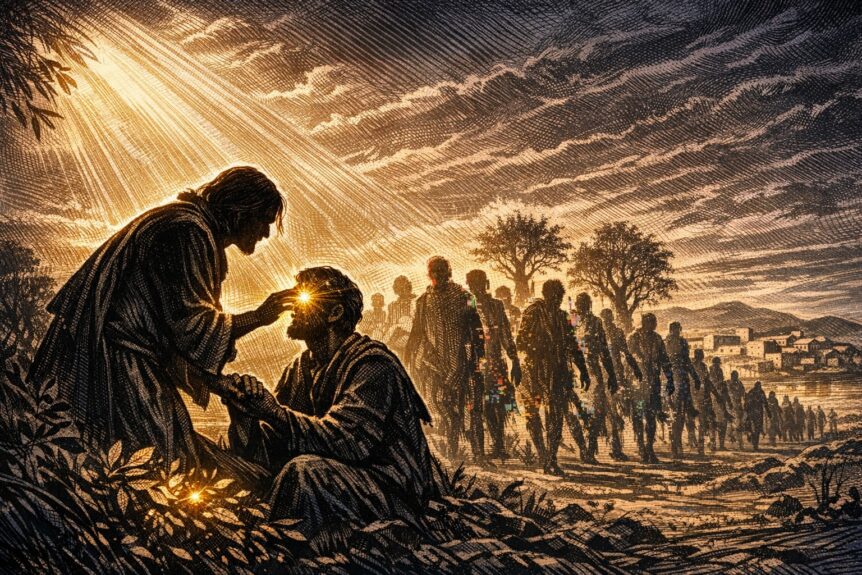
22 They came to Bethsaida. They brought a blind man to him and begged him to touch him. 23 He took the blind man by the hand and brought him out of the village. Spitting on his eyes and laying his hands on him, he asked him, “Do you see anything?” 24 He looked up and said, “I see people—they look like trees walking.” 25 Again Jesus placed his hands on the man’s eyes. The man looked intently and his sight was restored and he saw everything clearly. 26 Then he sent him home, saying, “Don’t even go into the village.”
Bethsaida – Jesus and the disciples are walking back into a city where the crowd still adores them, yet the city remains hostile territory because they are returning to Herod’s jurisdiction and the Pharisees’ realm of authority. This is important to remember because it clarifies why Jesus ends the encounter the way He does.
The approach – The way this man comes to Jesus is also important. The blind man is brought to Jesus by the crowd. Unlike many individuals we’ve seen so far, this man doesn’t take the initiative. Not only is he brought to Him by the crowd, but the crowd also begs Jesus to touch Him and heal him. Remember… there are those who act in faith by coming to Jesus to ask Him for help directly, and there are those who are brought to Jesus, with Jesus initiating the conversation. These people don’t initially demonstrate faith, but rather, it is drawn out of them. In these instances, they might not even know they have faith until they encounter Jesus directly. The same holds true today. Not everyone is overt with their faith, but Jesus sees it and lovingly works within them to make it known.
The Method – This is the second time Jesus used spit. This demonstrates how Christ’s purity overcomes impurity—a picture of His sanctifying work in our lives. But this time, it was for the benefit of the crowd rather than the individual, since the man could not see what Jesus was doing. Yet we discover that Jesus must apply His healing hand twice before the man is fully restored, which raises the question… Why twice? What does it mean, and what are the implications… and how can we know with certainty?
This is a difficult question to answer because Mark doesn’t tell us. He only states what happened and moves on without elaboration. Therefore, if we want to answer this question with a measure of confidence in our accuracy, we must use a fundamental principle of Bible study: let Scripture interpret Scripture—we understand unclear passages by comparing them with clear ones. Why do I say this? Because the first idea that comes to many minds is inability. Jesus couldn’t heal the man completely the first time, so He had to do it twice. But is that the right interpretation? To answer that, we simply need to look back at what Jesus has said and done so far… and you don’t have to look long to realize that Jesus has been demonstrating His complete sovereign power and authority over every realm of existence! He has all authority over:
• demonic possession (singular demons or a legion of them)
• physical sicknesses (like leprosy)
• physical handicaps (like deafness and blindness)
• forces of nature (like calming the storm)
• the “authority” of the Pharisees and Synagogue leaders
• death itself (resurrecting Jairus’ young daughter)
While it can be easy to look at this event in isolation and think that Jesus’ power is somewhat limited, it is an impossible conclusion to draw when you allow scripture to interpret scripture. Therefore, we can safely rule this out. So if it’s not inability, then what is it?
Well, what has Jesus done to others in the past? Has He not put people in situations, like the Syrophoenician woman, that brought them to a crossroads… to a place of decision, to accept His words as truth or not? Aren’t these exactly the kinds of situations Jesus uses to draw a response from that person? I believe that is true enough, but there is another, subtle element in the story that points us in this direction.
Looked intently—I believe this two-word phrase is the key to understanding the entire passage. Remember, this man didn’t come to Jesus on his own. He was brought. He didn’t demonstrate faith at first. But then Jesus took the first step. He spit and applied it to the man’s eyes. When He did, the man could see in part. He couldn’t see clearly, but he could make out the outlines of people he described as walking trees. This detail suggests he wasn’t born blind—he had a frame of reference for what trees look like, which makes his partial sight all the more meaningful.
In that moment, something happened to this man’s faith. Maybe he had serious doubts that Jesus could or would heal him. Maybe it was much easier to believe it for others than for himself. How many of us find it easier to believe God will work in others’ lives than in our own? But then he got a taste of what restoration looks like (pun intended). For the first time in who knows how long, he could see something. He could make out shapes and movement… and this gave him hope. Now he is taking Jesus seriously. Why? Because now, after hope has been rekindled, he looks intently, or steadfastly. We aren’t told who or what he is looking at this second time, but I have a strong conviction it is Jesus Himself. And now that he is looking steadfastly (and only after he looks with intention), he is fully restored and able to see everything clearly. It’s like finally putting on the right prescription glasses after years of squinting. Suddenly everything comes into focus. The man’s spiritual eyes were opening along with his physical ones.
For many of us, doubt is the biggest obstacle to faith. Maybe we can believe that God will work in other people’s lives but not in ours. We’ve messed up too much, gone too far, or think we don’t have enough faith to qualify as a son or daughter. Perhaps you’re like this blind man—brought to Jesus by others, uncertain whether He really sees you in your need. Maybe doubt feels more familiar than faith. Maybe you are one of those whose faith is being drawn out of them because it doesn’t come naturally. If that is you, be encouraged! Everything changed for this man the moment he looked intently at Jesus.
Here’s what this looks like in practice: Stop relying on others’ opinions about Jesus. Spend time in Scripture, looking directly at Him. Ask Him to open your eyes so you can see Him clearly.
Sent home privately instead of to the village publicly – But as soon as his sight is restored, this man is told to go straight home and not into the village. Why? Because the opposition from the Pharisees is growing stronger, and their schemes with Rome to get rid of Jesus are solidifying. To go into the village would mean instant recognition of Jesus’ presence, because everyone would recognize that the blind man had miraculously regained his sight. As He has done many times before, Jesus asks for silence so He can continue His ministry.
The conclusion of this story begins to draw Jesus’ healing ministry to a close. In Mark’s gospel, only one other man is healed of his blindness on the road to Jerusalem. That is the final act in His ministry of miracles (other than slapping a man’s ear back on after Peter lops it off, which is in a category all its own). Moving forward, Jesus will focus primarily on teaching and instruction.
The healing of this blind man sets up perfectly what happens next. Just as this man needed to see clearly—first partially, then completely—the disciples are about to be tested on how clearly they recognize Jesus’ true identity.
III – Personal Conviction vs. Public Opinion
Mark 8:27–30 CSB
27 Jesus went out with his disciples to the villages of Caesarea Philippi. And on the road he asked his disciples, “Who do people say that I am?” 28 They answered him, “John the Baptist; others, Elijah; still others, one of the prophets.” 29 “But you,” he asked them, “who do you say that I am?” Peter answered him, “You are the Messiah.” 30 And he strictly warned them to tell no one about him.
Caesarea Philippi – From Bethsaida, the crew travels north to several villages in Caesarea Philippi, but the story unfolds on the road rather than in the villages.
Time with the Team – It is on the road, between towns, that Jesus finally has some peace and quiet to spend with His disciples. Remember, He has been trying to have exclusive time with them, but the crowds always interrupt. Now, Jesus can finally drive some important points home, and He does so, as usual, by asking questions.
Question 1: Public Opinion – The first question He asks is, “Who do people say that I am?” Their response is the same as the one King Herod heard after John the Baptist was beheaded and after Herod heard about the impact of Jesus’ commissioned disciples, who were sent in pairs to do what Jesus had been doing. They said Jesus was the resurrected John the Baptist, Elijah, or like one of the other prophets. Evidently, the misunderstandings about who Jesus really is haven’t changed at all.
1- They think He is a prophet. Prophets can give a word from God about what is to come, so in that sense, Jesus is a prophet of sorts. But the main function of a prophet is to be an intermediary. He is the middleman who speaks the words of God to the people. And while it’s true that Jesus speaks on behalf of the Father in heaven, there is one major difference. Jesus doesn’t just speak on behalf of God… He is God. That is a major part of Jesus’ identity that the people are missing.
2- They think He is a forerunner. Both Elijah and John the Baptist were forerunners to the Messiah and the coming ‘Day of the Lord.’ Jesus Himself tied Elijah to John the Baptist, and John the Baptist said that He is not the Messiah, but only His unworthy herald. Jesus isn’t the forerunner to the Messiah; He is the Messiah… and the Messiah isn’t a mere man… He is God in human form. That is another major part of Jesus’ identity that the people are missing.
Jesus asks this question to provide contrast. These misunderstandings reflect what the people think. They represent the crowd’s varying vantage point, but Jesus wants to open the heart of the individual. Therefore, He asks the second question…
Question 2: Personal Conviction – “Okay, that is who the people say that I am… but who do you say that I am?” I understand the public’s opinion, but I want to hear about your personal conviction… you… who have also consistently failed to comprehend, trust, and walk in faith. The contrast in the question is the point. This is the most important question anyone can ask. If the point of the first story is to choose to set aside your doubts and fears and look intently to Jesus, then the next logical question you must ask yourself is: “Who, then, is Jesus?”
Is He a powerful teacher? Is He a Prophet-type figure who knows His Old Testament front to back and back to front… and who can speak God’s truths with a strong measure of power and authority? Does He command authority because His teachings are grounded in moral truths? Is He a herald of someone greater than He is? Can His restorative power reach me? Can He see me in the midst of the crowd? Can He really defeat any foe who currently has power over me? Does He truly wield power and authority over all other powers and authorities? If not, He is simply another human teacher… but if so… then He must be God’s anointed Messiah! But you can’t just think it internally…
Confession is key—like Peter, you must confess it. Peter speaks for the group, “You are the Messiah.” In Matthew’s gospel, he is even more specific: “You are the Messiah, the Son of the living God.” They get it! They finally get it! Imagine how melodic those words must have been to Jesus’ ears. Finally, the realization of who He is is sinking in, and not a moment too soon, because Passion Week is coming.
Strictly warned to remain silent – Finally, the disciples are not only warned to remain silent but strictly warned. This word is close to a rebuke, which again shows the seriousness of the mounting opposition from the religious leaders, as well as the seriousness of discipleship, which He will lay out next week.
🔥 Application: Who do YOU say Jesus is?
This isn’t merely intellectual agreement—this confession determines your eternal destiny.
But notice the order: believing comes first, then confession follows. God must first open our blind eyes to see Christ clearly—just as He did for the man in Bethsaida. We cannot produce this sight ourselves. It’s a work of God’s grace, and the beautiful truth is that Christ doesn’t leave us in partial sight. He doesn’t heal us halfway and walk away. Just as He completed the blind man’s healing, He completes the work of salvation in all who look to Him in faith.
These same two questions are still crucial today:
1. “Who do people say that I am?” (What’s the popular opinion?)
2. “Who do YOU say that I am?” (What’s your personal conviction?)
The first question is research. The second is revelation. The first is academic. The second is eternal. You cannot live on borrowed faith or on secondhand opinions about Christ.
Like the blind man, you must look intently at Jesus yourself. And like Peter, you must personally confess: “You are the Messiah, the Son of the living God.”
Romans 10:9–10 CSB
9 If you confess with your mouth, “Jesus is Lord,” and believe in your heart that God raised him from the dead, you will be saved. 10 One believes with the heart, resulting in righteousness, and one confesses with the mouth, resulting in salvation.
Let me ask you plainly: Who do you say Jesus is? Your answer to that question determines not only how you live but also where you spend eternity.
➤ Challenge: If you’ve never personally confessed Jesus as your Lord and Savior, I invite you to look intently at Him today. See Him not only as a good teacher or moral example but as the Christ, the Son of the living God, who died for your sins and rose again. Trust in Him, and He will grant you sight beyond what physical eyes could ever see.
FAQs
1. Why did Jesus heal the blind man in two stages?
Not because He lacked power, but because He was illustrating how understanding often unfolds. The miracle mirrors spiritual sight—partial at first, then clear as faith is drawn out.
2. Does this mean faith comes from us?
No. The man was brought to Jesus, and Jesus initiated the healing. Faith is awakened by God’s grace, not self-produced.
3. What does it mean to “look intently” at Jesus?
It means fixing your attention on Him—personally engaging Him through Scripture, not relying on secondhand opinions or cultural assumptions.
4. Why does Jesus warn them not to tell anyone?
Because opposition is intensifying, and premature exposure would hinder His mission. His identity must be revealed on His timeline, culminating at the cross.
5. What’s wrong with seeing Jesus as just a prophet or teacher?
It falls short of reality. Jesus is not merely a messenger—He is God in the flesh, the Messiah. Anything less is a distorted view.
6. Can someone have partial spiritual understanding and still be saved?
God often brings people along gradually, but saving faith ultimately rests in a true confession of who Christ is. Clarity matters because the object of faith matters.
7. Why is confession necessary if belief is internal?
Because genuine faith expresses itself outwardly. Scripture ties belief and confession together—what the heart trusts, the mouth declares.
8. What if I struggle with doubt?
Doubt doesn’t disqualify you. Like the blind man, bring what little you have and look to Christ. He is able to move you from partial sight to clarity.