
Highlight Reel
Sermon Summary
In “The Call of Christian Freedom,” Nate Roten explores Galatians 5:7-15, emphasizing the discerning call to reject the flesh and express freedom through loving service. The passage highlights the nature of persuasion, the prevention of spiritual growth, and the confidence in God’s sovereignty. Paul condemns false teachers and emphasizes the freedom in Christ, urging believers to serve one another in love rather than succumbing to the flesh.
Sermon Audio
Shareable Quote graphics


Sermon Text
Nate Roten / Galatians 5:7–15 / May 11, 2025
Main Idea
Freedom in Christ isn’t self-indulgence—it’s love in action.
Have you ever watched a highlight reel of a famous marathon, like the Boston or London Marathons? There are always participants who dress up or run in costumes. Once, I even saw a guy running in one of those inflatable T-rex costumes! I can’t even imagine…
Clearly, that is running in something that prohibits them from running well. In scripture, Paul likes to use the runner’s metaphor. Nearly everyone can understand it. They can see the runner in the Olympic games. Everyone knows you don’t burden yourself with additional layers of clothing that weigh you down and keep you from running at peak performance. That is a consistent way that Paul emphasizes the call to keep from sin, which are the layers that keep you from running at peak performance toward Christ.
While that idea is present in the text today, I want you to picture something different. Instead of the ridiculous T-rex costume, I want you to envision men on the sidewalk dressed like marathon coaches who are throwing hurdles in front of the runners. Picture that in your mind, and we’ll unpack that scene as we work our way through the text today.
Passage
Galatians 5:7–15 CSB
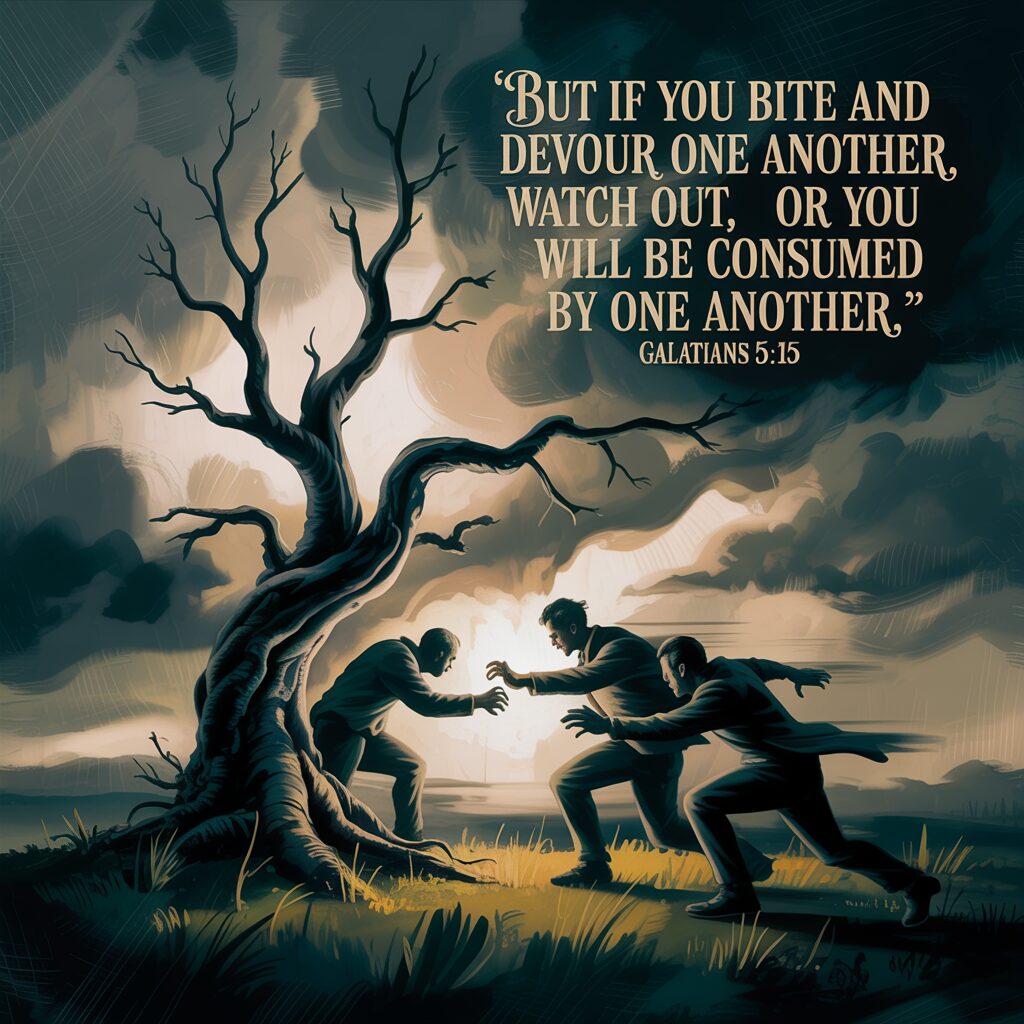
7 You were running well. Who prevented you from being persuaded regarding the truth? 8 This persuasion does not come from the one who calls you. 9 A little leaven leavens the whole batch of dough. 10 I myself am persuaded in the Lord you will not accept any other view. But whoever it is that is confusing you will pay the penalty. 11 Now brothers and sisters, if I still preach circumcision, why am I still persecuted? In that case the offense of the cross has been abolished. 12 I wish those who are disturbing you might also let themselves be mutilated! 13 For you were called to be free, brothers and sisters; only don’t use this freedom as an opportunity for the flesh, but serve one another through love. 14 For the whole law is fulfilled in one statement: Love your neighbor as yourself. 15 But if you bite and devour one another, watch out, or you will be consumed by one another.
I – A Matter of Persuasion
The core concept for this section is the nature of leaven. In scripture, leaven is used for two primary illustrations:
1. The effects of sin.
2. The effects of the Kingdom.
Seeing this, we can discern that the nature of leaven is morally neutral. It’s the concept of complete infiltration that is important. (Though, it’s worth noting that Satan is only ever a copycat). It only takes a tiny bit of leaven in a batch of dough to work its way through the entirety of the dough.
Persuasion permeates your mind like leaven. Once you are convinced of a particular point of view in an argument, that idea has taken over. It has permeated your mind so much that other ideas are pushed out.
Prevention of Persuasion
You were running well. This implies that Paul’s gospel was persuading them and that they were off to a good start. They weren’t wearing a T-rex costume that hindered them, nor did they seem to face many obstacles in their way as they ran their race. But all of a sudden, those spectators on the sidewalks dressed like marathon coaches started throwing out hurdles to trip them up. They were being prevented from running their race freely and without hindrance.
But the issues didn’t stop there. Instead of questioning why this was happening or what the intentions of these ‘coaches’ were in throwing out these obstacles, they accepted the additional challenges! They didn’t seem to question whether a marathon race should have hurdles. These guys look like coaches… they must know what they’re doing… perhaps this is how my marathon is designed. That may seem silly when illustrated that way, but that was essentially what was happening. Paul asks a rhetorical question here, but the identity of the ‘sidewalk coaches’ should be obvious. It is the Judaizers… those false teachers who are hindering spiritual growth and the very freedoms given in Christ, and Paul makes it very clear that this is not from Christ.
Confidence of Persuasion
Though Paul recognizes the trajectory of where this poisoned persuasion will lead, he makes a stunning profession.
“I myself am persuaded in the Lord you will not accept any other view.”
Though Paul watches the people he loves reject him and follow other voices that proclaim false truths, he doesn’t let that shake his confidence. However, we need to understand that his confidence wasn’t rooted in his ability to win them back (though he was skilled enough to do that). His confidence was anchored in the Lord’s power to draw them back through the truth. This is a declaration of God’s sovereign ability to move the hearts and passions of men. As Proverbs 21:1 says:
Proverbs 21:1 CSB
1 A king’s heart is like channeled water in the Lord’s hand: He directs it wherever he chooses.
Therefore, since God redeemed the men and women of the Galatian church, He can have full confidence that He who started a good work in them will bring it to completion!
Do you have wayward family… friends who are far from the Lord? Do you worry about what you can say to convince them of the truth? I’m preaching to myself here… don’t put your confidence in your ability to present the gospel in a way that they will respond. That puts the onus on you, not to mention a ton of pressure. Take this play from Paul’s playbook and be confident… but be confident in God’s ability to draw them close. Proverbs 19:21 tells us:
Proverbs 19:21 CSB
21 Many plans are in a person’s heart, but the Lord’s decree will prevail.
The danger doesn’t just come from outside influences that twist the truth—it also rises from within. The false gospel may come through others, but our deepest struggle is with the part of us that wants to believe it. That’s why Paul doesn’t just confront the persuaders—he reminds us that the true tension lies in the message of the cross itself, which exposes our pride and demands our surrender.
II – External Ritual, Internal Rebellion
This is the last time Paul will mention circumcision before his concluding remarks. The message of circumcision as a means of salvation and righteousness has caused so much damage in the Galatian church that he feels the need to be more forceful than ever before, which he does in several different ways:
First, Paul condemns the confusers
They will pay for what they have done because God is a God of justice and a defender of His people. Their intentional deception and distortion of the gospel truth will be dealt with. This is similar to them being cursed earlier in the letter… that anyone doing this should be anathema… or to be cut off and severed from the community. Hold onto that imagery because that is where Paul is steering this ship.
Next, Paul condemns rumors
Evidently, the confusers are merely spreading false gospels, but they are lying about Paul. They are falsely accusing him of promoting circumcision, just as they are. If this were true, it would completely discredit his message, which, in all fairness, is a clever tactic if one wanted to take Paul down. However, Paul tackles this rumor head-on and dismisses it with a simple question that highlights an obvious contradiction of circumstances. He asks, “If I still preach circumcision, why am I still persecuted?” The obvious answer is, “Oh, yea… you wouldn’t be… I guess that is a lie.” He could have stopped there, and that would have been sufficient, but…
Thirdly, Paul condemns circumcision
As Paul does, he uses this as an opportunity to teach and apply a theological truth. He goes on to say that if this rumor were true, “the offense of the cross has been abolished.” (Similarly, Paul describes the cross as a stumbling block to Jews in 1 Cor. 1:23). Well, what exactly is the cross’ offense? For starters, the Jews weren’t looking for a crucified Messiah; they were looking for a military-like conquering king. But it goes deeper than that. It is that we are sinful and separated from God, and there is nothing we can do to reconcile. Circumcision won’t do it. Law-keeping won’t do it either. It is a full assault on their message. Only the cross of Christ is sufficient for that task, and that is an offensive reality to many… in their day and in ours. It also cuts to the core of 21st-Century autonomy, doesn’t it? We like to be self-made people who think we really aren’t that bad, which is the opposite of the call to recognize our sinfulness, sacrifice our independence, and instead depend and submit to Christ’s work in faith. In doing so, we’ll find that the offense of the cross is freedom to the humble.
Lastly, Paul expresses a parting wish
As a conclusion to these three condemnations, he conveys a farewell wish with a double meaning. First, he wants to clarify how much he despises the way the Judaizers are hindering the Christian faith, so much so that he articulates it in a memorable manner that lingers with you. He wishes that during the act of circumcision, the knife would slip, resulting in full castration. Wow, Paul! At first glance, this may seem like a rash emotional response, but there is meaning here. I believe Paul is frustrated, but since this made it into the Canon of scripture, there is also something here in this imagery that God wants us to grasp.
1. I believe this is a physical description of the anathema mentioned earlier. You should be cut off from the collective body, just like the illustration.
2. There is also a direct connection to Old Testament law regarding regulations for participation in corporate worship. In Deut. 23:1, any male who has had this happen to him was not allowed entrance into the Lord’s assembly. Because they emphasized adherence to the law, this is a clever way for Paul to express his desire for the false teachers to be completely cut off from fellowship… and therefore lose all influence in the Galatian church. Remove all the leaven…
But the gospel doesn’t just confront us—it transforms us. Once the cross has exposed and crucified our sinful motivations, it clears the way for true freedom, but it comes with a warning.
III – The Opportunity of Freedom
You could refer to Galatians 5:1-15 as the freedom sandwich, because Paul bookends this section with freedom:
Verse 1: For freedom, Christ set us free.
Verse 13: For you were called to be free.
Everything in between those verses elaborates on the reality of your freedom and how to maintain it. Now, Paul will conclude this section by discussing the two opportunities we have to live in this new freedom made available in Christ.
Opportunity for the flesh
Usually, when ‘the flesh’ is mentioned in scripture, it refers to our sinful, fallen nature. It’s not just a reference to sin but to the fallen nature of our mind and body. In this context, it is also connected to Ishmael, who was born of ‘the flesh’ and represents slavery to the law. Interestingly, there are multiple occasions in Paul’s writings where he must remind his readers that freedom in Christ is not a license to sin. Maybe you have heard grace defined in a similar way. I remember visiting a church where the pastor said, “If you are not preaching grace as almost having a license to sin, you are not preaching true grace.” I want to vomit whenever I hear that. I understand the gist of what they are saying, but sin and freedom in Christ are on opposite ends of the field. Why would you define freedom as toeing the line of sin? Liberty is not given to fuel lust. Grace is found in the exact opposite direction! Why step up to that line and give it opportunity to pull you into its chains again? That is the exact opposite of what you should do with your freedom. In fact, Paul will spend time in the next section discussing the nature of the flesh and the contrary nature of the Spirit.
For today, understand that taking this opportunity will only lead you down a path of division. Like wild animals, you will begin to bite one another… then again… taking larger chunks each time until you have completely consumed one another. That is not the ‘one anothers of scripture we want to emulate! No, we don’t want to entertain an opportunity to gratify the flesh. We want to glorify Christ, and we can do that in the second opportunity presented to us.
Opportunity to serve
Christ’s freedom presents an opportunity to serve, which in the original language literally means to serve as slaves. This is a brilliant move on Paul’s part and a wonderful ironic turn that God wants us to grasp today. Until now, Paul has emphasized the truth that attempting to fulfill the law by your own efforts to be declared righteous is foolishness and leads to slavery.
Now, he completely turns the tables on us! We are now encouraged to become slaves so that we can fulfill the law! Did you catch that? These are the same elements, but with some crucial differences:
1. The order is reversed. The first principle is that obedience to the law leads to slavery; however, now, submitting to slavery fulfills the law.
2. The means by which we do these things are completely different. The first is a self-righteous effort to become right with God, motivated by the ability to do good works. The second is a sacrificial effort to serve one another, motivated by love. The elements are the same, but the motive and the means are polar opposites, and they have drastically different outcomes.
Serve One Another In Love. What is truly amazing about this last section is how Paul uses the law against the Judaizers. We are most familiar with the phrase “love your neighbor as yourself” from Jesus’ Great Commandment, but both Paul and Jesus were quoting Lev. 19:18… which is from the law! Using the law, Paul declares that if you really want to fulfill it, you must stop trying to do what Jesus already did for you (keep all the commands of the law perfectly) and love one another. By focusing on this one command, you will fulfill the whole law. This is the light and easy burden of our Lord Jesus Christ!
Although the second part of Jesus’ commandment to love God isn’t explicitly stated here, it is implicit in our love for one another. We realize that we can only love one another in a godly way that fosters unity because God has loved us first, and the Holy Spirit within each of us is molding and shaping us into Christ’s image.
This is reiterated in Romans 13:8-10:
Romans 13:8–10 CSB
8 Do not owe anyone anything, except to love one another, for the one who loves another has fulfilled the law. 9 The commandments, Do not commit adultery; do not murder; do not steal; do not covet; and any other commandment, are summed up by this commandment: Love your neighbor as yourself. 10 Love does no wrong to a neighbor. Love, therefore, is the fulfillment of the law.
Therefore, to fulfill the law, we must become slaves to one another, motivated through the love that only the Father can give, and has given to us.
🔥 Application Points:
1. Don’t Let False Persuasion Spread Like Leaven and hinder your race.
Guard your mind from teaching that adds anything to Christ’s finished work.
Reflect: What subtle influences or voices have crept in and—like leaven—are quietly shaping the way I think about the gospel?
2. Let the Offense of the Cross Expose What’s in You.
Allow the cross to confront your pride, your self-righteousness, and your need to be your own savior.
Challenge: What part of me still resists the cross because it demands surrender rather than self-promotion?
3. Use Your Freedom to Love, Not to Indulge the Flesh.
Choose to serve others in love instead of returning to the carnal desires Christ freed you from.
Act: Am I using my freedom to build others up—or am I inching back toward the very sins that once enslaved me?
🔚 Takeaway Summary
Freedom in Christ is precious—but it’s also vulnerable. Like leaven, false ideas can spread subtly and shift our course. Don’t let persuasion rooted in human effort or cultural pressure replace the truth of the gospel. Instead, trust wholly in the offense—and power—of the cross, and let your freedom be expressed in love, not license. Christ didn’t set us free to serve ourselves, but to serve one another.
FAQs
1. What is the main idea of the sermon “The Call of Christian Freedom”?
– The main idea is that the call of Christian freedom is a discerning call to reject the flesh and express freedom through loving service.
2. How does the passage in Galatians 5:7-15 relate to the concept of Christian freedom?
– The passage emphasizes the importance of discerning the persuasion that comes from God versus the persuasion that comes from false teachers. It highlights the danger of allowing leaven (false teachings) to infiltrate one’s mind and the need to serve one another through love to maintain true freedom in Christ.
3. Who are the “sidewalk coaches” mentioned in the sermon, and what do they represent?
– The “sidewalk coaches” represent the Judaizers, who are false teachers hindering spiritual growth and the freedoms given to believers in Christ.
4. What is the significance of Paul’s confidence in God’s ability to move the hearts and passions of men?
– Paul’s confidence is rooted in God’s sovereign ability to draw people back to the truth, as stated in Proverbs 21:1 and Proverbs 19:21. This confidence is not in Paul’s own ability but in God’s power to complete the good work He has started.
5. How does Paul condemn the confusers and their actions in Galatians 5:7-15?
– Paul condemns the confusers by stating that they will pay for their deception, as God is a God of justice. He also dismisses the rumor that he preaches circumcision by pointing out the contradiction that if he did, he would not be persecuted.
6. What is the offense of the cross, and how does it relate to the Galatian church?
– The offense of the cross is that it reveals our sinfulness and our need for salvation through Christ, which is an offensive reality to many, including the Jews who were expecting a military-like conquering king.
7. What are the two opportunities presented in Galatians 5:1-15, and how do they relate to Christian freedom?
– The two opportunities are the opportunity for the flesh (sinful nature) and the opportunity to serve one another through love. Paul emphasizes that taking the opportunity for the flesh leads to division and sin, while serving one another through love fulfills the law and brings unity.
8. How does Paul use the law to declare that serving one another in love fulfills the whole law?
– Paul uses the law by quoting Leviticus 19:18, which is part of the Great Commandment to love one’s neighbor as oneself. He declares that if one truly wants to fulfill the law, they must stop trying to do what Jesus already did and focus on loving one another, thereby fulfilling the whole law.