Highlight Reel
Sermon Summary
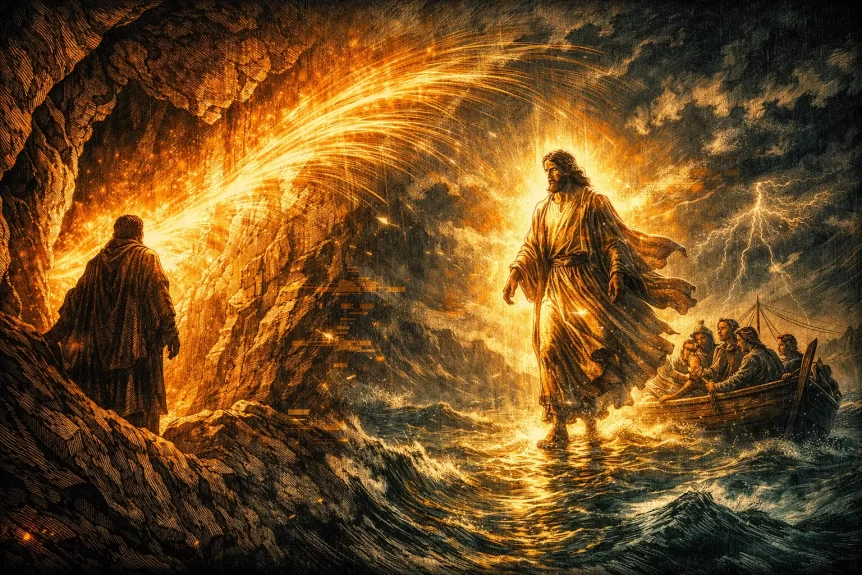
When disciples, fresh from miracles, face a midnight storm in Mark 6:45–56, Jesus strides across waters to “pass by” them like God’s glory to Moses—yet terror grips their uncomprehending hearts, unmoved even as winds obey Him. Gennesaret’s crowds, however, run with bold faith for healing. Friend, Jesus sees your struggles from afar; He’s not exposing flaws but calling for recognition—will you, unlike the Twelve, respond with open-hearted faith to the compassionate Lord who calms every chaos?
Sermon Audio
Shareable Quote graphics



Sermon Text
The Faith Retest
Nate Roten / Mark / Mark 6:45–56 / February 22, 2026
Main Idea
When Jesus reveals His glory, the issue is not exposure but recognition—will we harden our hearts or respond in faith?
Have you ever failed a test in school?
And I’m not talking about a C-minus that you could explain away… I mean a hard, unmistakable F. The kind of grade that makes your stomach drop when you see it written in red ink at the top of the page.
What did that feel like? Embarrassment? Frustration? Maybe even a little panic? Did it bother you at all? Did you start calculating how much it would hurt your overall grade? Did you wonder what your parents would say?
And what about your teacher? Were they angry? Disappointed? Did they see the gap between your potential and your performance? Maybe they even said those words: “I know you can do better than this.”
And if you were fortunate, maybe they gave you another opportunity — a retake, extra credit, a chance to prove that you actually understood the material.
The best teachers don’t give up when we fail to understand. They find new ways to teach the same essential truth.
Because in Mark 6, the disciples just failed a test. Not academically. Not morally. But spiritually.
They saw the bread multiplied.
They saw five thousand fed.
And yet Mark tells us they still don’t know the truth.
So what does Jesus do? Does He rebuke them? Dismiss them? Replace them? No. He gives them another lesson.
Passage
Mark 6:45–56 CSB
45 Immediately he made his disciples get into the boat and go ahead of him to the other side, to Bethsaida, while he dismissed the crowd. 46 After he said good-bye to them, he went away to the mountain to pray. 47 Well into the night, the boat was in the middle of the sea, and he was alone on the land. 48 He saw them straining at the oars, because the wind was against them. Very early in the morning he came toward them walking on the sea and wanted to pass by them. 49 When they saw him walking on the sea, they thought it was a ghost and cried out, 50 because they all saw him and were terrified. Immediately he spoke with them and said, “Have courage! It is I. Don’t be afraid.” 51 Then he got into the boat with them, and the wind ceased. They were completely astounded, 52 because they had not understood about the loaves. Instead, their hearts were hardened. 53 When they had crossed over, they came to shore at Gennesaret and anchored there. 54 As they got out of the boat, people immediately recognized him. 55 They hurried throughout that region and began to carry the sick on mats to wherever they heard he was. 56 Wherever he went, into villages, towns, or the country, they laid the sick in the marketplaces and begged him that they might touch just the end of his robe. And everyone who touched it was healed.
I – Dismissal
Seems like Jesus dismisses everyone quickly and almost abruptly.
The disciples – Jesus immediately sends them away across the sea toward Bethsaida. No doubt they were riding a spiritual high after the miracle of the Shepherd’s banquet. This was a literal mountaintop experience, where they witnessed something miraculous but hadn’t yet grasped the truths Jesus was really communicating. When excitement lacks wisdom, you are in a danger zone. As Warren Wiersbe says, “It is good to be on the mountaintop if you don’t get careless and step off a cliff.”
The crowd – As we saw last week, it’s already late, and they need to return home after the Shepherd’s banquet. We don’t know how many people knew the miraculous nature of their supper, but I suspect many did. After all, they saw Jesus and the disciples disembark from the boat with nothing and had them surrounded the entire time. Surely, they recognized they were supernaturally provided for.
Why the urgency? That still doesn’t explain why they were dismissed so abruptly. To understand that more fully, we need to turn to John’s account of this story.
John 6:14–15 CSB
14 When the people saw the sign he had done, they said, “This truly is the Prophet who is to come into the world.” 15 Therefore, when Jesus realized that they were about to come and take him by force to make him king, he withdrew again to the mountain by himself.
According to John, they were trying to make Jesus king by force. They were expecting a warrior king who would amass forces to overthrow Rome and establish a renewed Davidic rule in Jerusalem… not a sacrificial Shepherd who would lay down His life for the sheep. They saw the miracle but still didn’t perceive the true identity of the miracle worker… and neither did the disciples. Everyone’s idea of the Messiah was still political. When they heard of God’s kingdom, they still thought of an earthly, geographical rule over the promised land, but that wasn’t why Jesus came. His kingdom is not of this world and doesn’t operate like normal, earthly kingdoms, so He sent everyone away before it developed into a coup.
To pray – This must have been hard for Jesus. He is a king who is in the process of being given rulership. It is why He came, but this was not the way forward. He desires to lead His people, yet His people are acting on wrong assumptions and motives that would have had devastating consequences if they had attempted to assemble a rebel army. This is not God’s plan. This was a crisis moment, and in such times, Jesus goes to the Father. There are three such times in the book of Mark. The first was toward the end of chapter one, when the crowds gathered at Peter’s house. This is the second, and the third is after Passover in the garden of Gethsemane. The people needed to see the truth, and the enemy was waging counterattacks against Jesus’ infiltration of their territory. And no doubt, times like these were tempting for Jesus, but His reign cannot come through a coup. The road to the throne leads through the cross.
II – The Retest
Jesus sees them straining. From His mountain prayer retreat, Jesus sees His disciples struggling against the wind in the middle of the sea. Mark gives us a rare glimpse into Jesus’s omniscient care—He sees their struggle even from miles away. He sees what they are going through (because He is the one who sent them into the storm) and He acts. Here’s a truth that should anchor our souls: our Shepherd’s eye is still on His sheep. Even when He seems absent, He sees your struggle and will come to you in the storm.
Jesus walks into the storm – After seeing the peril of the disciples, Jesus finishes His conversation with the Father and walks down from the mountain to the water’s edge. We are used to visualizing ourselves in the boat with the disciples as Jesus approaches, but consider it from Jesus’ perspective for a moment. The disciples are in the middle of the sea, and Jesus is on the shore. The sea is approximately 7-8 miles wide at its widest point. If you flip back to John’s gospel, he says the disciples had rowed about 3-4 miles, which confirms they are somewhere in the middle. This means Jesus didn’t just walk a few dozen feet to reach the disciples. He walked on water for 3-4 miles to get to His disciples in the 4th watch of the night (around 3 am). A picture of the incarnation, where God comes from heaven to earth and enters the turbulent waters of humanity… into our pain, suffering, and brokenness to reveal Himself and illuminate a way out.
Wanted to pass by them – This is a peculiar phrase. There is much speculation. Why did He want to pass by? Did He intend to walk by unnoticed? Did He want them to see Him but not interact? This is specific wording used in the OT. Remember, Jesus is doing things illustrated in the OT to reveal who He really is. This wording is in the reference in Exodus where God passes by Moses.
Exodus 33:12–23 CSB
12 Moses said to the Lord, “Look, you have told me, ‘Lead this people up,’ but you have not let me know whom you will send with me. You said, ‘I know you by name, and you have also found favor with me.’ 13 Now if I have indeed found favor with you, please teach me your ways, and I will know you, so that I may find favor with you. Now consider that this nation is your people.” 14 And he replied, “My presence will go with you, and I will give you rest.” 15 “If your presence does not go,” Moses responded to him, “don’t make us go up from here. 16 How will it be known that I and your people have found favor with you unless you go with us? I and your people will be distinguished by this from all the other people on the face of the earth.” 17 The Lord answered Moses, “I will do this very thing you have asked, for you have found favor with me, and I know you by name.” 18 Then Moses said, “Please, let me see your glory.” 19 He said, “I will cause all my goodness to pass in front of you, and I will proclaim the name ‘the Lord’ before you. I will be gracious to whom I will be gracious, and I will have compassion on whom I will have compassion.” 20 But he added, “You cannot see my face, for humans cannot see me and live.” 21 The Lord said, “Here is a place near me. You are to stand on the rock, 22 and when my glory passes by, I will put you in the crevice of the rock and cover you with my hand until I have passed by. 23 Then I will take my hand away, and you will see my back, but my face will not be seen.”
This is another display of His deity. During their first test on the sea, Jesus spoke to the forces of nature He created and commanded them to be still, a power only God can wield. Here, He demonstrates His ability to defy natural laws and tread on the sea, which, in Scripture, is an unruly, chaotic realm that only God can control.
Job 9:8 CSB
8 He alone stretches out the heavens and treads on the waves of the sea.
This is Jesus’s repeat lesson in divine identity. They missed it the first time on the sea, and again at the feeding; they have another chance now. Will they recognize that the carpenter from Nazareth is actually Yahweh in flesh?
III – The Test Failed
Tragically, the answer is no.
They cried out in fear. The first thing they do is scream in fright. And let’s be generous. They have, after all, been fighting against a storm ever since they were dismissed from the dinner table. Here it is… at least 3 am. The poor guys are exhausted, and now they see something they’ve never experienced… a humanoid figure walking toward them on the raging waters. Any one of us would have reacted the same way. And yet, this was another test. The first time, Jesus was in the boat with them. Now, would they recognize their Master’s voice and presence even in unexpected circumstances like this?
Jesus’ gentle reply – Even though they failed to see His glory in the moment, Jesus didn’t get angry. He treated them as He had treated the crowd… with compassion. He spoke tenderly to them, encouraging them with three simple exhortations:
a. Take courage.
b. I am
c. Don’t be afraid
This isn’t Jesus telling grown men to stop being afraid. This is the divine formula for courage that appears throughout Scripture. What do I mean? Let’s take a look at a few scriptures:
Deuteronomy 31:6–8 CSB
6 Be strong and courageous; don’t be terrified or afraid of them. For the Lord your God is the one who will go with you; he will not leave you or abandon you.” 7 Moses then summoned Joshua and said to him in the sight of all Israel, “Be strong and courageous, for you will go with this people into the land the Lord swore to give to their ancestors. You will enable them to take possession of it. 8 The Lord is the one who will go before you. He will be with you; he will not leave you or abandon you. Do not be afraid or discouraged.”
Joshua 1:9 CSB
9 Haven’t I commanded you: be strong and courageous? Do not be afraid or discouraged, for the Lord your God is with you wherever you go.”
The command to have courage in Scripture, then, is not the absence of fear but trust grounded in God’s presence. The command to “be strong and courageous” is paired with the assurance that God accompanies you wherever you go, establishing a pattern repeated throughout Scripture: boldness flows from relational certainty rather than favorable circumstances. What distinguishes biblical courage is its source. Rather than self-generated bravery, courage flows from God’s strengthening hand and active help (Isa 41:10). The repeated refrain across these passages—“do not fear,” “do not be discouraged”—isn’t naive denial of difficulty but a call to reorient your confidence away from circumstances and toward God’s character and presence.
And that’s the piece the disciples keep missing. Despite everything Jesus had shown them up to that point, such as being fed from heaven’s storehouses in the wilderness, just as the Hebrews of the exodus were fed, their hearts remained hardened to the truth.
The test wasn’t whether they would act courageously when they are fearful. The test was having the faith to see Jesus as Yahweh. Nestled between the imperative commands to have courage and not to be afraid is the truth Jesus was trying to get them to discern: He is the ‘I AM.’ This is the same phrase God uses of Himself when He speaks to Moses in the burning bush.
And if that wasn’t enough proof for them, Jesus stepped into the boat, and without even having to command the winds, the storm ceased. It was as if creation itself were emphasizing this main point! Yet Mark tells us they were “completely astounded” not because they finally understood, but because their hearts remained hardened. Neither the multiplication of bread nor the mastery over nature opened their eyes to see that God Himself was with them.
IV – Galilean Ministry Summary
We now move into a summary scene in which Jesus demonstrates His compassion for the residents of Gennesaret, a city on the western shore of the Sea of Galilee, which is miles off course from their intended destination of Bethsaida. But this “accidental” arrival becomes a powerful contrast to the disciples’ hardened hearts.
Marketplace gathering – Soon, everyone started pouring into the marketplace… people from the villages, towns, and countryside. The marketplace was usually in the city center and was a major hub of communal activity, so it made logistical and strategic sense to gather the sick here so Jesus could heal them.
Compressed Montage – What’s interesting about this summary is: (1) the faith demonstrated by these townspeople is incredibly high, especially given the disciples’ lack of faith and Jesus’ recent visit to His hometown, where there was virtually no faith. But even more intriguing is (2) that the way it is described is almost a compressed montage of the people Jesus has ministered to thus far.
• The sick lying on mats is reminiscent of the paralytic on the mat lowered from the rooftop.
• The beggars parallel the leper, the demoniac, and Jairus.
• Those reaching for His robe reference the faith of the chronically ill woman.
These stories are about active faith in desperate circumstances. What was once done in personal interactions or small crowds was now being done on a large scale. The faith of the one has become the faith of the many.
• The woman who touched His garment in fear? Now, entire crowds are touching His garment in confidence.
• The paralytic lowered through the roof by friends? Now, entire villages carry their sick on mats.
• The demoniac who ran to Jesus from the tombs? Now, entire regions run toward Him.
🔥 Application: Is your heart open to truth?
So, the movement of responses in this chapter is interesting:
• In Nazareth (Mark 6:1–6), there was unbelief.
• In the boat (6:52), there was hardness of heart despite the miracle in the wilderness or what they experienced by being sent in pairs throughout the region.
• But in Gennesaret (6:53–56), there is widespread faith.
Mark is contrasting responses to Jesus.
• Familiarity with Jesus is not enough.
• Exposure to Jesus is not enough.
• Proximity is not enough.
• Participation in miracles is not enough.
Only desperate hearts that respond in faith, recognizing Jesus for who He truly is: the loving God of the Old Testament, always near and always ready to pour out His compassion on His people.
Don’t be the one who needs to take the test over and over again.
The question Mark leaves us with is not whether Jesus will reveal His glory—He will. The question is whether we will have eyes to see and hearts to respond.
➤ Reflect: When was the last time you pursued Jesus with urgency? Do you still reach for Him in desperation — or have you grown comfortable?
FAQs
1. Why did Jesus dismiss the disciples and the crowd so abruptly after the feeding of the five thousand?
Jesus dismissed them urgently to prevent the crowd from forcing Him to be a political king, as they misunderstood His miracles as signs for an earthly coup against Rome rather than His true identity as the sacrificial Shepherd. The disciples, still on a spiritual high without grasping the truth, were sent ahead to Bethsaida, highlighting the danger of excitement without wisdom.
2. What does it mean that Jesus ‘wanted to pass by them’ while walking on the water?
This phrase echoes Exodus 33, where God’s glory passes by Moses, intentionally revealing Jesus’ deity as Yahweh who treads on the chaotic sea (Job 9:8). It was a divine display for the disciples to recognize Him, mirroring His earlier command over nature and offering a retake on their failed test of faith from the loaves.
3. Why were the disciples’ hearts hardened despite witnessing the miracle of the loaves and now Jesus walking on water?
Mark 6:52 explains their hearts were hardened because they failed to understand the loaves’ significance, missing Jesus’ divine identity even after repeated revelations. This spiritual failure persisted despite proximity, exposure, and miracles, contrasting with the faith in Gennesaret.
4. How does Jesus’ response to the disciples’ fear demonstrate His compassion?
Jesus gently spoke, “Have courage! It is I. Don’t be afraid,” a divine formula echoing Deuteronomy 31:6–8 and Joshua 1:9, where courage flows from God’s presence, not circumstances. He entered the boat, ceasing the wind without command, yet they remained astounded due to unbelief.
5. What is the connection between the feeding miracle and this sea event as a ‘retest’?
The disciples saw the five thousand fed but didn’t grasp Jesus’ identity, failing the first spiritual test. Jesus provided this retake by walking on water, defying nature as only God can, to teach the same truth: He is Yahweh incarnate, entering human storms like the incarnation.
6. How does the ministry in Gennesaret contrast with the disciples’ response?
While the disciples’ hearts hardened (6:52), Gennesaret’s people showed desperate faith, rushing the sick to Jesus, carrying them on mats, and touching His robe for healing—echoing earlier individual stories now on a massive scale, proving recognition leads to faith and healing.
7. What does Mark 6 teach about true faith versus mere exposure to Jesus?
Familiarity (Nazareth), proximity (boat), participation in miracles, and exposure aren’t enough—only desperate hearts recognizing Jesus as the compassionate God of the Old Testament respond in faith. Hardened hearts repeatedly fail tests; faith urgently pursues Him.
8. How should this passage challenge our own hearts today?
Jesus always reveals His glory; the issue is recognition—will we harden like the disciples or respond in faith like Gennesaret? Reflect: When did you last pursue Jesus desperately, or have you grown comfortable, needing endless retakes?