Highlight Reel
Sermon Summary
Good Friday ended in silence—but Easter morning did not. In Mark 16:1–7, we see how God meets grieving hearts, solves what we cannot, and declares the victory of a risen Christ. This message calls us out of spiritual resignation and into resurrection living, where even our failures are met with restoring grace.
Sermon Audio
Shareable Quote graphics



Sermon Text
What is Said When the Silence is Broken
Nate Roten / Easter 2026 / Resurrection / Mark 16:1–7
Main Idea
The silence of Good Friday is shattered by God’s triumphant declaration: “He is risen!”
On Friday, we left this sanctuary carrying the burden of Golgotha’s darkness. We felt the pain of Judas’s betrayal, the shame of Peter’s denial, and the fickleness of crowds who cried “Hosanna” one day and “Crucify Him” the next. We saw the injustice from religious leaders and Roman soldiers, and the cruelty of the cross. Most heartbreaking of all, we heard Jesus cry out to His Father—only to be met with divine silence. No answer. No rescue. No voice from heaven. Just darkness, abandonment, the bearing of God’s wrath for our sins, and death.
But the story doesn’t end in a tomb’s silence. Today, God speaks again—and when He speaks, the very foundations of death and hell tremble!
And I want us to feel the impact of Sunday morning, just as we did on Friday evening. To accomplish that, we will enter the narrative together with the women who visited the tomb to feel what they felt and see what they saw.
Passage
Mark 16:1–7 CSB
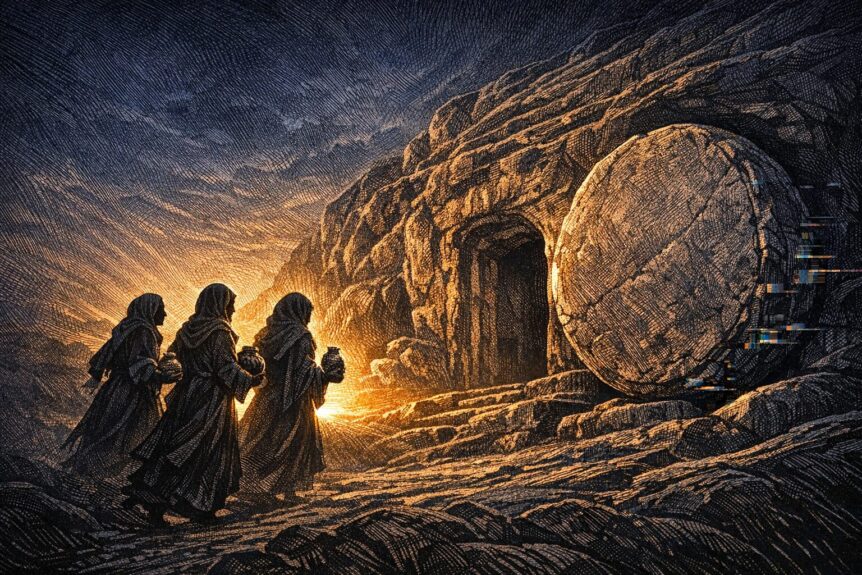
1 When the Sabbath was over, Mary Magdalene, Mary the mother of James, and Salome bought spices, so that they could go and anoint him. 2 Very early in the morning, on the first day of the week, they went to the tomb at sunrise. 3 They were saying to one another, “Who will roll away the stone from the entrance to the tomb for us?” 4 Looking up, they noticed that the stone—which was very large—had been rolled away. 5 When they entered the tomb, they saw a young man dressed in a white robe sitting on the right side; they were alarmed. 6 “Don’t be alarmed,” he told them. “You are looking for Jesus of Nazareth, who was crucified. He has risen! He is not here. See the place where they put him. 7 But go, tell his disciples and Peter, ‘He is going ahead of you to Galilee; you will see him there just as he told you.’ ”
I – Living in the Silence (v.1–3)
Though Jesus clearly predicted both His death and resurrection three times (Mark 8:31, 9:31, 10:33-34), His followers could not understand the reality of His promise. Judas had taken his own life in despair. The eleven remaining disciples hid behind locked doors.
But these faithful women? They, at least, had the courage to publicly mourn their crucified Lord. They purchased burial spices—expensive spices—to honor Jesus, whose hurried burial had denied Him that respect.
When heaven falls silent, life still requires movement. These women remained loyal to Christ, but they were living based on what they saw on Friday, not according to what their ears had heard in Jesus’ promises. You see, they are simply doing what love does in grief. They wait until the Sabbath ends so they can come to honor and mourn. They aren’t expecting a resurrection of their Rabbi. They are still living in the sorrowful silence of Good Friday.
Here’s what strikes me about these women—and perhaps about us: They loved Jesus deeply, yet they were preparing to embalm a living Savior. They were faithful, yet caught between Friday’s tragedy and Sunday’s triumph.
How often do we live like these women did? Carrying grief without hope of deliverance? Going through spiritual motions without joy? Asking “What now, God?” while forgetting “He told us what’s next.” How many years have you honored Jesus’ death on Friday while failing to live in His resurrection power on Monday?
II – The Problem We Can’t Solve (v.3)
As these women approached Jesus’ tomb, reality confronted them: a massive stone sealed the entrance—and they had no way to move it. The large stone serves a practical purpose: it seals in the dead, keeps out the living, prevents disturbance of the body, contains the stench of decay, and stands as a lasting symbol of death’s finality.
But beneath this practicality lies a deeper question—something profound: “How do we deal with the finality of Jesus’ death? How do I remove the barrier so I can take the next step in facing death?” The struggle we all wrestle with is how permanent death is. It’s a human limitation we haven’t yet overcome. It’s an unbreakable barrier, and even though Jesus declared He would overcome it and gave a preview of this through Lazarus’s resurrection, they still couldn’t see beyond it. Their perspective wasn’t hope for new life but an effort to manage the impact of death. It’s a reality rooted in our earthly experience. Who can fix death? Who can move such an unmovable boundary?
That stone symbolizes every barrier between God and us that we can’t move ourselves—our sin, guilt, spiritual death, and separation from holy God.
III – The Surprise They Didn’t See Coming (v.4–5)
What greeted these women at the tomb? The very problem that had consumed their thoughts on the journey—the immovable stone—had vanished! Before they could even attempt a solution, God had already acted.
While they planned, God had already performed… before they understood what He was doing. As they arrived, they saw that:
• The stone is already rolled away
• The tomb is already open
• Heaven has already acted
Remember this foundational truth: God’s silence never equals God’s absence. What appeared to be divine inaction was, in fact, divine preparation for the greatest action in human history.
We don’t always see or understand what God is doing. In Reformed theology, we refer to this as God’s eternal decree—His sovereign plan unfolding exactly as He intended from before the creation of the world. While these women mourned, God was at work. While they prepared spices for a corpse, God was preparing to reveal a conquering King.
If we played a highlight reel of the past year, would it show you living in hope or despair? Do you believe that God is working out His eternal decree, even when you cannot see its effects?
If so, why are you living so defeated?
If the silence of God does not mean the absence of God, then you can always live with hope, joy, and expectation of victory, because God is faithful and powerful enough to carry out His plans. Keep faith!
There will be a time when you realize the stone has been removed from your life, and you’ll see that God has been working all along!
IV – The Voice That Breaks the Silence (v.6)
Seeing the displaced stone, they cautiously entered the tomb. Mark tells us they were “alarmed”—and who wouldn’t be? The last thing you expect in death’s domain is a messenger of life!
Seated calmly in the tomb was a young man dressed in brilliant white—clearly an angel, a messenger from heaven sent to deliver the most important announcement in human history. Here, in a grave where death is a permanent resident, God’s messenger breaks heaven’s silence with one of the most glorious statements in all of scripture.
“He is not here. He has risen!”
Imagine the impact of this moment. These women were mourning. They had given the last three years of their lives to a man whom they saw be brutally beaten and crucified with their own eyes. For three days, their hearts were broken and their minds reeled as they tried to figure out what to do next. But now, suddenly, everything is restored… because He is risen.
Notice the pastoral care woven into this cosmic announcement:
First, he addresses their fear: “Don’t be alarmed.” Even in this moment of ultimate triumph, God’s first word is comfort to trembling hearts.
Second, he acknowledges their devotion: “You are looking for Jesus of Nazareth, who was crucified.” God sees their grief and their confusion. He honors their devotion and love while gently correcting their expectation — they seek a corpse, but they’re about to encounter the Living One!
Third, he provides evidence: “He is not here. See the place where they put him.” If they didn’t understand that Jesus would be resurrected, even after He told them three times, this messenger knows they won’t be able to grasp seeing the stone moved and the tomb empty. Knowing that human hearts rationalize the miraculous, God graciously provides physical proof. The grave clothes and the empty slab all bear witness to the reality of the resurrection.
Finally, he makes the declaration that splits history in two: “He has risen!” This is no metaphor, no spiritual symbolism. This is bodily, physical, literal resurrection. The Son of God who died for sinners is alive forevermore!
When God breaks the silence, He declares victory! Throughout the entire book of Mark, we see the battle between the kingdoms continue. Satan tempted Jesus in the wilderness, but Jesus stood His ground, and Satan fled. Over the next three years, Jesus consistently brought the kingdom of God into enemy territory, causing their retreat. Now, three days after Satan and his forces believed they had overthrown God’s kingdom, Jesus claimed eternal victory. He was the sacrifice that paid for the sins of His people, but He is also the Messiah and High Priest who lives to intercede and rule His people from the position of ultimate authority.
This is the reality you and I live in every minute of every day. When we look at the cross, we recognize the sacrifice made for us, but we don’t stay there. We don’t dwell in the darkness of Good Friday; instead, we live in the power of the resurrection, where Jesus conquered every enemy we will ever face. He has already won the battle!
V – The Grace We Don’t Deserve (v.7)
But that’s not the end of the resurrection story. The impact of Christ’s rise to universal authority and kingship doesn’t end with a personal revelation. It must be shared with others. The greatest news in history needs to be spread, and God chooses these faithful women as His first evangelists. The final instruction from the angel was to “go, tell his disciples—and Peter…”
The victorious message of the cross and the empty tomb must be proclaimed, which means we are the proclaimers. The women were instructed to go and tell the disciples, including the command to tell Peter specifically, which is only found in Mark’s gospel.
Isn’t that interesting? Since Mark is probably jotting down Peter’s recollections, it’s likely from Peter himself. Why is that?
I don’t believe this is an ego trip; it’s not a sneaky way to assert his authority by being named. Quite the opposite. I see this as a first-hand testimony of restoration. Why do I say that? Because, according to his own admission:
• Public failure—cursing and denying Christ before witnesses
• Repeated betrayal—three denials as Jesus predicted
• Shameful flight—abandoning his Lord at the darkest hour
And yet… he is singled out. Peter denied his Lord. He failed Jesus and wounded Him during the darkest moment of His earthly life. But when Jesus announced His triumph over death itself, the voice that broke heaven’s silence didn’t say, “Where were you?” or “You failed me.”
Instead, it was, “Go get Peter.”
You see, the message of resurrection Sunday isn’t just victory… it is grace… It’s about grace for failures like Peter… and like us.
In naming Peter, God was pulling him out of his shame and restoring him to loving and joyful fellowship. This is how the Sovereign God of grace operates—He doesn’t discard broken vessels; He mends them for greater service.
Who here can relate? Who here has ever felt disqualified when you fall short, repeat the same familiar sin, or fail again to do the right thing? To anyone who has been where Peter is now… be encouraged. Christ calls imperfect people. When He sees you, He sees a son or daughter who is still in the process of maturing. He sees the new heart He has given you operating inside of a person who is struggling against a sin nature. Like Peter, He isn’t looking at you and saying, “What is wrong with you?” He sees you where you are and is excited to come alongside you to take you from where you are to where He has designed you to go.
🔥 Application:
When God breaks His silence, He speaks resurrection, not condemnation.
Good Friday looked like defeat:
• Death appeared victorious
• Sin seemed to triumph
• Satan celebrated conquest
But Easter Sunday reveals God’s eternal plan:
Jesus took the silence we deserved. He bore the Father’s wrath for your sin so that when you cry out to God, you hear not silence but “beloved child,” And you don’t experience wrath, you experience grace. The crushing isolation of the cross becomes our eternal invitation to a restored fellowship with the God we were once at odds with.
Friday declared, “You are separated from God by sin.” Sunday announces: “You are welcomed home by grace.”
The silence was real, but it was never final.
In the death and resurrection of Jesus Christ, death has truly lost its grip because Jesus bore its penalty for us. God’s judgment on sin has been satisfied. His silence has served its purpose.
Now, God speaks life into every person who looks to Jesus and believes in Him.
FINAL INVITATION
Some of you are still living in Friday’s tomb:
• Carrying guilt that Christ has already carried
• Bearing burdens that grace has already lifted
• Questioning God’s presence while sitting in the shadow of the greatest display of it
If that describes you, hear this clearly:
Because He is risen, you can walk out of here knowing that for anyone who calls on the name of Jesus in faith and repentance:
• Your sins are forgiven through His sacrifice
• Your future is secure in His victory
• Your prayers are heard by a living Savior
• Your name is called with the same grace that called “Peter.”
Stop living in the apparent defeat of the cross.
Live in the victory of the resurrection!
FAQs
1. Why did the women expect to find a dead body if Jesus predicted His resurrection?
Because grief and fear often overpower memory. They heard His words, but they lived by what they saw.
2. What does the stone represent spiritually?
It represents the barrier of sin, death, and separation from God—something no human effort can remove.
3. Is the resurrection meant to be taken literally?
Yes. The text presents a physical, bodily resurrection, not a metaphor or spiritual idea.
4. What does it mean that God was silent on Friday?
God was not inactive—He was accomplishing redemption. The silence served His saving purpose.
5. Why is Peter singled out in the resurrection message?
It highlights restoring grace. The one who failed most publicly is personally called back.
6. How does the resurrection change daily life?
It moves us from defeat to victory. We don’t just remember Christ’s death—we live in His risen power.
7. What if I feel stuck in guilt or spiritual failure?
The message “and Peter” applies to you. Christ restores those who return to Him in repentance and faith.
8. Does God still feel silent today?
At times, yes—but His silence never means absence. His promises and purposes are still unfolding.