
Highlight Reel
Sermon Summary
What happens when Jesus steps into your silence? In this week’s message from Mark 7, we see that Christ not only heals a man who cannot hear or speak, but also fulfills the promise that the desert will one day sing. This is more than a miracle—it is a picture of how Jesus meets us in our brokenness and restores us completely. If you’ve been walking through a spiritual wilderness, this message points you to the One who brings life where there was none.
Sermon Audio
Shareable Quote graphics


Sermon Text
When the Desert Starts to Sing
Nate Roten / Mark / Mark 7:31–37 / March 22, 2026
Main Idea
The unworthy and broken are made worthy and whole through the love of Jesus.
Have you ever experienced a kind of silence that feels as sorrowful as it is quiet? Not just the absence of noise, but the absence of connection. Watching life happen around you but feeling cut off from it. Seeing laughter but not hearing it. Having thoughts you cannot express. Wanting to speak but feeling stuck inside yourself.
This is exactly how the man in today’s passage lived every day… mute and deaf… unable to connect with those around him. His life was a lonely one. Have you ever walked through a spiritual season that felt just as silent? A dry stretch where prayer felt unanswered, where your heart felt barren, where you wondered if you would ever feel whole again?
The Bible calls this a wilderness… a desert.
Today we’ll discover that, in Mark 7, we see the promise begin to unfold: God’s answer to spiritual deafness and silence—not in Jerusalem, not in the temple courts—but in Gentile soil, in a place that looked like a wasteland.
And with one word from Jesus, the silence breaks… and the desert starts to sing.
Passage
Mark 7:31–37 CSB
31 Again, leaving the region of Tyre, he went by way of Sidon to the Sea of Galilee, through the region of the Decapolis. 32 They brought to him a deaf man who had difficulty speaking and begged Jesus to lay his hand on him. 33 So he took him away from the crowd in private. After putting his fingers in the man’s ears and spitting, he touched his tongue. 34 Looking up to heaven, he sighed deeply and said to him, “Ephphatha!” (that is, “Be opened!”). 35 Immediately his ears were opened, his tongue was loosened, and he began to speak clearly. 36 He ordered them to tell no one, but the more he ordered them, the more they proclaimed it. 37 They were extremely astonished and said, “He has done everything well. He even makes the deaf hear and the mute speak.”
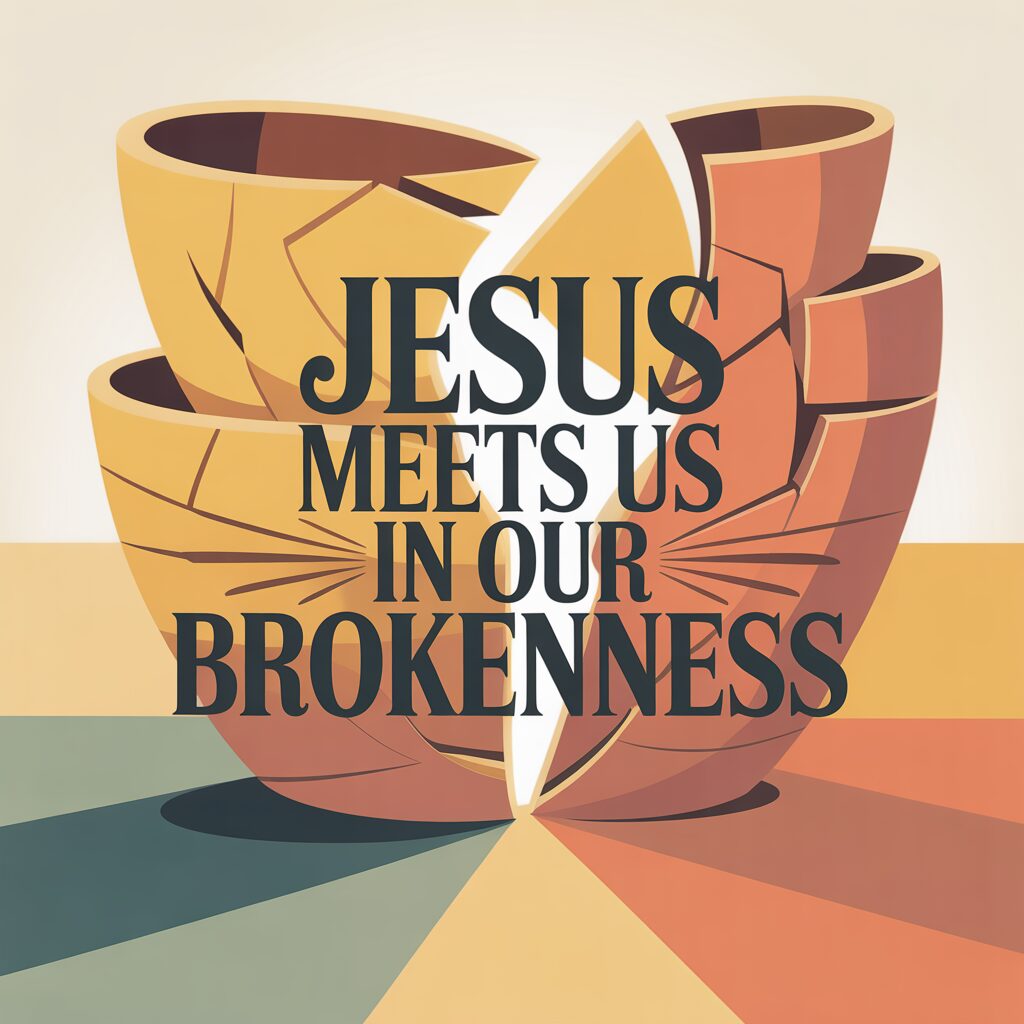
I – Jesus Meets Us in Our Brokenness vv. 31-32
Lay of the Land
Jesus has traveled 120 miles from Jewish territory into pagan Gentile lands—first to Tyre and Sidon in modern-day Lebanon, now to the Decapolis region east of the Sea of Galilee.
This wasn’t a quick mission trip—Jesus spent months ministering among people who were considered spiritually deaf and mute by Jewish standards. As He reaches the eastern side of the sea, a large crowd is waiting for Him, as expected, since He had gained widespread fame for healing the demoniac the last time He was in the area. This crowd, no doubt, wants to see Jesus perform His miraculous wonders, but they also bring a deaf man to Him who is also hard of speech. Since he’s hard of speech, he likely wasn’t born deaf. It is more likely that he lost his hearing at some point when he was able to form words, but has now nearly lost the ability due to his deafness.
This account is unique to Mark, though Matthew also records the broader interaction. Let’s review that together as well, so we have the full picture: Matt 15:29–31.
Matthew 15:29–31 CSB
29 Moving on from there, Jesus passed along the Sea of Galilee. He went up on a mountain and sat there, 30 and large crowds came to him, including the lame, the blind, the crippled, those unable to speak, and many others. They put them at his feet, and he healed them. 31 So the crowd was amazed when they saw those unable to speak talking, the crippled restored, the lame walking, and the blind seeing, and they gave glory to the God of Israel.
This event was much more impactful, wasn’t it? The crowd’s amazement remains unchanged, though we see those who were healed giving glory to the God of Israel. That’s a small detail Mark doesn’t include. While Matthew shows us that dozens, if not hundreds, of people were healed and delivered from their afflictions, revealing the scale of Jesus’ impact in terms of quantity, Mark highlights His impact in terms of quality—this intimate moment between Jesus and one poor soul. Matthew has a wide, cinematic shot, while Mark zooms in on an individual. It’s important to see both perspectives, but for our personal application, I believe Mark is calling all of us—you and me—to put ourselves in this individual’s position so we can see, hear, and feel the impact firsthand… to receive the intimate touch from Jesus ourselves.
Private Interaction
The first thing Jesus does when the man is brought to Him is to pull him aside. This wasn’t religious theater. Jesus pulls him aside to have a personal, one-on-one moment with him. Jesus wanted to focus completely on this man, and He wanted this man to focus entirely on Him.
The seclusion was also meant to help Jesus connect with the man in a way he could understand. The uniqueness of His methods here might distract us if we read too much into them or try to decode His tactics. The simple answer for the uniqueness of the interaction is that the man cannot hear; therefore, Jesus must communicate differently. Jesus’ approach shows us that since the man cannot hear or speak, He uses every other sense to communicate—touch, sight, sighs, and ultimately His authoritative word.
As we step into the story, this first realization should give us confidence that Jesus meets us where we are and graciously works with us in ways we can understand in our current circumstances. Here’s the first beautiful truth: Jesus sees you in your sufferings and connects with you in a meaningful way. How many of us need to hear that truth today?
II – Jesus Speaks Life into Our Silence vv. 33-34
His touch
Jesus communicates hope through His hands. Since the man cannot hear, Jesus touches his ears to show him exactly what will be healed. Then, Jesus imparts His life-giving speech by touching his tongue with His own saliva. Why saliva? While it’s true that salvia was seen to have medicinal properties, we should also remember what Jesus taught earlier in this chapter: defilement doesn’t come from the outside in… it comes from the inside out. Jesus, the sinless Son of God, has no defilement—only purity flowing from within Him. That’s why He could heal the leper with a touch, and why He can use His saliva to heal the man’s tongue, demonstrating that He alone has the power to heal and restore!
Therefore, through the ministry of human touch, Jesus preaches to the man who cannot hear, telling him exactly what He intends to do for him. And unlike the Syrophoenician woman who approaches Jesus and responds in praiseworthy faith, this man is brought to Jesus broken and unable to express faith. Studying these two passages together, we see both sides of the coin—healing as a result of acting in faith and healing despite a lack of visible faith. This contrast shows the sovereign, providential care of Jesus… He is the focal point.
What we should observe in this moment is Jesus’ compassion for this broken man. Although he is brought to Jesus, Jesus initiates the interaction. The love of Christ reaches down to a single individual among the crowd and ensures His love is communicated in a way that can be received. Do you see yourself in this man, needing a loving touch from God? If you are His, He is already reaching out. What might be preventing you from feeling His touch today?
His sight and sigh
Mark tells us that He looks up to the Father before He speaks a word. Two profound things happen here:
First, Jesus shows the source of all healing. He wants the man to see where true power comes from. Not only is this a special moment of communion between the Son and the Father, but it also visually indicates to the man where the power of his liberation comes from. First, it comes directly from Jesus, as we have just seen, but His authority is from on high… from the God of Israel. He is the source of healing, and Jesus is His agent on earth… the Messiah… God Himself in the flesh. This is a visual depiction of Jesus’ later confirmation that He and the Father are one. Isn’t it amazing that Jesus is communicating all of this without uttering a single word?!
If we put ourselves in this man’s position, it should cause us to pause and ask: Where does my help come from? When you are weighed down by hardship, where or to whom do you turn first? Yourself? Your spouse? Your best friend? Do you seek help at all? Or do you numb yourself from reality with alcohol, food, binge-watching Netflix, or something else? May we, like the Psalmists (121, 124, 115, 54, 46), when we ask that question, proclaim “My help comes from the Lord, the maker of heaven and earth!”
Second, Jesus reveals His heart for the broken. This is another intriguing reaction from Jesus. What might it signify that he sighs deeply? Well, what does it suggest when you do it? Isn’t it a form of groaning—an emotional response to what you’re experiencing in the moment? I believe that is exactly what is happening here, in many ways. Jesus is on a mission—to seek and save the lost, to reveal the Kingdom of God, and to set the captives free. That deep sigh reveals Jesus’ heart— His commitment to the mission, His compassion for this man’s suffering, and His grief over what sin has done to His creation.
How would your life change if you realized that Jesus doesn’t look at your brokenness with irritation, but with compassion? What if you saw Jesus as still emotionally connected to the mission of redemption and sanctification, compassionate and understanding of your shortcomings, and empathetic towards how sin affects all of His precious creation?
His words
After all this non-verbal communication, Jesus finally speaks, and when He does, He shows His complete power, authority, and ability to restore. Just one word changes everything:
“Ephphatha!” – Be Opened!
The power wasn’t in the method; it was in the Master. The power of Jesus Christ lies in His word! The same word that spoke creation into existence is the one that heals the sick and restores the broken!
Isaiah 55:11 CSB
11 so my word that comes from my mouth will not return to me empty, but it will accomplish what I please and will prosper in what I send it to do.”
The word of Christ prevails over all the schemes of the enemy and defilement of sin’s curse!
III – Wholeness v.35
The healing is instant and complete. Remember Jesus’ imperative commands from earlier in Mark: listen and understand. The Syrophoenician woman heard Jesus’ words and understood. The parable He spoke to her was used to draw out her faith, and her daughter was delivered from demonic oppression because of it.
Hearing. The deaf man’s ears are opened to listen. The authoritative words spoken over him to heal him from his affliction were the first words he had heard in years, perhaps decades.
Speech. His tongue is unshackled to proclaim. In Greek, the term ‘loosened’ literally means to be unshackled… to have the chains broken and the tongue liberated and freed from bondage. Whether disorder or ailment, this man had experienced for most of his life has been healed by a word from the Creator.
Fullness. The healing and restoration are powerful enough, but what is truly incredible is the full extent of his restoration. Imagine being healed the way this man was. Your hearing has been restored, and your tongue is no longer tied down. You can now hear and speak, but no one would expect your speech to be perfectly clear at first. If you’ve spent a lifetime in silence, unable to put words together, you would need quite some time to learn how to speak—learning to form words, use inflection, and so on. But this man didn’t have to. His speech is perfect immediately! When Jesus restores, He doesn’t do partial work.
IV – Section Summary and Application vv. 36-37
The end of chapter seven serves as a section summary. From this point, Mark begins to shift the focus of Jesus’ ministry toward Jerusalem and the cross through a few chapters that act as a bridge, connecting Galilee’s ministry to Passion Week. There are a few things to note in this summary:
First, the crowd was extremely astonished. Matthew tells us that they praised the God of Israel, but during their praise, they failed to obey Him. God in the flesh—Jesus—was commanded them to remain silent. His desire is to continue ministering in the region, but to do that, He needs an audience that seeks Him for the right reasons. Clearly, Jesus knew that their proclamations would hinder His ministry.
Secondly, the crowd said that Jesus does everything well. The way Mark says this sounds very similar to the way God describes His creation in Gen. 1:31 as being ‘good,’ which ties Jesus’ work as the Messiah to the good work of creation… and so it is, because He is making us new creations!
Do you believe that? Despite your trials and tribulations, do you believe that Jesus is still working in your life in a way that is ‘good’? Is the ministry of His presence enough for your needs, or do you find Him lacking in His provisions? When we complain about our station in life, that is essentially what we are communicating. That’s a heavy realization, but the heavy truths are often the most transformative. We may not always understand what God is doing in our lives, but we should never doubt His goodness and plan. That is always a secure anchor for our lives.
But there’s something bigger happening here…
Something in this passage is much bigger than a single miracle. When Jesus heals the man who cannot hear and cannot speak clearly, Mark uses a rare word — mogilalos. That word appears in just one other place in all of scripture, in the Greek Old Testament: Isaiah 35. And this is no coincidence.
After chapters of divine judgment on Edom, Egypt, Tyre, Israel, and Jerusalem, Isaiah 35 bursts with hope:
Isaiah 35:1–6 CSB
1 The wilderness and the dry land will be glad; the desert will rejoice and blossom like a wildflower. 2 It will blossom abundantly and will also rejoice with joy and singing. The glory of Lebanon will be given to it, the splendor of Carmel and Sharon. They will see the glory of the Lord, the splendor of our God. 3 Strengthen the weak hands, steady the shaking knees! 4 Say to the cowardly: “Be strong; do not fear! Here is your God; vengeance is coming. God’s retribution is coming; he will save you.” 5 Then the eyes of the blind will be opened, and the ears of the deaf unstopped. 6 Then the lame will leap like a deer, and the tongue of the mute will sing for joy, for water will gush in the wilderness, and streams in the desert;
Do you see what’s happening? Jesus is in Lebanon, and the Decapolis—the very territories Isaiah promised would sing for joy! This is not just a story of a random miracle; it is the fulfillment of Messianic prophecy. When Jesus frees a Gentile girl from demonic oppression and then opens the ears and loosens the tongue of a Gentile man, Isaiah 35 is being fulfilled before their eyes.
– The desert is beginning to sing.
– The Kingdom of God has arrived in the person of Christ.
– Salvation and restoration are going beyond Israel’s borders.
Here’s what this means for you and me: The same Jesus who brought life into Lebanon continues to bring life to our spiritual deserts today.
If salvation and restoration have reached the far corners of the pagan world, then they can reach you.
The question we face is: Do I believe that Jesus will meet me in my wilderness? Will I faithfully wait and continue to trust Him until streams flow in my desert, I see the splendor of my King, and my sorrow is replaced with singing?
God loves His own. He may have led you into the wilderness, but He doesn’t intend to keep you there. Listen to His instruction so that you may understand the purpose of your trial… then wait in eager expectation for His deliverance and restoration.
Then, may your heart be full enough to sing and your tongue be loosened to proclaim His greatness!
FAQs
1. Why did Jesus take the man aside privately?
Jesus was not performing for a crowd. He was ministering to a person. The private setting shows His personal care and His desire to communicate in a way the man could understand.
2. Why did Jesus use touch and saliva in this healing?
Because the man could not hear, Jesus used physical actions to communicate what He was about to do. The method was not the power—the power was in Christ Himself.
3. Does this passage teach that physical healing always follows faith?
No. This man did not demonstrate explicit faith. The passage highlights Christ’s sovereign grace—He heals according to His will, not human merit.
4. What does Jesus’ sigh reveal about Him?
It reveals His compassion and grief over the effects of sin. Jesus is not distant from suffering; He feels the weight of it as He redeems it.
5. Why did Jesus tell the crowd to remain silent?
He wanted to avoid being followed merely for spectacle. Their disobedience shows that amazement at Jesus does not equal submission to Him.
6. How does this miracle connect to Isaiah 35?
The healing of the deaf and mute directly fulfills Isaiah’s prophecy that in the Messianic age, the deaf would hear and the mute would sing, even in the wilderness.
7. What if I feel like I am in a spiritual desert right now?
This passage assures you that Jesus meets people in those places. The desert is not the end of your story—Christ brings life, often in ways you do not expect.
8. Is it wrong to question God’s goodness in suffering?
The struggle is real, but the passage calls us to trust that Jesus does all things well. Even when we do not understand His ways, His character remains good and trustworthy.