Highlight Reel
Sermon Summary
Descending from glory into failure, Jesus confronts both spiritual darkness and human unbelief. A desperate father’s honest cry—“I do believe; help my unbelief”—becomes the model of true faith. While the disciples relied on past success and failed, Jesus shows that power flows through present dependence on Him. The passage calls us to bring our weak, struggling faith to a strong and sovereign Savior.
Sermon Audio
Shareable Quote graphics
Sermon Text
When Weak Faith Meets Strong Savior
Nate Roten / Mark 9:14–29 / May 3, 2026
Main Idea
Power isn’t in the strength of your faith. The power is in the object of your faith.
Picture the scene.
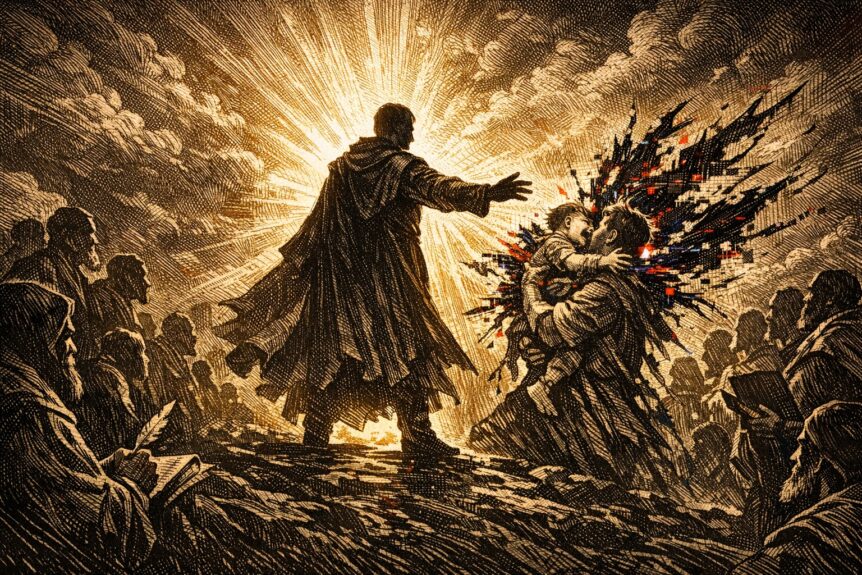
A dusty road at the foot of a mountain. A tense crowd has gathered… the kind of crowd that gathers when something has gone wrong. In the middle of it, a father is holding his son who is having seizures. This isn’t the first time. It’s been happening since he was small. And more than once, the thing tormenting him has tried to kill him.
The father has done everything a father can do. He’s tried every remedy, knocked on every door, and prayed every prayer he knows how to pray. And finally, he heard about a teacher whose followers were casting out demons in towns across Galilee. So he brought his boy. He found the disciples. He asked them to do what he could not do himself.
They tried. And they failed.
Now there are scribes arguing. Disciples standing around, embarrassed. And a father, still holding his son, still wonders if he just watched his last hope evaporate in front of him.
That’s the scene Jesus walks into when He comes down from the mountain.
And it’s not as far from us as we’d like to think. Most of us know what it’s like to try hard and fail anyway. To do everything you know to do for a marriage, a child, a sin you can’t shake… and watch it fall apart in your hands.
If that’s you this morning, the man at the center of today’s passage is going to pray one of the most honest prayers in all of Scripture. Six words that change his life and his son’s life forever:
“I do believe; help my unbelief.”
And here’s the truth this passage is going to press into us: the power isn’t in the strength of your faith. The power is in the object of your faith. A weak faith in a strong Savior will accomplish what a strong faith in yourself never can.
Passage
Mark 9:14–29 CSB
14 When they came to the disciples, they saw a large crowd around them and scribes disputing with them. 15 When the whole crowd saw him, they were amazed and ran to greet him. 16 He asked them, “What are you arguing with them about?” 17 Someone from the crowd answered him, “Teacher, I brought my son to you. He has a spirit that makes him unable to speak. 18 Whenever it seizes him, it throws him down, and he foams at the mouth, grinds his teeth, and becomes rigid. I asked your disciples to drive it out, but they couldn’t.” 19 He replied to them, “You unbelieving generation, how long will I be with you? How long must I put up with you? Bring him to me.” 20 So they brought the boy to him. When the spirit saw him, it immediately threw the boy into convulsions. He fell to the ground and rolled around, foaming at the mouth. 21 “How long has this been happening to him?” Jesus asked his father. “From childhood,” he said. 22 “And many times it has thrown him into fire or water to destroy him. But if you can do anything, have compassion on us and help us.” 23 Jesus said to him, “ ‘If you can’? Everything is possible for the one who believes.” 24 Immediately the father of the boy cried out, “I do believe; help my unbelief!” 25 When Jesus saw that a crowd was quickly gathering, he rebuked the unclean spirit, saying to it, “You mute and deaf spirit, I command you: Come out of him and never enter him again.” 26 Then it came out, shrieking and throwing him into terrible convulsions. The boy became like a corpse, so that many said, “He’s dead.” 27 But Jesus, taking him by the hand, raised him, and he stood up. 28 After he had gone into the house, his disciples asked him privately, “Why couldn’t we drive it out?” 29 And he told them, “This kind can come out by nothing but prayer.”
I – From Glory to Battle (vv. 14-16)
We just walked into that scene at the foot of the mountain. But Mark wants us to see something we can’t see from ground level, because while the chaos is unfolding below, something else has just happened above.
Jesus has come down from the Mount of Transfiguration. Peter, James, and John have just witnessed His divine glory—the embodied hand-off from the Law and the Prophets to Jesus Himself, the initiator of the New Covenant. And then they descend. Right into the failure. Right into the arguing. Right into a battle the other nine disciples are losing.
Two scenes, happening at the same time: three disciples on the mountain, witnessing glory. Nine disciples in the valley, trying and failing to cast out a demon. Doing what they could with human effort—but without Jesus, they had no divine power. And the moment Jesus appears, the crowd recognizes something different and runs to Him.
Here’s the opening principle we cannot miss: religious activity without the authority of Christ has no real power.
And power is the first of two points this passage communicates.
II – Kingdoms Collide (vv. 17-27)
The most vivid part of this passage is the son’s affliction by demonic forces and the father’s plea for freedom. When Jesus asks what they’re arguing about, a desperate father steps forward with a heartbreaking story of his son being tormented by a demon since childhood—not just inconvenienced or irritated but actively subjected to murderous attempts on his life. The intensity of the harm is also emphasized by Mark, who describes it four separate times! The struggle between the kingdom of light and the kingdom of darkness is at play, and this conflict demonstrates Jesus’ dominion: complete power, authority, and sovereign rule over every area of life.
A. The Enemy’s Destructive Purpose
While the symptoms might resemble what we’d call epilepsy—seizures, mouth foaming, and teeth grinding… the father recognizes something more sinister. Notice the demonic intent: throwing the child into fire and water “to destroy him.” Medical conditions don’t plot murder. This isn’t merely a medical condition—it’s spiritual warfare.
Think about this: The enemy has been playing the long game with this family. Day after day, year after year, this demon has systematically tried to destroy not only the boy’s body but also the family’s hope. Every seizure whispered the same lie: “God doesn’t care. God won’t help. He is not powerful enough. Give up.” The enemy’s goal remains unchanged since Eden: to kill, steal, and destroy image-bearers of God.
B. Christ’s Supreme Authority
Jesus issues a simple command: “Bring him to me.”
The demon hears it and panics. It attempts one final, desperate attack—the boy is thrown to the ground, convulsing and foaming. This isn’t just another seizure. This is defiance against the Judge of all the earth.
But notice Jesus’ response. No panic. No struggle. No negotiation. He speaks with the calm authority of the Creator: “You mute and deaf spirit, I command you: Come out of him…” And then He places a “No Trespassing” sign on this boy’s life, signed by the King of kings: “…and never enter him again.”
The demon makes one last attempt to steal hope from this family. The fit is so violent that the boy appears dead. The crowd says, “He’s dead.” It looks, for a moment, like the enemy has won.
And then Jesus simply reaches down—just as He did with Jairus’ daughter—takes the boy by the hand, and raises him up. A lifetime of suffering, restored in a moment.
This is Mark, once again, laying out Christ’s supremacy over everything: over disease, over demons, over death itself. While the enemy came to kill, steal, and destroy—and he’s been doing it in this boy’s life for years—one encounter with Christ ends it.
And here’s what you need to hear this morning: that same power holds your life. There is no enemy you face that He has not already defeated. The enemy hates you because you bear God’s image, but he has no authority over you. He’s already lost. If you are in Christ, you don’t need to fear being possessed by an unclean spirit; you are indwelt by the Holy Spirit, who leads you into truth and freedom, not oppression and slavery.
Where the disciples failed, Jesus prevailed. When you are hurting, when you need a remedy for your weakness, there is only One you can turn to.
III – Open-Heart Surgery (vv. 19, 22-24)
With Jesus’ power and authority firmly established, we can now focus on the second core truth of this passage: the nature of faith and unbelief.
This theme runs through the entire scene—in the father, the disciples, the scribes, and the crowd. And Jesus presses into it because He is preparing His disciples for what is coming. Remember, He is turning from Galilee to Jerusalem and the cross. What matters most is not just that they’ve seen His power, but that they demonstrate the faith He has been trying to instill in them, and the disciples’ failure to cast out the demon proves they haven’t gotten there yet. Therefore…
Jesus performs spiritual open-heart surgery on this man to draw out what is inside using four carefully crafted questions:
Question 1: “What are you arguing with them about?”
Notice that when Jesus asks about the argument, the disciples and the scribes don’t answer—but this desperate father steps forward. This question is asked to pull this father out of the crowd and to the feet of Jesus. And when he is drawn, the way he addresses Jesus reveals mixed faith: “Teacher”—not “Lord” or “Messiah,” just “Teacher.” His faith is real but incomplete, as we will see more fully in their dialogue.
Question 2: “You unbelieving generation, how long will I be with you? How long must I put up with you?”
These aren’t just pointed questions but an emotional outcry from a weary rabbi. They’re rhetorical, expressing the anguish in Jesus’ heart over what he sees. Any parent in the room will know exactly what I’m talking about. All of us, at one point or another (and my parents before me, and their parents before them), have instructed our kids to do something for the 400th time. And there comes a point when you get so frustrated that you just let it all out. “How many times do I have to tell you to do…?” That’s the human emotion in Jesus’ voice—holy frustration without sin.
But this runs deeper than parental exasperation. Jesus is never uncontrolled. This is a lament similar to those the prophets gave against unbelieving Israel… prophets like Moses, Isaiah, and Jeremiah. We see the perpetual unbelief of Israel throughout the Old Testament now carried into the present day. And just as we saw a connection with Moses and Mount Sinai last week, the parallel continues today. After Moses meets with God and comes back down from the mountain, he sees everyone worshiping idols. Their faith has leapfrogged from the God of Israel to a god they’ve crafted for themselves. So this is not a frustrated outcry from Jesus in response to their unbelief that He has dealt with for the first time, or even the 50th. This is a lament over the pattern of unbelief that plagued Israel from Genesis to Malachi and continued in Jesus’ day.
So far, what Jesus has done is call the man from the crowd, moving from the crowd to the individual. And then he calls out the unbelief. There’s unbelief in this father, unbelief in the disciples, and unbelief in the entire crowd. This draws out head knowledge.
Question 3: “How long has this been happening to him?”
By asking this question, Jesus reaches into the man’s heart, seeking to draw out his desperation. To answer, the father must go back and recount all the years his sweet boy has been tormented. He understands it’s been happening to the boy his whole life, and even after gaining an audience with nine of Jesus’ disciples, there is still no other answer. This is heart knowledge.
We hear the sorrow in his voice as he replies, “It’s been happening since childhood. Many times it has thrown him into fire or water to destroy him.” Then, after the recollection, the father makes his desperate plea: “But if you can do anything, have compassion on us and help us.”
Question 4: “If you can?”
These three words are at the epicenter of what Jesus is trying to do in this passage. There’s the spiritual tumor in his heart that needs to be extracted: doubt. The father’s faith is conditional—a weaker faith that questions Jesus’ ability rather than confidence in His identity or willingness. The disciples failed, so maybe Jesus will too. That’s the logic of doubt. Jesus sees this. He perceives it. He is the God who sees the thoughts and intentions of the heart that we, as human beings, can’t see. This is what Jesus latches on to. He says, “What do you mean, ‘if I can’?’ It’s not a matter of if. This has nothing to do with my ability or willingness. This has everything to do with your inability to believe. That’s probably why you didn’t call me Lord or Messiah, but Teacher.
“Everything is possible for the one who believes.”
Now this is where we must be careful. This verse is often misused.
Jesus is not saying:
– “Faith is a cosmic vending machine—insert belief, get your desired outcome.”
– “If you believe hard enough, you can have anything you want.”
– “Your faith controls God’s actions.”
That’s not biblical faith—that’s word-of-faith heresy.
What Jesus is actually saying cuts much deeper:
– This isn’t about My power—it’s about your trust.
– “Everything is possible” doesn’t give you control of outcomes.
It means faith connects you to the One who has control…
The power is not in the strength of your belief. The power is in the object of your belief.
The father’s response is one of the most honest prayers in Scripture: ‘I do believe; help my unbelief!’ He’s not pretending to have strong faith. He’s not mustering up more confidence. He’s simply admitting: ‘My faith is weak, but You are strong.’ And that humble dependence is exactly what Jesus honors.
IV – Why Couldn’t We?
After arriving home, the disciples ask privately the question that reveals their hearts: “Why couldn’t we drive it out?” They expected success—after all, they’d cast out demons before when Jesus sent them out in pairs. Their question reveals a subtle shift from dependence to self-sufficiency. Jesus’ answer doesn’t seem revelatory at first, but it cuts to the heart. “This kind can come out by nothing but prayer.”
The disciples didn’t fail because they lacked effort—they failed because they lacked dependence on God.
Notice their question: “Why couldn’t we do it?” There’s the problem. “We.” They had begun to trust in past success rather than in present dependence on God.
Prayer isn’t a spiritual technique or a magic formula—it’s a voiced dependence. It’s the heart cry that says, “I cannot do this, but You can. I’m trusting You to work through me.”
That’s why Jesus connects power to prayer, because power flows from relationship, not from self-sufficiency or methodology.
And now you can see the contrast:
• The father had weak faith but turned to Jesus and saw power.
• The disciples had past success but relied on themselves and were powerless.
That is the warning for us. You can have:
• knowledge
• experience
• training
• even past spiritual victories
…and still be completely ineffective if you are not dependent on Christ.
🔥 Key Takeaway
If you’re sitting here this morning at the bottom of your own mountain—exhausted, out of answers, holding something you can’t fix—Jesus is inviting you to do exactly what He did with that father.
He’s inviting you onto the operating table.
Ask yourself His four questions. Honestly. Slowly. With nothing held back.
Question 1 — “What are you arguing about?” Make it personal. What are you actually wrestling with? Not the polished version. The real one. What has a grip on you that you can’t shake?
Question 2 — “How long must I put up with you?” Name the unbelief (HEAD). What voices are you listening to instead of His? What keeps you from coming to Jesus honestly? What feeds the doubt?
Question 3 — “How long has this been happening?” Feel the weight (HEART). How long have you been carrying this? How long have you been trying to fix it yourself? How long before you admit your willpower isn’t the power that will free you?
Question 4 — “If you can?” Come back to dependence (HANDS). Do you really believe Jesus can free you, repair what’s broken, redeem what seems too far gone? Or is the real question, hidden underneath, whether He will?
Then pray the father’s prayer. Six words. “Lord, I do believe; help my unbelief.”
Because here’s what this whole passage has been telling you: the power isn’t in the strength of your faith. The power is in the object of your faith. And the object of your faith is the One who has all authority… who came down from the mountain, walked into the chaos, spoke a word, and raised a boy the crowd thought was dead.
Bring your weak faith to the strong Savior who specializes in doing impossible things through imperfect people.
FAQs
1. What does “help my unbelief” actually mean?
It’s an honest confession that faith and doubt can exist at the same time. It’s not pretending to be strong—it’s asking Jesus to strengthen what is weak.
2. Is Jesus saying we can do anything if we believe hard enough?
No. He’s not teaching that faith controls outcomes. He’s teaching that faith connects us to God, who alone has authority over all things.
3. Why did the disciples fail if they had done this before?
They shifted from dependence on Christ to confidence in themselves. Past success became present self-reliance.
4. What does it mean that “this kind comes out only by prayer”?
Prayer is dependence on God. Jesus is emphasizing that spiritual authority flows from reliance on the Father, not from methods or experience.
5. Can Christians be oppressed or possessed by demons?
Those in Christ are indwelt by the Holy Spirit and cannot be possessed. However, spiritual warfare is real, and believers must stand firm in Christ’s authority.
6. Why does Jesus sound frustrated in this passage?
His words reflect a holy grief over persistent unbelief—echoing the long history of Israel’s resistance to trusting God.
7. What if my faith feels too weak to matter?
This passage directly answers that fear: weak faith in a strong Savior is enough. The power is not in you—it’s in Him.
8. Does this mean God will fix every situation if I trust Him?
Not necessarily in the way we expect. God’s power is real, but His purposes are sovereign. Faith trusts Him whether He delivers immediately or sustains us through the struggle.