Highlight Reel
Sermon Summary
In Mark 9, Jesus reveals His divine glory to Peter, James, and John, confirming that His coming suffering is not a contradiction but part of God’s plan. Moses and Elijah testify that all Scripture points to Him, and the Father commands us to listen to His Son above all. As they descend the mountain, Jesus reminds them—and us—that the path to glory runs through suffering, and true discipleship is lived in the valley.
Sermon Audio
Shareable Quote graphics

Sermon Text
Transformed
Nate Roten / Mark / Mark 9:2–13 / April 26, 2026
Main Idea
Jesus reveals His glory so we trust Him in valleys, not just mountaintop moments.
Have you ever had a mountaintop moment?
I’m not necessarily talking about a literal hike—though some of you may have those stories—but about a moment when everything felt unmistakably clear. A moment when God’s presence seemed near, your faith felt strong, and your perspective finally made sense. Maybe it was at a camp, a conference, a retreat, or even a quiet time when Scripture came alive and your heart was stirred in a way you couldn’t quite explain.
In those moments, things feel settled. Questions fade, and doubts quiet. You see God more clearly, and for a brief time, everything feels exactly as it should be.
But then… you have to come back down.
Back to normal life.
Back to responsibilities.
Back to struggles that didn’t magically disappear.
Back to situations that still don’t make sense.
And if we’re honest, that descent can be disorienting.
You start asking:
- Was that real?
- Why doesn’t it feel the same now?
- If I saw God so clearly then… why is it harder to trust Him here?
That tension—between what you experienced on the mountain and what you face in the valley—is exactly where our passage meets us today.
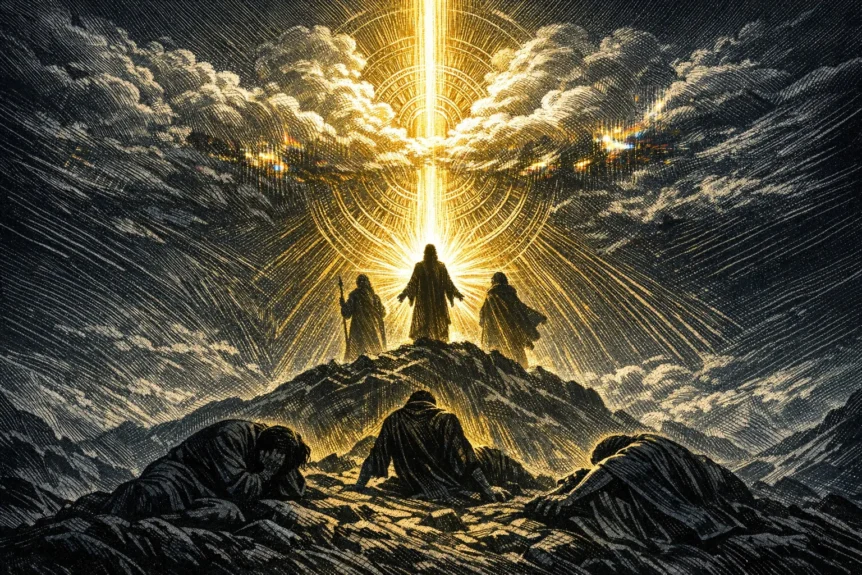
In Mark 9, three of Jesus’ disciples have the ultimate mountaintop experience. They see something no one else has seen. They witness the unveiled glory of Christ. They hear the voice of the Father. It is clarity they’ve never known.
But then comes the descent—back to confusion, back to questions, back to a path that leads through suffering before glory. What they discover—and what we desperately need to understand—is this:
Following Jesus isn’t about permanent mountaintop living. It’s about seeing His glory clearly enough on the mountain that we can trust Him completely in the valley.
Passage
Mark 9:2–13 CSB
2 After six days Jesus took Peter, James, and John and led them up a high mountain by themselves to be alone. He was transfigured in front of them, 3 and his clothes became dazzling—extremely white as no launderer on earth could whiten them. 4 Elijah appeared to them with Moses, and they were talking with Jesus. 5 Peter said to Jesus, “Rabbi, it’s good for us to be here. Let’s set up three shelters: one for you, one for Moses, and one for Elijah”—6 because he did not know what to say, since they were terrified. 7 A cloud appeared, overshadowing them, and a voice came from the cloud: “This is my beloved Son; listen to him!” 8 Suddenly, looking around, they no longer saw anyone with them except Jesus. 9 As they were coming down the mountain, he ordered them to tell no one what they had seen until the Son of Man had risen from the dead. 10 They kept this word to themselves, questioning what “rising from the dead” meant. 11 Then they asked him, “Why do the scribes say that Elijah must come first?” 12 “Elijah does come first and restores all things,” he replied. “Why then is it written that the Son of Man must suffer many things and be treated with contempt? 13 But I tell you that Elijah has come, and they did whatever they pleased to him, just as it is written about him.”
I – The Ascent (v. 2)
Six days— Mark begins with a quiet yet weighty detail: “After six days…” This isn’t filler—it anchors us in real time and real space, because this story is so unique and supernatural that many think it is fiction or myth. However, this is not myth or symbolic storytelling detached from history. Mark is telling us that this actually happened, at a particular moment, in a particular place, witnessed by a specific group of men. Six days after Jesus spoke about the cross, suffering, and the cost of following Him, He leads Peter, James, and John up a high mountain. What they are about to see is not disconnected from what He just said—it is meant to interpret it.
Location – Geographically, we are still in the northern region near Caesarea Philippi, and most scholars point to Mount Hermon as the likely setting. Although the text doesn’t explicitly name the mountain, the location fits. More importantly, the type of place fits. Throughout Scripture, mountains are not just elevated land—they are meeting places between heaven and earth. From Eden, pictured as a high place where God walked with man, to Sinai, where God descended in fire and gave His law, to Zion, where His presence dwelt among His people—mountains are where God reveals Himself.
And this fits the pattern we’ve already seen in Jesus’ ministry. Again and again, He withdraws to mountains:
• to pray
• to teach
• to perform mighty works
• to call and commission His disciples
The mountain becomes a place of revelation and transformation. It is where earthly perspective begins to yield to heavenly reality. And that’s what is happening here. Six days earlier, the disciples heard something that shattered their expectations: the Messiah must suffer, be rejected, and die. That didn’t fit their framework or align with their vision of glory.
Jesus brings them to this mountain not to escape the hard reality of His coming suffering, but to reveal the glory that will make sense of it all.
II – The Transformation (vv. 2-3)
Transfigured – As they reach the mountain, Mark tells us something staggering: “He was transfigured before them.” The word used here is the Greek metamorphoō—where we get our word metamorphosis. But this isn’t a change from one thing into another. This is not Jesus becoming something He was not before. This is a revealing of what has always been true. The glory that was veiled in His humanity… is now partially unveiled. It’s as if He wanted to mirror the temple setup… taking these three men into the holy place, with Eden imagery everywhere, and give them a peek behind the curtain into the holy of holies, where God’s presence dwells.
For the first time, the disciples see Jesus not merely as the teacher, the miracle worker, or the Messiah they confessed—but as He truly is in His divine nature. Mark then struggles, almost humorously, to describe what this looked like. He says Jesus’ clothes became “dazzling—extremely white, as no launderer on earth could whiten them.” In other words, there is no earthly category for this. No human process can produce this kind of brilliance. This is not a trick of light. This is not a reflection. This is holy, pure radiance. Throughout Scripture, dazzling white represents absolute purity and righteousness. The disciples aren’t just witnessing power—they’re seeing sinless perfection radiating from within.
Matthew helps us even more in the Gospel of Matthew 17:2, where he says that Jesus’ face shone like the sun. Now, if you know your Old Testament, that should immediately bring to mind something that ties all this together.
In the book of Exodus, Moses went into the wilderness, but then was commanded to go up to the top of Mount Sinai, where he would meet with God himself, who was wrapped in a thick, thunderous cloud. It was there that he met with God, received the instruction of the law, and when Moses came down, he was radiating light… reflecting God’s glory. It shone because he had been near God. But here, Jesus is not reflecting anything. He is not borrowing glory… He is the source of it.
• Moses glowed like the moon—reflecting light that was not his own.
• Jesus blazes like the sun—because the light originates from Him.
And this is where Jesus stands in a category all His own. Every Old Testament encounter with God involved mediated glory:
• A burning bush
• A cloud
• Fire on a mountain
• Reflected radiance on a prophet’s face
But here, there is no intermediary. The glory is not around Jesus. The glory is not coming upon Jesus. The glory is coming from Jesus.
This is not just another mountaintop moment. This is a declaration: The One who will suffer… is the same One who possesses divine glory.
Here’s what confronts us: We naturally want to separate what God has joined together. We want the glory without the suffering, the radiant Christ without the crucified Christ. But the Transfiguration doesn’t contradict Jesus’ prediction of suffering—it confirms that the One who will suffer is worthy of our trust because He is God.
The question the disciples should be asking… the question we need to ask ourselves is: If this is who Jesus truly is, what does that mean for how I follow Him—even into suffering?
This parallel story with Moses matters, because it is the segway into the man showing up in person!
III – The Encounter (vv. 4-8)
With the Saints
Suddenly, Moses and Elijah appear—unmistakably recognizable—in conversation with Jesus.
Why them? Because together they represent the entirety of the Old Testament witness. Moses stands for the Law. Elijah stands for the Prophets. Everything God has revealed—from Sinai to the prophetic calls to repentance—finds voice in these two men. And now both stand with Jesus.
Both men had their own mountain encounters with God. Both were deliverers—Moses from Egypt’s bondage, Elijah from idolatry’s deception. Both pointed forward prophetically: Moses promised a greater Prophet to come, Elijah was linked to the coming day of restoration.
This scene isn’t arbitrary. The Law and the Prophets literally stand with Jesus because they have always pointed to Him. Even in how their lives ended, there’s a subtle picture of God’s people: Moses died and was buried, while Elijah was taken up alive. Together, they represent all of God’s people—those who sleep in death and those alive at His coming. And now, all of them find their fulfillment in Christ.
And right in the middle of this overwhelming moment… Peter starts talking.
Peter’s ramblings – Have you ever rambled when someone asks a question and you’re either too stunned to know what to say or simply don’t have a clue? This is how Peter responds. Mark doesn’t soften it. He tells us plainly—Peter didn’t know what to say. Stunned, overwhelmed, and likely terrified, he begins to ramble. He offers to build three shelters—perhaps thinking of the Feast of Tabernacles or simply trying to preserve this moment: “Let’s do something… let’s preserve this… let’s make space for all of you here.”
And before he can finish processing that thought, God the Father interrupts.
With the Father
The cloud—A cloud descends and overshadows them—a familiar sign throughout Scripture. He led the Hebrews through the wilderness in a cloud by day. When Moses ascended Mount Sinai, His glory settled on the mountaintop in a cloud. When God came to dwell among His people in the tabernacle and the temple, His glory filled those structures in the form of a cloud. Even the verbiage of overshadowing is significant, as we see when the Holy Spirit overshadowed Mary at the conception of Jesus, an important depiction of God being with us and fulfilling His promises.
This cloud is not just atmosphere—it is the manifestation of God’s presence, and from the cloud, a voice speaks…
The declaration and command—this echoes Jesus’ baptism, but now it’s not just for Jesus—it’s for the disciples. They need to know that this is God’s beloved Son. The word beloved is agape—the strongest form of love, used of someone cherished and preferred above all else. This is identity language. First, Jesus shows them, then the Father declares it. At Sinai, God revealed His character to Moses. Here, He reveals His Son’s identity—this is the divine Son, perfectly loved by the Father. Jesus isn’t just a Rabbi, prophet, or community leader like Moses or Elijah. He is the Son who is deeply loved… the divine Son of Psalm 2. Instead of misunderstanding or rebuking Him, they must listen to Him. This fulfills Moses’ own prophecy that God would raise up a Prophet like him, whom the people must hear. That Prophet is here, standing right in front of them.
And then, just as suddenly as it began, it all disappears.
With Jesus
Then, as suddenly as it began, everything else vanishes. Cloud gone. Moses gone. Elijah gone. Only Jesus remains. This alone preaches the gospel:
1. That the Father sends the Son. This is the mission of the Triune God.
2. The Law and Prophets, having fulfilled their pointing function, fade away, leaving Christ alone as the final focal point.
This is where the passage presses in on us. We are often more like Peter than we realize. We want to hold on to spiritual moments or keep Jesus alongside other voices—other authorities, priorities, and influences. But the Father cuts through all of it with one command:
“Listen to Him.”
Not:
• Listen to Him and everything else
• Listen to Him when it aligns with your expectations
• Listen to Him when it’s comfortable
Just — listen to Him.
Because at the end of the day, everything else fades. Good things—even God-given things—are not ultimate things.
People will come and go. Seasons will shift. Experiences will pass. But when it all settles… only one relationship ultimately matters… Christ alone. The question is: Do you see Jesus for who He truly is? When everything else fades, is Christ alone enough?
We need to ask these questions on the mountaintop because, at some point, we must come back down to real life.
IV – The Descent (vv. 9-13)
Silence and confusion – As they come down the mountain, Jesus gives them a surprising command: say nothing. Though Jesus has commanded silence before, this time is different. This silence has a deadline. They are not to speak of what they’ve seen until the Son of Man rises from the dead. This glory cannot be proclaimed until the resurrection provides its proper context.
But that’s exactly where the confusion sets in. Mark tells us they kept discussing what this “rising from the dead” might mean. Not because they had never heard the words before—Jesus had already spoken of it—but because they lacked a category for it. Their framework only includes a general resurrection at the end of the age. An individual Messiah rising in the middle of history—especially after suffering and death—made no sense to them.
So even after seeing His glory… they still don’t understand His mission.
Question about Elijah—this tension leads to their next question. Having just seen Elijah on the mountain, they ask: “Why do the scribes say that Elijah must come first?” It’s a good question, rooted in Scripture. Malachi 4 promises that Elijah would come before the great and dreadful day of the Lord—a figure who would prepare the way and bring restoration. Jesus affirms that expectation. Elijah does come first. He does prepare the way. But then Jesus reframes it: Elijah has already come… and they did to him whatever they pleased. Matthew makes explicit what Mark implies—Jesus is speaking about John the Baptist. He came in the spirit and power of Elijah. He called people to repentance. He prepared the way. And what did it lead to?
Rejection.
Opposition.
Execution.
The forerunner suffered. Then Jesus brings it back to Himself: “So also the Son of Man is going to suffer at their hands.” This is where Jesus lands the conversation. The disciples have just witnessed breathtaking glory, and there’s a real danger they might think Jesus can bypass suffering altogether—move straight from transfiguration to glorification. So Jesus brings them back down, both literally and theologically.
The pattern is the same:
• The forerunner suffers before restoration
• The Messiah suffers before glory
🔥 Application:
This descent is just as important as the ascent because it reminds us that spiritual highs are not where discipleship is ultimately lived out.
We all want the mountain:
• the clarity
• the closeness
• the undeniable sense of God’s presence
But most of life is lived in the valley. The question is not: “What did you see on the mountain?” It’s: “Will you trust Him when you get back down?”
Here’s what we must settle: The same Jesus who revealed His divine glory is the one who leads us through suffering we don’t understand. If we don’t grasp this, we’ll spend our lives confused by God’s ways—wondering why obedience is costly, why faith entails hardship, and why glory seems delayed.
The word “transfigured” (metamorphoō) appears again in 2 Corinthians 3:18, where Paul says that as we behold Christ’s glory, we are being transformed into the same image. The connection is intentional. These disciples aren’t merely witnessing Christ’s glory—they’re seeing their own destiny. Yet transformation requires a process, and for followers of Jesus, that process leads through suffering before glory… so the process must come before the result.
This is our calling: to see Christ’s glory clearly enough that we trust Him completely—even when He leads us through valleys we wouldn’t choose.
Jesus makes it crystal clear: For Him and for all who follow Him, the path to glory leads through suffering. The question is: Have you seen His glory clearly enough to trust Him on that path?
FAQs
1. Why did Jesus reveal His glory to only three disciples?
He chose key witnesses who would later help lead the early church. Their testimony confirms this was a real, event and not a private vision detached from reality.
2. What does the Transfiguration actually show us about Jesus?
It reveals that Jesus is fully divine—the radiance of God’s glory belongs to Him. His suffering is not weakness but the mission of the Son of God.
3. Why do Moses and Elijah appear?
They represent the Law and the Prophets, showing that all of Scripture points to Christ and finds its fulfillment in Him.
4. What does “Listen to Him” mean for us today?
It means Jesus has final authority over every other voice. We don’t filter His words through our preferences—we submit to them.
5. Why does Jesus command silence about this event?
Because His glory cannot be rightly understood apart from the cross and resurrection. Without that context, it would be misunderstood.
6. Why is suffering such a central part of following Jesus?
Because the pattern of redemption is suffering before glory. Christ walked that path, and all who follow Him share in it.
7. What should we do when mountaintop experiences fade?
Remember what you saw and trust what you know to be true. The purpose of the mountain is to prepare you for the valley.
8. How are we “transformed” today?
By beholding Christ through His Word. The Spirit uses that vision of His glory to shape us into His likeness over time.