Highlight Reel
Sermon Summary
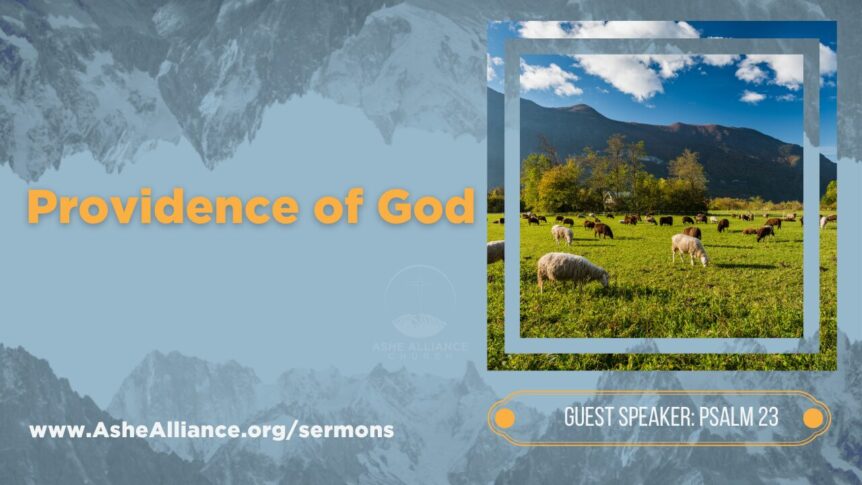
The sermon, Providence of God, reveals God’s purposeful guidance and care, allowing us to look back at His faithfulness (like protection from war or Ebola) and move forward with confidence. Psalm 23 illustrates this through three confessions: “I shall not want” (as the Shepherd provides), “I shall not fear” (as the Companion is with us even in darkness), and “I shall dwell” (as the Host welcomes us eternally). This journey assures us that God makes, leads, restores, is with us, prepares, and anoints, leading us to His house forever
Sermon Audio
Shareable Quote graphics
Sermon Text
Kendell Kauffeldt
Ashe Alliance Church
July 13, 2025
Providence of God:
Divine Providence refers to the purposeful guidance, care, and governance by the eternal God over all creation. It is rooted in the understanding that the Creator not only originates all things but also continually sustains and directs them toward His sovereign plan. This governance applies to both the grand tapestry of history and the individual details of daily life
Have you ever stopped and thought how faithful God has been to you.
As I think of my life here are few of the highlights where I see how awesome God has been
- We were kept us safe through a war, one night we sat in our house hall way listening to rockets land all around us. You protected me.
- You blessed me with a great wife and two amazing sons
- You protected my wife, family, friends and staff when we were overrun by Ebola.
- You led us to NC and blessed us with a great home, a great job and a great church.
If you we were to take some time I am sure you all can do the same
We look back to see God’s providence so that we can move forward with God’s confidence.
Providence is also a good reminder that God is God and were are not – “My thoughts are nothing like your thoughts,” says the LORD. “And my ways are far beyond anything you could imagine.” Isaiah 55:8
Considering the providence of God should humble us.
Psalm 23 Introduction:
- David wrotes this Psalm later in his life looking back, as it were, to his experiences and describes his guide, his Shepherd his lord. Just like we did earlier.
- “The Lord of Psalms 23 – David Gibson
Outline
- We will break up Psalm 23 into three sections with a confession for each section:
- The Sheep and the Shepherd (vs 1 – 3) – I SHALL NOT WANT
- The Traveler and the Companion (vs 4) – I SHALL NOT FEAR
- The Guest and the Host (vs 5-6) – I SHALL DWELL
Look what the Shepherd, Companion and Host does:
- He makes
- He leads
- He restores
- He is with me
- He prepares
- He anoints
What is it that you need today ?
He gives us everything we need because He himself is everything we need.
- The Sheep and the Shepherd
The Lord is my shepherd; I shall not want.
He makes me to lie down in green pastures.
He leads me besides still waters.
He restores my soul.
He leads me in paths of righteousness
For his name’s sake.
Psalm 23:1-3
Who the Shepherd Is
- This Shepherd is the LORD – YAHWEH
- I Am the Almighty God
- The Everlasting God
- The Living God – Joshua 3:10
- A Faithful God – Deuteronomy 7:9
- Jehovah Adonahy: God the Lord of the Lord God – Psalm 68:20
- Jehovah Elohim: The Lord God – Genesis 3:9
- Jehovah Elyon: The Lord Most High – Psalm8:17
- Jehovah Jireh: The Lord Will Provide – Genesis 22:8
- Jehovah-Mekaddishkem: The Lord Our Sanctifier -Leviticus 20:8
- Jehovah Nissi: The Lord My Banner – Exodus 17:15
- Jehovah-Rohi: The Lord My Shepherd – Psalm 23:1-6
- Jehovah Rophi: The Lord Who Heals You – Exodus 15:26
- Jehovah Sabaoth: The Lord of Hosts – 1 Samuel 1:3
- Jehovah-Shalom: The Lord of Our Peace – Judges 6:24
- Jehovah-Shammah: The Lord is There – Ezekiel 48:35
- Jehovah-Tsidkenu: The Lord Our Righteousness – Jeremiah 23:6
- This is who your Shepherd is!
- He is unchanging
- He is despite our life circumstances.
- Our shepherd – The Lord provides everything we need from his fullness and he is never the poorer for it.
- The Lord is MY Shepherd – note the present tense and the personal implication.
What the Shepherd Provides
- Another way to translate this is – “The Lord is my shepherd what more do I need?”
- So, what does the Shepherd provide:
- Food, green pastures, drink, still waters. rest, renewal, spiritual food, security,
- Still waters – depth, life, peaceful, cleansing, refreshing
- He makes mw to lie down in his provision. There is enough
- Sheep only lie down when they feel safe. Do you trust the shepherd enough to lie down?
- Out of this bounty: “he restores my soul”.
- Food, green pastures, drink, still waters. rest, renewal, spiritual food, security,
- Do you trust the Shepherd to provide for you today and going forward?
Where the Shepherd Leads
- Leads us into, through and by paths of righteousness
- Literally oxen cart ruts
- Leading us, through the inputted righteous of God to us to dwell with him forever (end of the Psalm)
- How do we know the paths the Shepherd is leading us in are good? For His name’s sake. God has staked his reputation on these being the right paths.
- Sheep benefit greatly from regular daily, weekly reminders that we are sheep and not the Shepherd.
- There is a relationship to how close we are following our Shepherds lead and the blessings we have described.
The Lord is my shepherd I lack nothing!
2, The Traveler and The Companion
Even though I walk through the valley of the shadow of death,
I will fear no evil,
For you are with me,
Your rod and your staff,
They comfort me.
Psalm 23:4
How the Companion leads
- The unexpected development in the story of Psalm 23 is that the good shepherd’s paths of righteousness sometimes include the valley of the shadow of death.
- If I find myself in the valley of deep darkness it is because he has led me there.
- The valley of the shadow of death, the days of deep darkness, do not mean we have left the paths of righteousness, in fact, they are where the shepherd’s paths of righteousness are sometimes located.
- For if God is not in charge of the valley, how do you know he can get you through it?
- THROUGH
- Your valley is not the destination but the journey.
- Story – Image of a Landcruiser going through mud, slow, methodical, relying on spiritual disciplines will help get you through. Allows the engine, gearbox and tires to do their job.
- Who walks through the valley? One that does not fear.
- How does one not fear – because of where the Shepherd is.
Where the Companion is
- Story – Dad going with me to lock the gate.
- In the Hebrew Psalm 23 is written out in 20 lines. Line 10, the exact midpoint of the Psalm, is the phrase “for you are with me”.
- The author wants to remind us to remember at the center of all that we go through “God is with us”.
- “I will fear no evil, for you are with me.” (v.4)
- The comfort is the presence of the shepherd in the midst of the danger rather than the comfort of the removal of the danger.
- The reason for not fearing resides in the who the shepherd is and where the shepherd is.
- He has moved from walking in front (vs. 1-3) to coming alongside (vs. 4).
What the Companion Holds.
- Our shepherd is a warrior, as shepherds had to be. No one can snatch hos sheep put of His hand (John 10:28)
- Rod
- It is the shepherd’s primary offensive weapon for protecting the flock from enemies, be they wild animals or human thieves. The instrument is about two and a half feet long with a mace like end into which the heavy pieces of iron are often embedded.
- The rod is symbolic of the power of God
- The rod was also used to part the wool of the sheep to see if there are sickness and diseases that are being covered over by the wool. Psalm 139:23-24 (another Psalm written by David, I wonder if he was remember the role of the rod) – “Search me O God and know my heart test me and know my anxious thoughts. See if there is any offensive way in me and lead me in the way everlasting. Is there sin keeping us from the Shepherd?
- Staff
- The mishenah or staff has the meaning of support.
- The staff was used to direct, to round up the sheep to pull them in. One instrument for defense – rod, the other for correction – staff.
- The shepherd’s staff is not for defending the flock from external threat, but for caring for the sheep as he leads them daily in search of food, drink, tranquility and rest.
- 2 X 4
- Oh, how I need Christ’s staff in my life to continually pull me back to him.
Conclusion
- Where has the Good Shepherd led you? Where are you at this point? What part of the Good Shepherd character does he want you to know about him in the place where you are right now.?
- The Guest and the Host
You prepare a table before me
In the presence of my enemies;
You anoint my head with oil;
My cup overflows.
Surely goodness and mercy shall follow me
All the days of my life.
And I shall dwell in the house of the Lord forever.
Verse 5-6
What the Host does
- You prepare a table for me.
- You – personal, you know the host – prepare a table before me
- He hosts us personally and we can know him personally.
- The word prepare refers to exactness of care and attention to detail – and these are always the marks of a very good host.
- Picture – to prepare a table was to make ready a feast. It was to do more that to give a loaf of bread to a weary pilgrim. It was to detain one as a guest and set before him the best of everything that could under the circumstances to be had.
- In traditional Middle East society the “master of the house provides the food, he does not prepare it. How astonishing is it then that in the Lord here provides and prepares the feast for you.
- In the presence of my enemies
- One thought is that shepherds would walk their sheep through valleys to take them to better feeding grounds and in this movement the sheep would be exposed to their enemies.
- Others think this language is similar to the story of David when he was on the run and he is literally fed by the soldiers what he is being hunted (2 Samuel 17)
- Our host; who has not only the bounty to feed me, but power to protect me; and, though surrounded by enemies, I sit down to this table with confidence, knowing that I shall feast in perfect security.”
- The host’s care and concern doesn’t eliminate the presence of my enemies but enables the experience of God’s goodness and bounty even in their midst.
How the Host welcomes us
- You anoint my head
- The word anoint here is not the same word anoint when kings or priests were anointed
- In David’s culture you would wash the guests feet and perfume their heads with oil.
- Notice the liberality of the host – the provisions are lavish and rich, not meager or minimal. Anointing is a gesture of hospitality, and it is generous, which is why “my cup overflows”
What are the Attributes of the Host
Surely goodness and mercy shall follow me all the days of my life.
- “Follow”
- At the very heart of the word is the meaning “pursue”.
- The word is so intensive, it is often used in combat scenes, where people are “pursued”
- Goodness and mercy pursue David; they do not merely follow him.
- Goodness
- Covenant goodness
- Psalms 119: – “You are good and do good.”
- Mercy
- Hesed – the word for God’s steadfast love.
- The relational nature of this term cannot be overemphasized.
These words are another way of saying that the Lord himself is pursuing us. They are His divine attributes.
- God doesn’t have goodness or love that he might dispatch them; he is goodness and love. God sends these attributes after us as a way of giving himself.
How long will the Host host
“I shall dwell in the house of the Lord forever” (vs. 6)
- Our shepherd-host; he comes to be with us (vs.4) so that we can go and be with him (vs, 6).
- In Psalm 23:6 David takes us from all our days of pressing onward with the shepherd in front of us and from all our days of looking back over his goodness and mercy behind us. We have been hemmed in safely all along the paths and in the valleys, but now he asserts with bold confidence that we are going to make it all the way to the shepherd’s home. And as we enter we will hear: “You’re with me now. You’re home. Welcome.”
Conclusion
- Do you know how God welcomes you?
- Do you know just how good the Lord Jesus is in his care for you, his guest?
- His welcome is second to none!
- The journey is long, so we need a shepherd; it is dangerous, so we need a companion; and it is wearisome, so we need a host. But the journey has always had an ultimate destination in mind; the restoration of return to the house of the Lord. A
Application – Providence of God in your Life
- He makes
- He leads
- He restores
- He is with me
- He prepares
- He anoints
Therefore :
I shall not want
I shall not fear
I shall dwell
FAQs
What is Divine Providence and how does it relate to our lives?
Divine Providence is the concept that God, as the Creator, not only originated all things but also continually sustains and directs them according to His sovereign plan. This guidance applies to both the broad sweep of history and the specific details of individual daily life. The source encourages reflection on personal experiences to recognize God’s faithfulness and guidance, reinforcing the idea that looking back to see God’s providence helps us move forward with confidence. It also humbles us, reminding us that God’s thoughts and ways are far beyond our comprehension (Isaiah 55:8).
How does Psalm 23 illustrate God’s character and care through the metaphor of a Shepherd?
Psalm 23, written by David looking back at his life, uses the metaphor of a Shepherd, Companion, and Host to describe God’s unwavering care. As the Shepherd, God provides everything His sheep need, leading them to green pastures and still waters, restoring their souls, and guiding them in paths of righteousness. This highlights God as “The Lord My Shepherd” (Jehovah-Rohi) who is unchanging and provides from His fullness. The “I shall not want” confession from the first section of the Psalm emphasizes the Shepherd’s comprehensive provision.
In what ways does the Shepherd provide for our needs, and what does it mean to “lie down” in His provision?
The Shepherd provides for all our needs, including “food, green pastures, drink, still waters, rest, renewal, spiritual food, security.” The phrase “He makes me to lie down in green pastures” signifies that God provides abundantly, and there is enough for us to rest securely. Sheep only lie down when they feel safe, which implies that trusting the Shepherd leads to a sense of peace and security in His provision. The question “The Lord is my shepherd what more do I need?” encapsulates the idea of His complete sufficiency.
How does the concept of God as a “Companion” address the challenges of life, particularly in the “valley of the shadow of death”?
As a Companion, God remains with us even through difficult times, symbolized by “the valley of the shadow of death.” The source clarifies that these challenging paths are not a sign of straying but are sometimes where the Shepherd’s paths of righteousness are located. The key takeaway is “I will fear no evil, for you are with me.” God’s presence provides comfort in the midst of danger, rather than removing the danger itself. The rod (for protection and examination) and staff (for direction and correction) represent God’s power and guidance, emphasizing His active role in leading and sustaining us through adversity. This leads to the confession “I shall not fear.”
What do the rod and staff of the Shepherd symbolize in Psalm 23?
The rod and staff are distinct yet complementary instruments of the Shepherd. The rod is primarily an offensive weapon for protecting the flock from enemies, symbolizing God’s power and protection. It was also used to part the wool to check for sickness, representing God’s search of our hearts (Psalm 139:23-24) for anything that might separate us from Him. The staff, on the other hand, is for support, direction, and correction. It is used to guide, round up, and pull the sheep back to the Shepherd, signifying Christ’s continuous work in drawing us back to Him.
How does God act as a “Host,” even in the presence of our enemies?
As a Host, God “prepares a table before me in the presence of my enemies.” This signifies a lavish feast prepared with “exactness of care and attention to detail,” demonstrating God’s personal and abundant hospitality. The profound aspect is that this feast occurs “in the presence of my enemies,” meaning God’s care and bounty are experienced even amidst threats and adversaries. It illustrates that God not only has the provision but also the power to protect, allowing His guests to feast in perfect security, regardless of external circumstances.
What attributes of God are highlighted by “goodness and mercy shall follow me”?
The phrase “Surely goodness and mercy shall follow me all the days of my life” highlights God’s inherent attributes. The word “follow” is intensely strong, akin to “pursue,” indicating that God’s goodness (His covenant goodness, as described in Psalm 119) and mercy (Hesed, His steadfast love) actively pursue us. The source emphasizes that God doesn’t merely dispatch these qualities; “he is goodness and love.” Therefore, when goodness and mercy pursue us, it is God Himself giving Himself to us, revealing His constant and relational nature.
What is the ultimate destination and promise conveyed in Psalm 23?
The ultimate destination conveyed in Psalm 23 is to “dwell in the house of the Lord forever.” This signifies a permanent return and abiding with God. The journey with the Shepherd, Companion, and Host leads to this final homecoming, where we are welcomed into God’s presence. It is the culmination of being guided, protected, and provided for throughout life’s journey, asserting with bold confidence that we will make it “all the way to the shepherd’s home,” ultimately being home with God. This leads to the final confession “I shall dwell.”