Highlight Reel
Sermon Summary
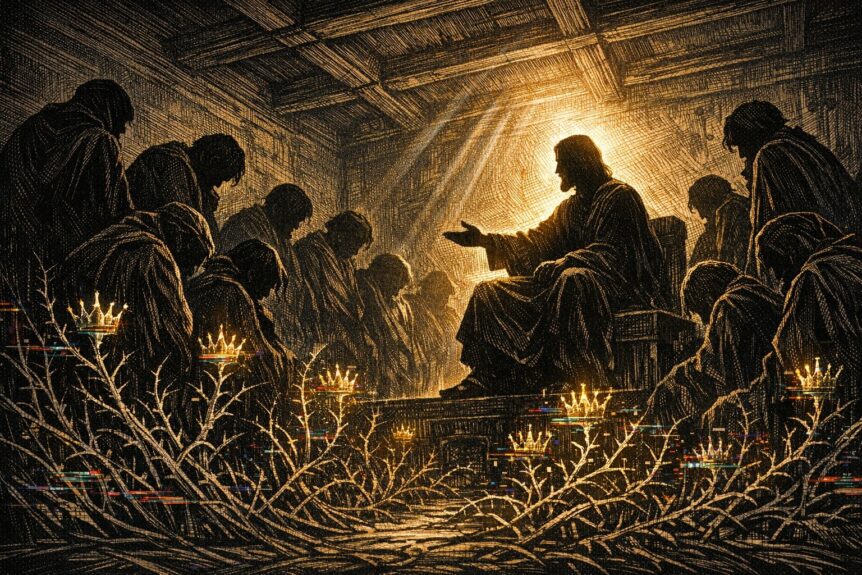
As Jesus prepares His disciples for His coming death, they argue about who is the greatest. Their silence and pride reveal how easily the human heart drifts toward status over surrender. Jesus responds by turning their understanding upside down: true greatness is not found in being first, but in becoming last, serving others, and welcoming the least. In doing so, we reflect Christ Himself, who humbled Himself to the point of death on a cross.
Sermon Audio
Shareable Quote graphics



Sermon Text
Greatness in the Kingdom
Nate Roten / Mark / Mark 9:30–37 / May 10, 2026
Main Idea
We all want significance, recognition, and prominence… but Jesus defines greatness through humility, sacrifice, and welcoming the overlooked.
Have you ever noticed how early the desire to be or have “the greatest” shows up in us? You don’t have to teach children to argue over trivial things, like:
- Who won?
- Who gets the bigger slice?
- Who gets more attention?
- Who gets to sit in the special seat?
- Who does Mom or Dad love more?
- Who matters most?
And honestly… we don’t really outgrow it. We just dress it up and make it look more respectable. As adults, it sounds more like:
- Who gets the bigger slice?
- Who got the new promotion or fancy title?
- Who gets recognized?
- Who has the bigger platform?
- Who gets listened to in the meeting?
- Whose kids perform the best?
- Who has the nicer house?
We live in a world obsessed with being noticed. And if we’re honest, there’s something inside all of us that wants to matter… wants to be important… wants to be seen.
That’s exactly where the disciples are in Mark 9.
Jesus is modeling His sacrificial nature: walking toward the cross, talking about betrayal, suffering, and death…
…and behind Him, the disciples are revealing their selfish nature: arguing about which one of them is the greatest.
However, before we judge them too harshly, we should recognize that they are exposing something that lives in every human heart.
Passage
Mark 9:30–37 CSB
30 Then they left that place and made their way through Galilee, but he did not want anyone to know it. 31 For he was teaching his disciples and telling them, “The Son of Man is going to be betrayed into the hands of men. They will kill him, and after he is killed, he will rise three days later.” 32 But they did not understand this statement, and they were afraid to ask him. 33 They came to Capernaum. When he was in the house, he asked them, “What were you arguing about on the way?” 34 But they were silent, because on the way they had been arguing with one another about who was the greatest. 35 Sitting down, he called the Twelve and said to them, “If anyone wants to be first, he must be last and servant of all.” 36 He took a child, had him stand among them, and taking him in his arms, he said to them, 37 “Whoever welcomes one little child such as this in my name welcomes me. And whoever welcomes me does not welcome me, but him who sent me.”
I – Second Death Prediction (vv. 30-32)
Private instruction — Jesus intentionally sought privacy—not for secrecy’s sake, but for intimacy. Like a master craftsman taking his apprentices into the workshop away from public distractions, He needed uninterrupted time to prepare them for what lay ahead. But notice the irony: while Jesus opens His heart about His coming sacrifice, the disciples close theirs in fear and confusion.
Patterns of Prediction – This is the second of three predictions about his death and resurrection.
• First prediction (8:31) – Son of Man > Suffer and Rejected > by elders, chief priests, and scribes > killed > rise after 3 days.
• Second prediction (9:31) – Son of Man > Betrayed > into the hands of men > killed > rise after 3 days.
• Third prediction (10:33—34) – Son of Man > Handed over and Condemned > by chief priests and scribes to the Gentiles > mock, spit, flog, and kill > rise after 3 days.
Each prediction adds detail, like a photograph coming into focus. But here’s the theological masterpiece hidden in verse 31: The Greek passive voice reveals that Jesus “is betrayed” or “handed over” (παραδίδοται)—not just by Judas, but ultimately by the Father Himself. This is divine sovereignty at work: wicked human hearts will do what they will, but they will never thwart God’s eternal plan. As Acts 2:23 declares, Jesus was “delivered up according to the definite plan and foreknowledge of God.”
The Disciple’s Fearful Response
Mark gives us the brutal truth: they didn’t understand, and they were afraid to ask. Luke adds a crucial detail in his parallel account:
Luke 9:43–45 CSB
43 And they were all astonished at the greatness of God. While everyone was amazed at all the things he was doing, he told his disciples, 44 “Let these words sink in: The Son of Man is about to be betrayed into the hands of men.” 45 But they did not understand this statement; it was concealed from them so that they could not grasp it, and they were afraid to ask him about it.
Luke’s record brings in some divine tension, doesn’t it? God concealed the truth from them, but we must understand that God conceals truth not to hide it forever, but to create holy curiosity. As Proverbs 25:2 says: “It is the glory of God to conceal things, but the glory of kings is to search things out.” Think of it like this: a parent teaches a child to ride a bike; they don’t explain every principle of physics and balance. They give instructions, let the child experience some wobbles, then provide more guidance. The temporary confusion creates dependence and deeper learning.
Jesus knew His earthly ministry was ending. The disciples needed to move from passive receivers to active seekers of truth. But silence and fear are like spiritual cancer—they don’t stay neutral, they always metastasize into pride and conflict.
The antidote to their fear? The very humility Jesus was about to demonstrate. But first, their pride had to be exposed.
II – Pride Fills the Silence (vv. 33-34)
The Last Lap – Capernaum—Jesus’ ministry headquarters, where He’d healed the paralytic, called Matthew, and taught in the synagogue. This was His final visit to the place where His public ministry flourished. From here, the path led straight to Jerusalem and the cross.
What breeds in the silence- Picture the scene: Jesus walks ahead, speaking of betrayal and death. Behind Him, His chosen disciples argue about greatness. Maybe Peter, James, and John had a bit of a chip on their shoulders because they got to experience the incredible event of Jesus’ transfiguration. Maybe they thought this special witness to this special event meant that they had a higher status than everybody else. Ultimately, it doesn’t matter who started the quibble. What matters is the selfishness that brews as they discuss among themselves who has superiority. The contrast is stunning. What they are doing is as helpful as debating seating arrangements while the captain announces the ship is sinking.
What caused this harmful shift in attitude? PRIDE. Pride always fills a vacuum. When we stop seeking truth, we start seeking status. Maybe the others resented being left out. But here’s the principle: Spiritual pride is like a weed—it grows fastest in the silence where truth should flourish.
Drawing out the contents of the heart –
Jesus doesn’t miss anything. He knows what is growing in their hearts, so He asks a diagnostic question to help them see it: “What were you arguing about on the way?”
And their answer to Jesus’ question was silence… again. Not a single one of them answered His question. And so we see this same repeated offense. When they’re confronted with something about themselves they don’t like, they don’t seek answers; they remain silent. And they allow the weeds to grow in their hearts. The antidote to their fear and pride is being selfless… being sacrificial for the benefit of others. But the problem is the disciples are acting in the opposite way. They’re being selfish. They are like teenagers gossiping and snickering who suddenly fall silent and stare at the floor when mom walks in. But notice the pattern: Fear of truth → Silence → Pride → Deeper silence. It’s a downward spiral that every believer must break.
Jesus question wasn’t asked to embarrass or shame them. He was doing two things:
First, He was performing heart surgery, as He did in last week’s story. Pride was causing the disciples to play “King of the Hill” while Jesus modeled “Servant of All,” and they were blind to it. Their prideful attitudes have to be drawn out so they can be weeded out. Pride must be exposed before it can be healed.
Second, He is not only preparing the disciples for His rejection and death… He is teaching them the true nature of the Messiah and His kingdom. They still imagine greatness the way the world does: power, prominence, authority, and recognition. Like many in first-century Judaism, they envision a victorious ruler who will overthrow Rome, and they want positions of honor beside Him. But they still do not understand that true greatness in God’s kingdom is sacrificial rather than self-seeking. Ironically, even the men personally chosen by Jesus are still fighting for status the same way we do today.
Before we judge the disciples too harshly, let’s pause. Pride is like carbon monoxide—odorless, colorless, and deadly. It rarely announces itself with a shout; it whispers through our reactions, our need for recognition, our subtle competitions.
James tells us that God opposes the proud, and Proverbs reminds us that pride always leads to disgrace. So if we want to avoid becoming like the disciples here—arguing over status, recognition, and importance—we need to ask ourselves some uncomfortable questions.
Maybe sometime this week, sit quietly before the Lord and ask yourself:
• Do I get discouraged or irritated when my efforts go unnoticed?
• Do I secretly want to be seen as more important than others in the room?
• Am I quick to take credit but slow to give it away?
• Do titles, recognition, or positions make me feel more valuable?
• Is my sense of worth tied to how many people know, affirm, or admire me?
• Do I subtly try to impress people by mentioning who I know or what I’ve done?
• Do I always feel the need to speak, correct, or prove that I’m knowledgeable?
And maybe the biggest question of all is this: “Am I more concerned with being recognized… or being faithful?” Because pride constantly asks: “How can I rise above others?” But Jesus is about to teach that greatness in the kingdom asks: “How can I lower myself for others?”
And that is the concept He will drive home next.
III – True Greatness Welcomes the Least (vv. 35-37)
The Teacher’s Posture – In the house—probably Peter’s home—Jesus assumed the formal teaching position. When rabbis sat, students knew to listen carefully. But this lesson would dismantle the foundation they thought they knew about leadership.
The Great Reversal – After calling the disciples over to where he was, he said an incredibly countercultural statement. He said, “If anyone wants to be first, he must be last and servant of all.”
We have to remember that before Jesus taught this idea, it was not a concept taught by the spiritual leadership. In both Roman and Jewish culture, leadership meant privilege, position, and power. Leaders commanded; servants obeyed. Leaders received honor; servants gave it. But Jesus introduced an entirely new paradigm: In God’s kingdom, the greatest leaders are the greatest servants. The word “servant” (διάκονος) referred to a table waiter—someone who exists to meet others’ needs, not their own.
Then Jesus did something shocking—He drew a child into the center of their circle. In first-century culture, children were like servants: necessary but not noteworthy, present but not prominent. They had no social capital, no network to offer, and no ability to return favors. They were powerless, dependent, and often overlooked.
The world’s leadership ladder has rungs marked by power, privilege, and position. But Jesus flips the ladder upside down. In His kingdom, every step up requires going down, every promotion demands demotion, and every advancement requires advancement of others.
Then Jesus delivers the stunning climax: “Whoever welcomes one little child such as this in my name welcomes me. And whoever welcomes me does not welcome me, but him who sent me.”
So what Jesus is saying is that if you want to be a leader in God’s kingdom, you must be selfless, which means you must humble yourself and welcome the lowly, the ones without social standing, the outcast, the very ones that Jesus embraces. And when you have that attitude, not only are you welcoming the real Jesus, but you are also welcoming His Father.
The word: welcome, means to accept… to be receptive of someone… to receive someone into your heart, your home.
Here’s the connection: When we cling to pride and resist correction, we cannot welcome the lowly—because pride always looks down on others. But when we embrace humility, we see others as Jesus sees them. We welcome the child and the type of people they represent: the outcast, the marginalized, the powerless —and in doing so, Jesus says we welcome Him. Think about it: Jesus could have chosen any object lesson—a crown, a sword, a throne. But He chose a child. Why? Because children also naturally embody what kingdom citizens must become: dependent, trusting, humble, and willing to receive love they cannot earn or repay.
If we are willing to humble ourselves and consider even the lowliest among us more important than ourselves, we’ll be able to welcome the character and attributes of God’s Kingdom that Jesus embodied and modeled. In that way, we can also be welcoming of Him, Jesus Christ, the person He seeks to reveal to His disciples, not their misinterpretation of who He is. And the character of Christ is the same as His Father’s.
So when you embrace the attributes of humility and sacrificial living, you embrace the heart and character of the entire Trinity, because here’s the New Covenant wonder: Every believer carries the Spirit of God. When we welcome fellow believers—especially the seemingly insignificant ones—we’re welcoming the very presence of God within them… and as we turn from selfishness to selflessness, we will be come more like Christ. As Paul writes:
Philippians 2:3–11:
3 Do nothing out of selfish ambition or conceit, but in humility consider others as more important than yourselves. 4 Everyone should look not to his own interests, but rather to the interests of others. 5 Adopt the same attitude as that of Christ Jesus, 6 who, existing in the form of God, did not consider equality with God as something to be exploited. 7 Instead he emptied himself by assuming the form of a servant, taking on the likeness of humanity. And when he had come as a man, 8 he humbled himself by becoming obedient to the point of death— even to death on a cross. 9 For this reason God highly exalted him and gave him the name that is above every name, 10 so that at the name of Jesus every knee will bow— in heaven and on earth and under the earth— 11 and every tongue will confess that Jesus Christ is Lord, to the glory of God the Father.
🔥 Application: Humility and Sacrifice
At the heart of this passage is a question every disciple must answer:
“What kind of greatness am I really pursuing?”
Because Jesus and the disciples are moving in two completely different directions. Jesus is walking toward rejection, sacrifice, and the cross. The disciples are arguing about status, prominence, and recognition.
And if we are honest, we are often far more like the disciples than we want to admit.
We all want to be noticed.
We want affirmation.
We want importance.
We want people to recognize our value, our effort, our contribution.
But Jesus says:
“If anyone wants to be first, he must be last and servant of all.”
That is not just a command—it is a description of Jesus Himself.
Philippians 2 shows us that true greatness is not found in exalting yourself, but in emptying yourself. Jesus had all glory, all authority, all power—and yet He willingly humbled Himself. He stepped down from heaven, took the form of a servant, embraced weakness, welcomed the lowly, and ultimately gave His life on a cross.
That is what real discipleship looks like.
Real disciples are not marked by self-promotion or by demanding recognition.
Real disciples are marked by humble sacrificial living.
When you look in the mirror, is that who you see?
FAQs
1. Why didn’t the disciples understand Jesus’ teaching about His death?
Their expectations of a conquering Messiah clashed with the reality of a suffering Savior. God, in His wisdom, also allowed a level of concealment that would later deepen their understanding.
2. Is it wrong to want to be great?
Not necessarily—but it depends on how you define greatness. Jesus redirects that desire toward humility, service, and faithfulness rather than recognition.
3. What does it mean to be “servant of all”?
It means adopting a posture of self-denial and actively seeking the good of others, especially when there is no benefit or recognition in return.
4. Why does Jesus use a child as an example?
In that culture, children had no status or influence. Jesus uses a child to show that true greatness is seen in how we treat those who cannot repay us.
5. How does pride show up in everyday life?
It often appears subtly—in comparison, the need for recognition, irritation when overlooked, or the desire to prove ourselves right or important.
6. How do we fight pride biblically?
By pursuing truth, confessing sin, meditating on Christ’s humility, and actively serving others in unseen ways.
7. What does welcoming others have to do with welcoming Christ?
Jesus identifies Himself with the lowly. To receive and love those the world overlooks is to receive Him and reflect the heart of God.
8. Doesn’t this teaching discourage leadership or ambition?
No—it redefines leadership. In God’s kingdom, the greatest leaders are those who serve most faithfully and sacrificially.