Highlight Reel
Sermon Summary
Mark 1:1–8 calls Christians to embrace their role as gospel witnesses, echoing prophetic voices and John the Baptist’s wilderness cry to prepare the way for Jesus, the true Son of God. Contrary to Rome’s false claims, this gospel promises repentance, forgiveness, and a Spirit-filled new life, inviting believers to respond with faith and boldly proclaim the kingdom that surpasses all earthly reigns.
Sermon Audio
Shareable Quote graphics

Sermon Text
Prepare the Way
Nate Roten / Mark / Mark 1:1–8
Main Idea
You are not just a reader of the gospel—you are a witness to it.
Mark’s gospel was probably written in Rome for a Roman audience. Therefore, it helps to interpret his gospel from a Roman perspective whenever possible.
In 9 B.C., the cities of the Roman province of Asia gathered to honor their emperor, Caesar Augustus. Their tribute was carved into a large stone tablet—nearly three feet wide, inscribed with over 80 lines of Greek text—so it could be read and remembered for generations. Known today as the Priene Inscription, it was a formal declaration from the provincial assembly that even changed the calendar so the New Year began on Augustus’ birthday. The language was grand, depicting him not just as a ruler but as divine. At the heart of the inscription is this remarkable line: “The birthday of the god Augustus was the beginning of the good news [euangelion] for the world that came by reason of him.”
In the Roman world, a gospel—an euangelion—wasn’t necessarily a religious term, but an official announcement proclaiming the arrival or victory of a ruler, meant to be publicly shared and celebrated. Citizens saw it as the announcement of a new era, a message designed to shape their loyalty and hope. This is the cultural backdrop into which Mark writes.
It’s also worth re-emphasizing the importance of credible witnesses. The Old Testament required that a testimony (or declaration) be confirmed by the accounts of 2-3 witnesses. We discussed last week how the four gospel accounts serve as credible eyewitness testimonies. Today, we will revisit three eyewitness accounts of the coming of the Messiah so that, once the declaration is given and the eyewitnesses have spoken, we can proceed through the rest of the gospel account with confidence.
Let’s begin the scriptural reading today with this context in mind.
Passage
Mark 1:1–8 CSB
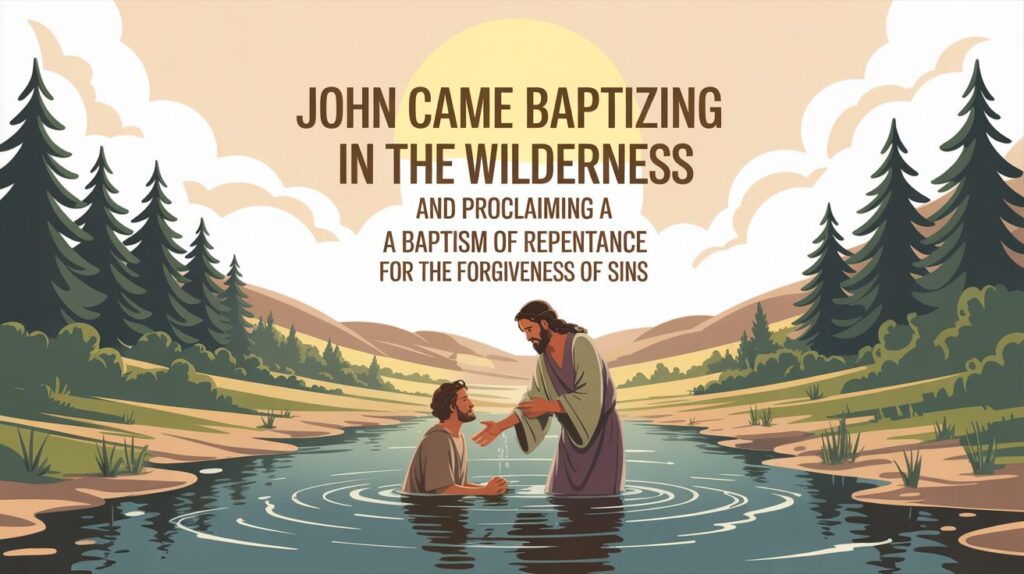
1 The beginning of the gospel of Jesus Christ, the Son of God. 2 As it is written in Isaiah the prophet: See, I am sending my messenger ahead of you; he will prepare your way. 3 A voice of one crying out in the wilderness: Prepare the way for the Lord; make his paths straight! 4 John came baptizing in the wilderness and proclaiming a baptism of repentance for the forgiveness of sins. 5 The whole Judean countryside and all the people of Jerusalem were going out to him, and they were baptized by him in the Jordan River, confessing their sins. 6 John wore a camel-hair garment with a leather belt around his waist and ate locusts and wild honey. 7 He proclaimed, “One who is more powerful than I am is coming after me. I am not worthy to stoop down and untie the strap of his sandals. 8 I baptize you with water, but he will baptize you with the Holy Spirit.”
I – Eyewitness #1: Mark
His opening words—“The beginning of the gospel of Jesus Christ, the Son of God”— seem to deliberately echo the political language of the empire. Yet Mark’s proclamation stands in bold contrast: the true good news is not about Caesar’s reign or Rome’s peace, but about Jesus—the rightful King—who’s coming brings not a temporary stability but eternal reconciliation and peace with God.
The beginning. Reminiscent of Gen. 1:1. In the beginning, God created the heavens and the earth. He is just as much the author of the world as He is the author of salvation.
Of the gospel. The entirety of Mark’s account heralds good news that the whole nation should embrace and live by. If it is true that Mark is intentionally using the language of his time to make a public declaration, then the person he is heralding is meant to be put on the same level as Caesar himself, or more accurately, to be the focal point instead of Caesar, and his name is…
Of Jesus Christ. Jesus was a common name. Christ, on the other hand, was not a common title. Pairing both fully identifies the Jesus of Nazareth as the Messiah, or ‘Anointed One,’ who would bring a prophesied kingdom with Him. The Caesars may have instituted the Pax Romana, thus being heralded as a savior-type figure, but they were not a fulfillment of THE Messiah of the Jewish scriptures.
The Son of God. After Julius Caesar’s assassination in 44 BC, the Roman Senate officially deified him as Divus Iulius (“the divine Julius”) in 42 BC. In response, Octavian (later Emperor Augustus) took the title Divi filius (“son of the divine one” or “son of a god”) as a major part of his public identity. He even stamped it on coins and titles to strengthen his divine connection. This title helped Augustus show himself not just as Caesar’s heir, but as the chosen, divine successor—giving him strong political and religious legitimacy.
The opening line both establishes who Jesus is and de-thrones Caesar as Lord and Savior.
II – Eyewitness #2: The OT Prophets
Isaiah is credited with his own writing, as well as Malachi 3:1, probably because Isaiah is the most prominent prophet. Both quotations mention a messenger sent ahead of the King to make the pathway straight. Isaiah is the first major prophet to have a book named after him and to prophesy about the coming Messiah. Malachi, although not the last book in the Old Testament as it is in our Bibles, was the final prophet to speak God-breathed scripture before Jesus’ birth. Since Mark combines the voices of both prophets, he essentially creates a single, powerful eyewitness that reflects the collective prophetic message about the coming Messiah, which all falls under the category of ‘good news.’ And with any proclamation of good news, two things need to happen.
1. A messenger to prepare the way. In history, people were sent ahead to literally smooth the pathway by removing large rocks and filling in ruts, ensuring the path for the King was level and free of obstructions.
2. A voice in the wilderness crying out to prepare the way of the Lord. The prophets were also messengers pointing to this future King, though they did not yet know His identity. They were heralds spanning across vast periods of time, yet no less authoritative and confident. While part of their role was to prepare the actual road for the King’s arrival, they were also entrusted with the privilege of preparing the people to receive their King.
III – Eyewitness #3: John the Baptist
Final OT Prophet. We all know John as Jesus’ cousin and ‘the Baptizer,’ but have you ever stopped to think of him as the last Old Testament Prophet— in the lineage of Isaiah and Malachi? That’s how Mark presents him. He may not have a book named after him, but he is no less a prophet who, like Isaiah, has the privilege of preparing the way of the Lord. Not only that, but John is the fulfillment of Isaiah’s prophecy! And unlike his contemporaries, he didn’t have to prophesy about a veiled figure… he got to point directly to the Messiah in the flesh! He knew His name!
400 years of prophetic silence. Imagine how exciting it would have been for the people of Israel to hear from a prophet speaking on God’s behalf after 400 years of silence… at least in terms of God-breathed scripture. After all that time, imagine being told the promised Messiah has finally arrived. No wonder people traveled into the wilderness from Jerusalem and the entire Judean countryside! Who wouldn’t want to meet a true prophet claiming that the wait for their anointed Savior was finally over?
Elijah. The descriptions of John the Baptist are also important. Mark tells us that John wore a tunic made of camel’s hair, a leather belt, and had a diet that consisted of locusts and honey. Why does Mark include this kind of detail?
1. Wilderness travel. John was clearly not mainstream. He didn’t wear the robes of a Pharisee or have the food provisions of a prominent leader. In today’s terms, he wouldn’t be on stage dressed in a custom-tailored suit or $1,000 sneakers. He wore simple, poor man’s clothing. Camel hair was stiff and scratchy—the kind of clothing associated with the poor. His diet reflected the same simplicity. His outward appearance showed a detachment from worldly comforts and even resembled an Israelite wandering in the wilderness during the time of the exodus.
2. Elijah. His appearance also serves as a link to a prophet who came before Isaiah, named Elijah. Elijah wore a similar garment made of hair and a leather belt, and his role was to guide Israel away from their idolatry and back to faithful repentance toward Yahweh. John would be the new Elijah, as an angel confirmed to his father, Zechariah.
Luke 1:8–17 CSB
8 When his division was on duty and he was serving as priest before God, 9 it happened that he was chosen by lot, according to the custom of the priesthood, to enter the sanctuary of the Lord and burn incense. 10 At the hour of incense the whole assembly of the people was praying outside. 11 An angel of the Lord appeared to him, standing to the right of the altar of incense. 12 When Zechariah saw him, he was terrified and overcome with fear. 13 But the angel said to him, “Do not be afraid, Zechariah, because your prayer has been heard. Your wife Elizabeth will bear you a son, and you will name him John. 14 There will be joy and delight for you, and many will rejoice at his birth. 15 For he will be great in the sight of the Lord and will never drink wine or beer. He will be filled with the Holy Spirit while still in his mother’s womb. 16 He will turn many of the children of Israel to the Lord their God. 17 And he will go before him in the spirit and power of Elijah, to turn the hearts of fathers to their children, and the disobedient to the understanding of the righteous, to make ready for the Lord a prepared people.”
IV – Prepare the Way
John the Baptist was the messenger who prepared the way for Jesus. He was to make the way level and to declare the King’s coming.
1. Preparing the way to Jesus is through a baptism of repentance and confession of sin.
What is fascinating about this is that the act of baptism wasn’t a common ritual or sacrament for the Jews. Have you ever thought about that? There was a similar process for Gentiles who wanted to convert, and there were washing basins called Mikvahs that a person could use to become ritually clean, but these were still very different from what John was doing in the Jordan River. They wouldn’t have needed dunking like a Gentile because they were already Jews. A Mikvah was used if they needed to be cleansed externally according to the Mosaic Law, and they could do that themselves.
John’s baptism was for both Jews and Gentiles who needed to confess and repent of their sins and be dunked in water as a symbol of that internal, moral cleansing. The call to repentance is as old as sin itself, but the demonstration of that moral cleansing through water baptism was entirely new. This wasn’t just a ritualistic cleansing that satisfied Old Testament law. Later, Jesus himself would rebuke the Pharisees for washing the outside of the bowl while the inside remained dirty and defiled. No, this was John’s way of preparing their hearts and minds to meet the King through a new process that would point to an initiator of a New Covenant, which would forever remove their guilt and make them clean.
2. Declare His coming
John does this by humbling himself and exalting Jesus. Despite his ability to draw crowds of thousands (perhaps even hundreds of thousands) and call for people to repent of their sins, he still considered himself unworthy to perform even the most basic duty of a servant, which was to untie and remove the sandals of a guest.
Before Jesus enters the scene, John wants to clearly convey one truth to their softened minds and hearts: while he was baptizing them outwardly as a sign of repentance from their sins, it only pointed to a greater reality—that the Messiah, the Anointed One, would baptize them inwardly with the Holy Spirit. In the Old Testament, the Spirit was given to individuals to empower them for specific missions and could only come from God Himself. Yet, the long-awaited Messiah would do what only God can do—and He would do it for all who come to Him in repentant faith. The physical act of being fully immersed in water symbolized the greater reality of being fully immersed in the Spirit, in full communion, and in the power of the Most High God, whom, as the prophet Joel announced, “would pour out His Spirit on all people” (Joel 2:28-29), not just a select few.
Fulfillment of an OT Story
The story of Israel is not just about escaping from Egypt—it’s about inheritance. For forty years, they wandered in the wilderness, not simply as punishment for unbelief but as preparation for promise. Moses led them through that desert—a place of testing, longing, and refining. When the time was right, it was Joshua who led them across the Jordan River, out of the wilderness, into the land that God had promised to Abraham. That moment—the crossing of the Jordan—was more than just a geographic event. It was symbolic. It marked the end of wandering and the start of receiving. The end of fear, the start of faith. They were no longer orphans, no longer slaves—they were heirs.
Now, fast forward to another wilderness. Mark’s Gospel doesn’t open with a manger, or a genealogy—it begins in the desert. John the Baptist, dressed like Elijah, stands not in Jerusalem but in the wilderness, by the Jordan River. The same place where Israel once crossed into promise. And he cries out, “Prepare the way for the Lord!”
Then Jesus comes. Not just any man—but Yeshua. The Hebrew name for Joshua. And what does He do? He steps into the Jordan River.
Do you see it?
This is not coincidental geography. This is divine choreography.
Just as Joshua once led Israel through the waters into their inheritance, Jesus—the greater Joshua—steps into those same waters, not to cross into Canaan, but to open the way to an eternal Kingdom. Not a plot of land, but a promised inheritance that would be secured in His blood. A better inheritance—salvation, sonship, Spirit-filled life.
Repentance of sin that leads to new life in Jesus the Messiah. This is the beginning of the good news of that Messiah.
Application Point:
1. Live as a witness.
Mark, the prophets, and John all pointed boldly to Jesus. You have the same mission: humbly declare Christ with your life and your words.
Your life confirms the gospel’s truth or obscures it. When people see the way you live your life, what do they see? When they hear you speak, what do they learn?
➤ Challenge: Who in your life needs to hear the good news through your voice this week?
FAQs
1. Why does Mark’s gospel open with a political-sounding declaration about the gospel of Jesus Christ?
Mark’s opening deliberately echoes the Roman political language of an emperor’s “good news” (euangelion) to highlight a stark contrast: the true gospel is not about Caesar but about Jesus, the rightful King whose coming brings eternal reconciliation and peace with God, dethroning Caesar from his false divine status. This also connects Jesus to the creation theme (“In the beginning”), showing God as author of salvation as well as creation.
2. What is the significance of John the Baptist’s role as a messenger preparing the way?
John the Baptist functions as the final Old Testament prophet, the appointed messenger tasked with “making the way straight” for the Messiah by calling for repentance and baptism. His wilderness lifestyle and attire link him to Elijah, affirming his prophetic authority. He bridges the prophetic tradition with the arrival of Jesus, preparing people’s hearts to receive the King directly.
3. How does the practice of baptism by John differ from Jewish ritual washings?
John’s baptism was a public call to repentance and confession of sins, distinct from Jewish ritual baths (Mikvah) that cleansed external impurities. His baptism symbolized an inward, moral cleansing and pointed to the coming Messiah who would baptize with the Holy Spirit, inaugurating a New Covenant cleansing far beyond external ritual.
4. Why is it important that the gospel is supported by eyewitness testimony, especially in the context of the Roman audience?
The Old Testament required two or three witnesses to establish a testimony. Mark emphasizes eyewitness accounts (himself as the narrator, Old Testament prophetic witnesses, and John the Baptist) to provide credible, authoritative confirmation of Jesus as the Messiah. This was important for the Roman audience to trust the gospel’s authenticity as a public declaration, countering imperial claims on truth.
5. What does it mean that Jesus is called “the Son of God” in a Roman context?
Romans understood “Son of God” as a divine title connected to the deified Julius Caesar and Emperor Augustus who claimed divine sonship. Mark’s gospel uses this title to identify Jesus not merely as a messianic figure but as the true divine Son, thereby dethroning Roman imperial claims and affirming Jesus’ unique divine authority and kingship.
6. How does the image of Jesus stepping into the Jordan River connect to Israel’s history?
Jesus’ baptism in the Jordan symbolically parallels Joshua leading Israel across the Jordan into the promised land. This divine choreography signals Jesus as the greater Joshua, not just leading people to land, but opening the way to eternal inheritance—salvation and sonship in God’s kingdom.
7. What is the practical implication of being a “witness” to the gospel as the sermon suggests?
Believers are called to actively and humbly declare Christ through both words and lifestyle. Our conduct either confirms or obscures the gospel’s truth. Like Mark, the prophets, and John, Christians bear the responsibility to live as credible, loving witnesses who point others to Jesus, making the gospel message known to those around them.
8. Why does John humble himself by saying he is unworthy even to untie Jesus’ sandals?
John’s humility highlights the superiority of Jesus and points to his role only as a precursor, not the Messiah himself. Baptizing with water is symbolic and limited; Jesus will baptize with the Holy Spirit, bringing a new, transformative work beyond John’s baptism. It’s both a testimony to Jesus’ exalted status and an invitation to receive the fuller work of the Spirit.