Sermon Summary
To accomplish the mission God gave us, we must understand the true purpose of the church—and our personal place in it: making and multiplying disciples under the authority and presence of Jesus.
Sermon by Elder Jordan Newman
Introduction
Three weeks ago, Pastor Nate started this series of teaching by giving us the mission and purpose of the Church and believers. The mission given in Matthew 28:18-20
“And Jesus came and said to them, “All authority in heaven and on earth has been given to me. Go therefore and make disciples of all nations, baptizing them in the name of the Father and of the Son and of the Holy Spirit, teaching them to observe all that I have commanded you. And behold, I am with you always, to the end of the age.”
This is what we have mirrored in the mission for us specifically in this local body of believers at Ashe Alliance Church. “Ashe Alliance Church makes and multiplies fully-formed disciples of every generation, from Ashe County to the nations.”
If you also remember Pastor Nate identified five steps in a series that reflects the effects of a high-impact church. They are:
1. The Lost come to Christ
2. The Found get connected into the life of the church
3. Those who are connected mature in their faith
4. Those who are maturing discover their God-given gifts to serve
5. Those who are maturing and serving naturally multiply other disciples.
In this process new believers repent of their sins and place their faith in Jesus who paid the penalty for their sins and they are Connected with Christ
Then they are joined to a local body of Christ and Belong with that Church. Then begins the cycle of Maturing, and Ministering, which then leads to them naturally Multiplying.
Elder Dan two weeks ago did a great job of showing us that Maturing and becoming like Christ takes the work of the Holy spirit and our commitment and effort. He highlighted the importance of this commitment to growing together through intentional discipleship.
Last week Kendall challenged us to get off of the bench and into Ministering in the church. He showed us that as we Mature we should discover the ways that God has gifted us for the benefit of the church and our mission of making disciples, and then faithfully put those gifts to good use for that mission.
So, the next natural place for us to go from here would be…
Belonging
There are main three reasons that I chose to go back and cover this part of the process
One is that if we are Maturing and Ministering then we will naturally Multiply.
Two, if we do not understand what it means to Belong to the body of Christ then as we multiply we will not multiply well
Third, this is an area that is particularly meaningful to me. Once I understood my relationship to the local church and adjusted my life to align with that God began to grow me in ways that I did not imagine. More about that and my story later.
What is so important about belonging? First and foremost, it is a command you are called to gather have to gather with believers regularly in scripture 10:23-25 Says:
“Let us hold fast the confession of our hope without wavering, for he who promised is faithful. And let us consider how to stir up one another to love and good works, not neglecting to meet together, as is the habit of some, but encouraging one another, and all the more as you see the Day drawing near.”
And earlier in Hebrews 3:13
“But exhort one another every day, as long as it is called “today,” that none of you may be hardened by the deceitfulness of sin”
We see this pattern in early Acts and throughout the new testament and old, God’s people are called to come together and worship him.
But do I need to belong to a local body? I am a Christian and I belong to catholic “meaning universal church” not the Roman Catholic church. We will go into more detail soon but the short answer is you cannot be an obedient follower of Jesus or even work at the mission of the Church without being a part of a local body of believers.
What does Belonging look like? What are some of the things that come from belonging?
Obedience we have briefly covered. If you have been through a Discover Event you have heard this before and it comes from the section on our value of intentional discipleship. In the new testament there are over forty “one another” commands that are addressed to the church. An abbreviated list includes welcome one another, be subject to one another, forbear one another, forgive one another, confess sin to one another, pray for one another, serve one another, encourage one another, comfort one another, bear one another’s burdens, stir up one another and the list goes on and on.
This is what a life of belonging looks like. It would be impossible to obey any of those commands if you isolate yourself. If you approach church with a consumeristic attitude you rob not only others but even yourself of this type of fullness that can had for those becoming like Christ Jesus
Submission and Shepherding
Ephesians 5:21 says before the passage on wives and husbands calls the church to walk in love
“submitting to one another out of reverence for Christ.”
Hebrews 13:17-18
“Obey your leaders and submit to them, for they are keeping watch over your souls, as those who will have to give an account. Let them do this with joy and not with groaning, for that would be of no
advantage to you. Pray for us, for we are sure that we have a clear conscience, desiring to act honorably in all things.”
Who am I supposed to submit to then? Am I supposed to submit to every other Christian on earth? Who is a spiritual authority and shepherd over me responsible for my soul? Is it the head of the Southern Baptist Convention, John Piper, Franklin Graham, Joel Osteen? The other side of that question needs to be answered as well. As under shepherds accountable to God we will have to answer to our Good Shepherd for how we cared for his flock, who are we answering for, all of Christendom? No, I believe that our responsibility for submission and for leadership extends to our local body of believers.
Accountability/Affirmation Part of submitting to one another means being accountable to one another for our growth and our continued meeting together. If I am part of a local body and begin to fall away someone should notice and come after me to find why I am missing. We can exhort and encourage one another as we walk with Jesus and we can stir one another up to good works. Additionally, James 2:17 tells us that “So also faith by itself, if it does not have works, is dead.” Good works and Christlikeness are the evidence that we have been saved and transformed. Just as our baptism was an outward sign of our faith in Christ, confirmed by the church our faith continues to be affirmed by our brothers and sisters as they are witnesses to us following and growing in Christ.
Church Discipline and the Out
One of the roles that have been given to the body of Christ in the same vein as accountability and affirmation and that is Church discipline. In 1 Corinthians 5 Paul tells the Corinthian church that they are not to judge world but to judge the immorality within the Church and that a man who has taken his father’s wife should be put out of the assembly
Jesus shows us how in Matthew 18 how we are to correct a brother when he lays out the model for discipline of those claiming to be his followers.
“If your brother sins against you, go and tell him his fault, between you and him alone. If he listens to you, you have gained your brother. But if he does not listen, take one or two others along with you, that every charge may be established by the evidence of two or three witnesses. If he refuses to listen to them, tell it to the church. And if he refuses to listen even to the church, let him be to you as a Gentile and a tax collector. Truly, I say to you, whatever you bind on earth shall be bound in heaven, and whatever you loose on earth shall be loosed in heaven. Again I say to you, if two of you agree on earth about anything they ask, it will be done for them by my Father in heaven. For where two or three are gathered in my name, there am I among them.”
We see that we are to go in private, then with witnesses, then before the church. Then if still unrepentant they are to be removed and treated as the worst of sinners. By their unrepentance they have given us cause to believe that they are not truly redeemed and followers of Christ, meaning they should not be in the privileged place of communion with those who do follow Jesus. For someone who really is a disciple this should so shock their system that they repent of their sin and turn back towards Christ. The goal of this process is repentance, forgiveness, and then restoration. Jesus’ disciples are given the keys to the kingdom and Jesus says “whatever you bind on earth shall be bound in heaven, and whatever you loose on earth shall be loosed in heaven.”
If we are to remove those from among us who claim to be followers of Christ but whose worldly lives are marked by persistent unrepentant sin it implies that there is an “in” or assembly or body or belonging that they are to be removed from.
I understand that this can be a difficult concept for us. Most of us have grown up in a culture that values individualism and consumerism. If we look back at Romans 12 that Pastor Nate, Dan, and Kendell have been referencing these last several weeks in verse 1-2 it says
“I appeal to you therefore, brothers, by the mercies of God, to present your bodies as a living sacrifice, holy and acceptable to God, which is your spiritual worship. Do not be conformed to this world, but be transformed by the renewal of your mind, that by testing you may discern what is the will of God, what is good and acceptable and perfect.”
Part of the renewing of our mind is holding up what is in our mind and comparing it with the truth of God’s word and see how they match up. We are then presented with two options: we can throw out the parts of ourselves that are conformed to this world or we can throw out God’s word. This is not to say that all of our culture is bad, I am grateful for where I was born and the freedom, safety, and general peace that this country has afforded me and my family. But our culture, just like every other part of life, has been corrupted by sin and needs to be brought under the Lordship of Jesus Christ just like our emotions, our minds, our finances, and our free time. Belonging requires openness, and vulnerability as we trust in and submit to God’s plan for our lives which is to conform us to the image of Christ.
An Officer of the Church.
Part of Belonging means that you have been given responsibilities in the church not by man but by your master Jesus. Being a part of a church is to take on the role of an officer. The office of Elder is given responsibility to shepherd the church in teaching and spiritual matters. The office of Deacon is to serve the body of Christ in physical needs. The office of a church member is given many duties no less important and integral to the function of the body than that of an Elder or Deacon. We have mentioned several of those responsibilities already. The members have a responsibility to see that the church reflects Jesus Christ, the integrity of the gospel is protected, and to aid, affirm, or discipline those that are in the body. There are four elders in this church and 100-120 people who regularly attend this church. There is no way that we can personally intentionally disciple all of you. Part of the duties of your office as one that belongs to the body is to disciple one another, urging each other toward Christlikeness and good works.
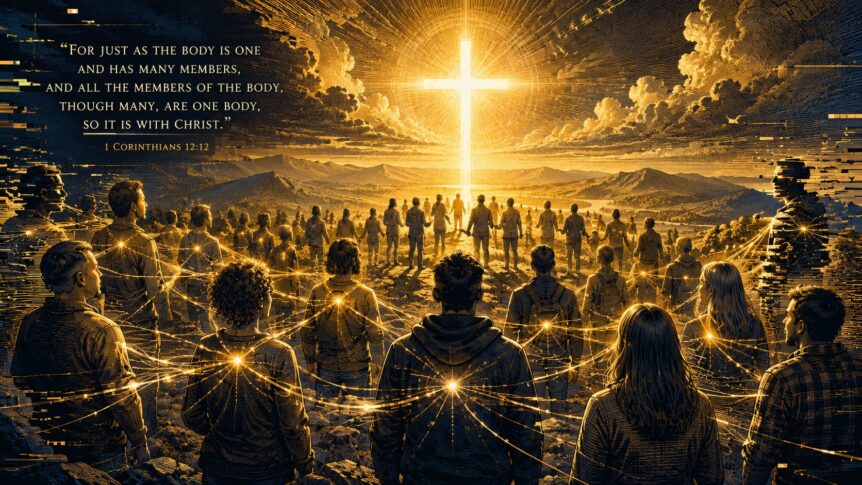
God has established his church as the primary way that we grow. We are to become disciples and make disciples and obey the commands of Christ; neither of those can be done well without being a part of the body. 1 Corinthians 12:24b-27 says
“But God has so composed the body, giving greater honor to the part that lacked it, that there may be no division in the body, but that the members may have the same care for one another. If one member suffers, all suffer together; if one member is honored, all rejoice together. Now you are the body of Christ and individually members of it.”
It is only in a group of believers that you can fulfill those “one another” commands that we talked about, it cannot be done to the universal church in a meaningful way. I hope you now have a broad picture of what it means to Belong, and it is an incredible blessing to be in a body of believers. If you desire a place to be taught, encouraged, loved, poured into, and where you can do the same for others then the body is where you belong. However, much like salvation it is not to be entered into lightly and we should count the cost. I hope you can see that part of what it means to belong is to be committed to the body. That is why we practice church membership the way we do.
From this Membership
I want to explain a little bit about my background for those of you who don’t know me as well. I also want to share how God has grown me in this area. When I was about 9 years old my parents joined a mission agency to become missionaries to the country of Bolivia. We moved from our home in Texas to Indiana so they could close to the mission headquarters and begin fundraising. We spent a couple traveling around the country fundraising and then spent a year on the Mexico border for my parents to attend language school. During these years we attended several different churches and many weekends were in a different church. Once we arrived in Bolivia we joined a local church. I moved back to the U.S. after graduating high school and lived in Indiana again for a bit and then eventually to Ohio where Tiffany and I met and then I was in the army for several years in North Carolina. During these years I attended many churches of all different kinds, English, Spanish, Local, International, Arminian, Calvinist, Military, Civilian. I always was involved and did my best to follow the Lord. I had a great sense of the breadth and the importance of the universal church. Partially because of this I didn’t really see the point of becoming a member of a local church. “I was a member of the universal church, I thought.” Why would I sign a paper that is making me a member of something less, than the big church around the world” The first time I became a member was at a southern Baptist church in Fayetteville called Cliffdale Community Church. That was largely because it seemed like the thing that was expected of me after Tiffany and I were married and we began attending that church, but I still didn’t really understand much of the purpose of it. It wasn’t until I went to a church in Ohio after I got out of the Army that I began to understand the real purpose of church membership. The church we were going to, began to experience a renewal of their minds, they noticed that they were not living like the early church was living and that the way they thought about church and their involvement was not aligned with scripture. They began to read God’s word and they discovered in Acts, specifically 2:42-47, the centrality of the gathering in the believer’s lives.
“And they devoted themselves to the apostles’ teaching and the fellowship, to the breaking of bread and the prayers. And awe came upon every soul, and many wonders and signs were being done through the apostles. And all who believed were together and had all things in common. And they were selling their possessions and belongings and distributing the proceeds to all, as any had need. And day by day, attending the temple together and breaking bread in their homes, they received their food with glad and generous hearts, praising God and having favor with all the people.”
We began to see the centrality of the church in the lives of the early believers in Jerusalem, how they were committed to teaching and life together and we wanted that. It was a big shift when we rewrote the church founding documents to reflect the structure of the early church with elders and deacons and focused on studying God’s word not just people talking about God’s word and we redefined what it meant to be a member of our specific body of believers. We covenanted together to commit ourselves to each other’s growth and accountability, and submission to the teaching of God’s word. It changed how we viewed one another and gave others the authority to speak into our lives when we struggled or fell into sin. It was transformational.
Well that’s great you say but can’t you do that without becoming a member. Well why do we get married? Not the reason behind why we want to be together, but why do we want to go through with a marriage ceremony. Isnt it just the same if we live as if we are married and I tell Tiffany I love her and I’m her man. All of us mature believers know that is inherently wrong but Adam and Eve did not have a specific ceremony as we think of it. The difference is a covenant. We pledge our faithfulness to each other before God and our relatives and friends to say that this is a commitment forever to faithfully bear with one another as long as we live. There can be no real security without that commitment, no obligation, no accountability until we say that we commit to the truth that
“a man shall leave his father and his mother and hold fast to his wife, and the two shall become one flesh’? So they are no longer two but one flesh. What therefore God has joined together, let not man separate.”
Then we have the mechanism of the witnesses both God and Man that hold us to that covenant. This all reflects the commitment and sacrifice that Christ had for his bride and body the church.
To expect the shepherds of the church to devote themselves to your growth and leadership, to expect the body of believers to hold you accountable to your faith, to chase after you when you stray, and sacrifice their lives for you but you have not likewise committed to them the same thing is not reasonable. You have not given them the right to do this and be involved in your life this way. This is what convicted me to covenant with my brothers and sisters in the first church where I really understood this.
Application/Conclusion
I hope that from this you can see the importance of belonging to a local body of believers and that truly belonging means putting yourself all in for the benefit of those people. We want to see our brothers and sisters Maturing, Ministering and Multiplying. I have a couple of action points for us this week.
First, if you are a member here, take it seriously. You have a whole group of people here counting on you. They need your help to become apprentices of Jesus Christ. Be devoted to our brothers and sisters, the teaching of God’s word and meeting together, and prayer.
Second, if you are not yet committed to this Church, think about whether you should be a member here. Look around at us, broken, sinful, imperfect but redeemed people and think if you could partner with us to fulfill the mission of the church. Look at what we believe and how we live that out. Go to the website, see the doctrine we hold to, our statement of faith and look into God’s word and see if you believe that you truly must belong to a local community of believers. Even if that is not here that is ok there are other Gospel churches nearby they may practice their faith differently or be in a different season of growth, or have a different calling inside the scope of the great commission. I just want you to belong in a faithful body of believers. If you are being called to a different church for God’s purpose go in peace we will be fine without you.
Finally, if you do believe that this church is where you belong but you have not fully committed to these dear brothers and sisters, think about why that is. What is holding you back from dedicating your life within a local body of God’s universal church to fulfill the thing that you were made for? Is it an unrepentant sin? Is it dread of being involved in the messy lives of others? Is it a theological disagreement? Is it worrying about exposing your own struggles with sin to others? Is it feelings of inadequacy? Or is it self-centeredness? Jesus loves his people and he gave his life to pay for our sins to redeem us. How can we not love the bride and the body of our savior as well?
Frequently Asked Questions
1. Isn’t reading the Bible and praying part of my purpose?
They are essential, but they are not the end goal. They are how you are shaped into a disciple—so that you can become like Christ and help others do the same.
2. What if I don’t feel ready to disciple someone?
Neither did the disciples in Matthew 28. Some doubted, and Jesus sent them anyway. The mission depends on His authority, not your confidence.
3. Does every Christian really have a role in making disciples?
Yes. There is no category of believer exempt from the Great Commission. Every follower of Jesus is called to both grow and help others grow.
4. What does “making disciples” actually look like in daily life?
It looks like intentional relationships—opening Scripture together, sharing life, modeling obedience, and pointing others to Christ in everyday settings.
5. Why focus so much on the next generation?
Because God has clearly placed them in front of this church. Faithfulness means stewarding what God has entrusted to us right now.
6. How do we know if we’re succeeding as a church?
Not by attendance alone, but by transformation: people coming to Christ, growing in maturity, serving with their gifts, and multiplying into others.
7. What if our church feels stretched already?
That tension is real. But the call is not to do more in our own strength—it’s to trust Christ’s presence and steward what’s already in our hands faithfully.
8. Isn’t this approach too narrow for all the needs around us?
Trying to meet every need often leads to doing nothing well. A focused mission allows the church to be faithful and effective where God has specifically called it.