Highlight Reel
Sermon Summary
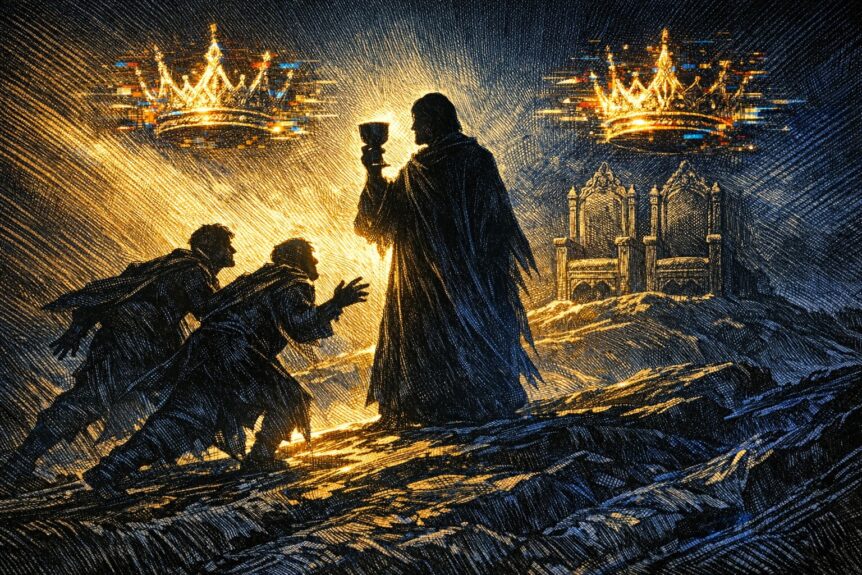
On the road to Jerusalem in Mark 10:32-45, Jesus clearly predicts His suffering and death, yet His disciples remain focused on power and position. James and John’s request exposes a deeper problem: a desire for glory without the cross. Jesus corrects them by redefining greatness—away from domination and toward sacrificial service. He anchors this truth in His own mission: the Son of Man came not to be served, but to serve and to give His life as a ransom for many.
Sermon Audio
Shareable Quote graphics


Sermon Text
Sacrificial Servanthood
Nate Roten / Mark Series / Mark 10:32-45 / July 19, 2026
Main Idea
The call of every Christian is to serve others sacrificially.
Nearly two hundred years before the events we are reading about today, the Jewish people lived under the rule of the Seleucid Empire. Their king, Antiochus IV, tried to force Greek religion and culture on them. He outlawed many of their religious practices, halted their worship, and defiled the temple in Jerusalem. It was a dark time for the people of Israel. They lived in their own land, but they were not free.
Then an elderly Jewish priest named Mattathias refused to bow to their oppressive rule. He and his sons fled into the hills and launched a revolt. After Mattathias died, his son Judas took command. Judas became known as Judas Maccabeus. Although his fighters were badly outnumbered, they defied the odds and defeated the armies sent against them. They drove the foreign forces from Jerusalem, cleansed the temple, and restored Jewish worship. In time, the Maccabean family secured nearly eighty years of Jewish self-rule. Israel had seen an unlikely leader gather a band of faithful men, defeat a pagan empire, and restore a fair degree of autonomy in Jerusalem. This was known as the Maccabean Revolt.
That story became part of the Jewish people’s imagination. They told it to their children and celebrated it every year at Hanukkah. This would be the first taste of independence since the time just before the Babylonian empire took them captive in 586 B.C., and it showed that they could still have hope for their Messiah to come and make their freedom complete and permanent.
Generations later, when Rome ruled their land and another Jewish leader began gathering disciples, performing miracles, and making His way toward Jerusalem, it would have been natural to wonder whether history was about to repeat itself and whether the time for their liberation was at hand. Maybe Rome was about to fall. Maybe the kingdom was about to be restored.
If Jesus is that Messiah, maybe He was about to take His throne. If that was what the disciples expected, if they understood that Jesus was truly a king… then maybe they were about to see it fully realized as they marched toward Jerusalem… the capital city. Maybe they expected Jesus to be another Maccabee, but this time the liberation of Israel would be permanent, and they would be part of the battle and would rule with Jesus when it was over.
The only issue was that they still did not understand what kind of king he had become or that there would be no crown of victory without the cross of sacrifice.
Passage
Mark 10:32–45 CSB
32 They were on the road, going up to Jerusalem, and Jesus was walking ahead of them. The disciples were astonished, but those who followed him were afraid. Taking the Twelve aside again, he began to tell them the things that would happen to him. 33 “See, we are going up to Jerusalem. The Son of Man will be handed over to the chief priests and the scribes, and they will condemn him to death. Then they will hand him over to the Gentiles, 34 and they will mock him, spit on him, flog him, and kill him, and he will rise after three days.”
35 James and John, the sons of Zebedee, approached him and said, “Teacher, we want you to do whatever we ask you.” 36 “What do you want me to do for you?” he asked them. 37 They answered him, “Allow us to sit at your right and at your left in your glory.” 38 Jesus said to them, “You don’t know what you’re asking. Are you able to drink the cup I drink or to be baptized with the baptism I am baptized with?” 39 “We are able,” they told him. Jesus said to them, “You will drink the cup I drink, and you will be baptized with the baptism I am baptized with. 40 But to sit at my right or left is not mine to give; instead, it is for those for whom it has been prepared.”
41 When the ten disciples heard this, they began to be indignant with James and John. 42 Jesus called them over and said to them, “You know that those who are regarded as rulers of the Gentiles lord it over them, and those in high positions act as tyrants over them. 43 But it is not so among you. On the contrary, whoever wants to become great among you will be your servant, 44 and whoever wants to be first among you will be a slave to all. 45 For even the Son of Man did not come to be served, but to serve, and to give his life as a ransom for many.”
I – Follow the Leader
The job – Jesus is leading. The disciples are following. Not only is this a practice of the Rabbis, but the Good Shepherd also leads His flock, and it is not always to green pastures. Here, He is leading them toward danger.
The mission – Jesus is heading toward Jerusalem… toward His death. He is leading by example, marching toward the mission and calling the disciples to do the same (to take up their cross in a servant-hearted manner).
The posture – Jesus leads with calm determination and purpose, in contrast to the astonishment and fear of the others.
II – Third Prediction of His Death (vv. 32-34)
Given that they are traveling to Jerusalem, where Passion Week will begin, and that there is still a misunderstanding of His rule over God’s kingdom, Jesus tells His disciples about His coming death for the third time. Each time, Jesus adds a little more detail, and this time, not only will the chief priests and scribes be involved, but they will also partner with the Gentiles to hand Him over and condemn Him. It is the Gentiles who will treat Him so poorly: mocking, spitting, and flogging.
Patterns of Prediction –This is the second of three predictions about his death and resurrection.
• First prediction (8:31) – Son of Man > Suffer and Rejected > by elders, chief priests, and scribes > killed > rise after 3 days.
• Second prediction (9:31) – Son of Man > Betrayed > into the hands of men > killed > rise after 3 days.
• Third prediction (10:33-34) – Son of Man > Handed over and condemned by chief priests and scribes to the Gentiles > mocked, spat upon, flogged, > killed > rise after 3 days.
It is easy for us to look back at the crucifixion and see how accurately the predictions line up with it, but let’s not forget how stunning this is to the men who have not yet seen it come to pass. Right now, all of this is in their future, and after three predictions, Jesus lays out the location of His death (Jerusalem), what He would experience (humiliation, betrayal, suffering, rejection, and death), the bad-faith actors who would be involved (the elders, chief priests, scribes, and Gentiles), and the final outcome (His bodily resurrection).
This has led many scholars to conclude that this was a later addition by Mark because Jesus couldn’t have truly predicted His own death with this level of accuracy. But of course, we know that as God… He is perfectly capable. Perhaps now we can see why they were astonished and afraid. Though they didn’t fully grasp the idea of a Messiah who would die, they were still uneasy about being led into the city where this mystery event would take place. In their minds, they likely still believed they were approaching the tipping point of history, when Jesus would establish His earthly reign from Jerusalem and wage war against Rome, as the Maccabees had against Greece. If you were about to transition from planning a war to its execution, you’d be nervous too!
This could explain why the sons of thunder ask the question that follows, but as we will see, they do so in a way that shows how the reality of Jesus’ sacrifice flies 1,000 feet over their heads.
III – Selfish Sons of Thunder (vv. 35-41)
Imagine for a moment that your close friend invites you on a road trip and asks you to drive. You find that a bit odd, but you agree. It’s been far too long since you caught up. As you drive down the highway, your friend begins to unpack some heavy circumstances in their life that have led them to see that they need to enlist in the military. In fact, they already have. The reason they asked you to drive is to take them to the airport, where they will go through boot camp and then ship off to an undisclosed country to stage for a pending conflict. They have told no one… only you. This is the most impactful decision they have ever made, and they have confided only in you. Now, imagine… after they just unpacked the most dramatic change in their life… You then ask, “Wow, that sounds intense. Can I borrow your riding mower while you are away?”
That would make your friend feel terrible and make you look like a fool, wouldn’t it? That time of transparency is not the time for you to be selfish. In essence, this is what James and John do to Jesus.
Jesus just finished talking about spiritual barriers that keep people from entering the Kingdom of God, with wealth being one of the worst. He explained twice how a small child perfectly illustrates how one enters… through dependent trust. He reiterated the kingdom principle of humbling oneself so that the first will be last and vice versa. Now, He has given the third prediction of His gruesome and humiliating death. And what is their very next question to Jesus?
“Hey… when you finally set up your throne… we want you to make us your second-in-command. Will you do that for us?”
Just let that sit for a minute. That’s far worse than the example I gave earlier. Here is Jesus describing the ultimate act of sacrificial giving, and here are two of His inner three… demonstrating the ultimate act of selfishness!
Context from Matthew. Before we go any further, it would be helpful to turn to Matthew’s gospel, which provides additional information that helps us understand why James and John would make this thunderclap of selfishness. First, their mother, Salome, was involved. Evidently, she was among the larger crowd that was with them, so she contributed to their request. Mama bear wants the best for her little cubs.
But secondly, there is more to what Jesus said as He described the rewards given to those who give up family ties, houses, land, etc., for His name and the sake of the gospel. Let’s take a look:
Matthew 19:27–30 CSB
27 Then Peter responded to him, “See, we have left everything and followed you. So what will there be for us?” 28 Jesus said to them, “Truly I tell you, in the renewal of all things, when the Son of Man sits on his glorious throne, you who have followed me will also sit on twelve thrones, judging the twelve tribes of Israel. 29 And everyone who has left houses or brothers or sisters or father or mother or children or fields because of my name will receive a hundred times more and will inherit eternal life. 30 But many who are first will be last, and the last first.
Now, don’t get me wrong. They are still quite selfish, but at least this gives us a window into their thinking, allowing us to see their motivation. Jesus has just promised them thrones when He sits on His own. That is helpful context. As two of the inner three who had the privilege of witnessing Jesus’ unveiled glory at the transfiguration, perhaps they thought they would surely get more prominent positions. So they (with a little push from mama) ask if they can have the most prestigious ones… the ones on either side of Jesus. They are asking a question that directly refers to something Jesus had already promised them. That clarifies a lot.
Heart Issue. That said, there are still some issues here. The first and most obvious is their callous disregard for Jesus’ pending suffering and execution. It was insensitive, and their timing couldn’t have been any worse. Secondly, it revealed their perpetual heart issue. They were still seeking their own glory instead of God’s glory. While Jesus spoke of His humility, they were seeking prominence. What a contrast!
We might be tempted to think we can honor ourselves as we honor Christ, but it simply doesn’t work that way. The call to bear or own the cross spiritually (as Jesus will do physically) is a call to die to self, not to exalt self. There can be only one who is exalted. As Paul said to the Philippian church, because Jesus humbled Himself by coming from heaven, taking on the form of a servant, and dying for His people, He is the one who receives the name that is above all others. The call of every Christian is to serve others sacrificially.
Drink and baptize. And speaking of Jesus’ death… He describes it as drinking from a cup and being baptized… and He uses this imagery as a rhetorical question in response to their request. They mistakenly assume He means the trials of a war with Rome to seize control, which they think they can handle, but this isn’t what Jesus is talking about. He is talking about the cup of the Father’s wrath that will be poured out on the cross… the wrath that He will be baptized in as He bears the divine punishment for His people. This is not something the brothers can do. Only the God-man — Jesus — can do that.
However, that doesn’t mean they won’t endure suffering. They will indeed have their own cup to drink and their own baptism to endure, but not His Messianic cup. They endure great persecution in the book of Acts (the blessed persecution mentioned last week!). James is the first martyr… killed by Herod Antipas, and John is eventually exiled to the island of Patmos. Picture James, decades later, in a Roman cell, and John, an old man alone on a rock in the middle of the sea. Neither of them got the throne they asked for on that road. What they got instead was a cup of Christ’s suffering… and neither of them ran from it. The same men who once elbowed their way toward prominent thrones ended up laying their lives down in obscurity and exile.
So if you’re in a season right now where your cup tastes nothing like glory — a hospital room, an empty chair at the table, a diagnosis you didn’t choose — you are in good company. James and John didn’t get explanations. They got a Savior who walked ahead of them, drinking from His own cup first. He is not asking you to drink anything he hasn’t already drained to the bottom for you.
But to answer their question, Jesus said those seats are not His to give. That decision belongs to the Father. Even the Son submits. And friends, if the King submits, what does that tell us about our own demands for a throne?
The entire trajectory of our lives that we have dreamed for ourselves must be laid at the feet of Jesus and the Father’s will. That means He has the majority vote in what happens to our careers, our children, our bank accounts, our spare time, and our talents. To bear our own cross is to offer our lives as a living sacrifice in submission to God’s will and to serve others sacrificially.
But before the conversation ends, there is one more Kingdom mentality Jesus wants to teach them.
IV – Kingdom Conduct (vv. 42-45)
The occasion of Jesus’ teaching is a reaction to the other disciples’ outrage. They were indignant upon hearing that the sons of thunder had slipped away to selfishly secure the best seats in the house. They were fuming, likely not just because of the selfishness of the act itself, but because they all wanted the best seat, as they had discussed earlier. The heart issue persists in all of them and is causing division. So, what is the remedy for division? It is coming back to the feet of Jesus.
Cultural Power vs. Kingdom Power – Jesus begins by recognizing how cultural powers operate. He labels power in the current Roman system as tyrannical and as lording it over others. Every single one of his disciples would have experienced, time and again, the cold, cruel hand of power from the Romans. They know they have the upper hand in every situation, and they are not afraid or ashamed to flaunt that power to get what they want. After all, that’s how they became the current global superpower.
But Jesus then says, ‘Not so with you.’ No one in God’s kingdom wields power in that way. You are not given power to lord it over others, and there should be no such thing as a tyrant in God’s delegated leadership. This means that the way the disciples are acting right now is contrary to the basic principles of the kingdom Jesus is establishing. They are not acting like true rulers right now.
Imagine a military officer entrusted with significant authority. He wears the uniform. He bears the rank. When he gives an order, people obey. But over time, he begins to wield that authority for himself. He humiliates the soldiers beneath him. He demands special treatment. He uses his position to protect his comfort and advance his career. Eventually, he is called before a military court and charged with “conduct unbecoming of an officer.”
That phrase is important. It means his conduct is inconsistent with the office he holds. The problem is not that he lacks authority. He has authority. The problem is that he is using it in a way that brings dishonor to the uniform. His behavior does not align with the position he has been given.
That is what Jesus is confronting among his disciples. James and John want the seats of honor. The other disciples become angry, probably because James and John asked first, but they all want to be at the top of the pecking order. They are all thinking about power the way the world around them does. Rome has taught them that greatness means climbing above others, giving orders, receiving honor, and making people serve you.
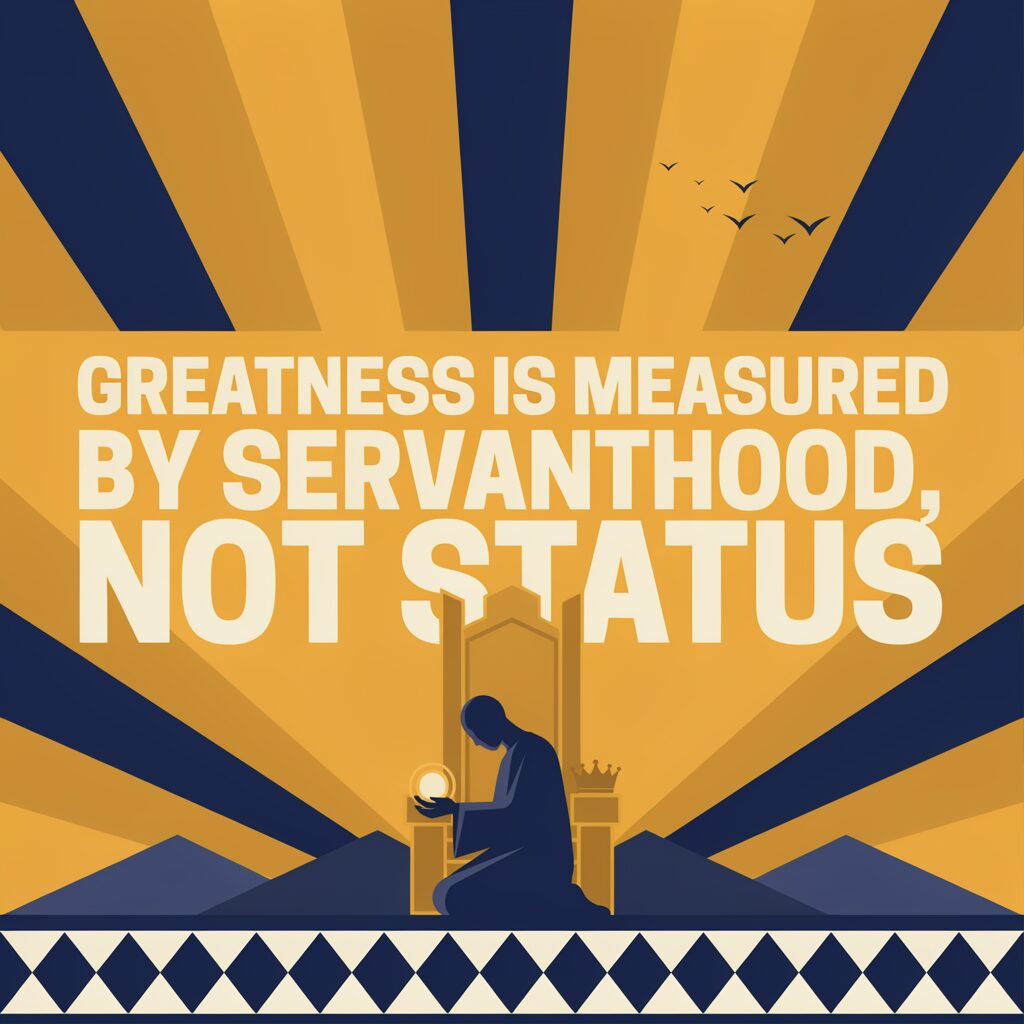
Jesus says, “Not so with you.” In other words, that behavior is unbecoming of a citizen of my kingdom. You may see rulers using authority to elevate themselves, but that is not how my people will live. In my kingdom, greatness is not measured by how many people serve you. It is measured by how willingly you serve them. The word for “serve” is the common term for “serve” and the same one used to describe the position of deacon… literally, a servant of tables. The highest place in God’s kingdom belongs to the one who takes the lowest place. Why? Because the call of every Christian is to serve others sacrificially.
Then Jesus points to himself. He does not merely give them a new leadership principle; he gives them his own life as the pattern: “For even the Son of Man did not come to be served, but to serve.” The King does not use his authority to save himself. He uses it to give himself away. Just as He is physically leading them toward Jerusalem, He is spiritually leading them by calling them to emulate His servant-oriented character. In doing so, He proclaims His divine mission statement: “For even the Son of Man did not come to be served, but to serve, and to give his life as a ransom for many.”
The Son of Man – This reiterates Jesus’ kingly credentials. He is both the Ruling Messiah and the Suffering Messiah… two roles promised in Daniel 7 and Isaiah 52-53. He is both the one given eternal dominion by the Ancient of Days and the one who bears the transgressions of His people. The Son of Man, who holds the highest position in the cosmos, takes the lowest position on earth and gives His life as a ransom for many… to redeem them from their perpetual acts of “conduct unbecoming.”
Let’s not think that the ransom is paid to Satan, as some believe. The term ‘ransom’ means a price paid to free a slave or a prisoner of war. Earlier, Jesus said that He binds the strong man, which we know is Satan, to pillage his house. You don’t bind someone and then pay a ransom to them. No, Jesus pays the ransom to the Father for the transgressions of His people, liberating them from the condemnation and eternal punishment their actions deserve.
🔥 Application: Serve others Sacrificially
As we come to a close today, we need to circle back to the core message Jesus is teaching us alongside his twelve disciples. I’d like to begin with the concept of conduct unbecoming.
See, Jesus doesn’t court-martial us for unbecoming conduct. He doesn’t strip the uniform and send us home. He does something the Roman world never imagined a King doing – He takes our poor conduct onto Himself and pays the ransom for it.
How many of you can relate to that? How many of you are aware that your conduct does not align with Jesus’ example? Praise God that he does not dismiss or condemn us. Praise God that he acts out of love, compassion, and mercy rather than ruling with an iron fist. Even when we act like the sons of thunder, and the reality of his sacrifice flies over our heads, he still patiently calls us to take up our cross and follow him.
If you do not yet know Christ, know that you are not free. You live in a free land, but internally, you’re enslaved and captive to your own sin… your own “conduct unbecoming.” Jesus didn’t come to lead a revolt against Rome. He came to pay what you owe, so you could walk out of that prison. The ransom has been paid and is ready for you to receive.
Some of you are drinking a cup right now you didn’t ask for — grief, illness, a diagnosis, a loss you can’t undo. Hear this: James drank his cup. John drank his. It wasn’t the Messianic cup, but Jesus didn’t leave them to drink it alone. He walked ahead of them then, and He walks ahead of you now.
And that is where true transformation happens. When you encounter the extreme love and grace of God, you can begin to think the way Paul does. In his letter to the Philippian church, he says that his primary goal in life is to know Jesus and his sufferings. There is no higher goal for him than to be in full communion with Christ, no matter what the sacrifice.
So this week – in the way you lead your kids, in how you treat the people who report to you at work, in the way you help your neighbor – remember that in God’s kingdom, greatness is not measured by how many people serve you. It is measured by how willingly you serve them, because the call of every Christian is to serve others sacrificially… not because you owe Jesus a performance, but because you’ve already been ransomed by One who owed you nothing at all.
FAQs
1. Why were the disciples so focused on status?
They were shaped by cultural expectations of power and a misunderstanding of the Messiah. They expected victory like the Maccabees—political and visible—rather than a suffering Savior who would redeem through sacrifice.
2. What does it mean to “drink the cup” Jesus mentions?
Jesus is referring to the cup of God’s wrath that He alone would bear on the cross. Believers may suffer, but only Christ drinks the full measure of divine judgment for sin.
3. Is it wrong to desire greatness?
Not entirely—but Jesus redefines greatness. The problem is not the desire itself, but how it’s pursued. In God’s kingdom, greatness is expressed through humble, sacrificial service.
4. How does this apply to leadership in the church?
Leadership in Christ’s kingdom is never about control or self-promotion. It is about responsibility, humility, and serving others for their spiritual good, not personal gain.
5. What does “ransom for many” mean?
It means Jesus paid the price required to free sinners from guilt and judgment. The ransom is not paid to Satan, but to satisfy God’s justice, securing redemption for His people.
6. Why does Jesus allow His followers to suffer?
Suffering is not meaningless. It conforms believers to Christ, deepens dependence on Him, and displays His worth. He never calls His people into suffering alone—He goes before them.
7. How can I serve sacrificially in everyday life?
Start where you are—at home, work, and in your community. Serve without seeking recognition. Give your time, attention, and resources for the good of others, not your own advancement.
8. What if I feel like I’ve failed at this kind of servanthood?
The gospel begins there. Jesus doesn’t discard those with “conduct unbecoming.” He bears it, pays for it, and calls you again to follow Him in grace-fueled obedience.