Highlight Reel
Sermon Summary
In Mark 10:23–31, Jesus dismantles the belief that status or success can secure salvation. Wealth, and anything that fosters self-reliance, becomes a barrier to entering the kingdom. Salvation is impossible through human effort but fully accomplished by God’s grace. While following Christ involves real sacrifice, Jesus promises a multiplied return—spiritual family, purpose, and eternal life—showing that what we gain far surpasses what we lose.
Sermon Audio
Shareable Quote graphics
Sermon Text
Gaining by Losing
Nate Roten / Mark Series / Mark 10:23-31 / 7.12.26
Main Idea
The kingdom of God belongs not to those who bring the most, but to those who need Him most.
Imagine a man and a woman standing at the altar. It is their wedding day. Months and months of work, planning, and prayer have paved the way for this day. They dated for many years. They were engaged for another year, and now the time has finally come, this long-awaited day, when they would start their new life together. As they stand there, holding hands and staring deeply into each other’s eyes, how silly would it be if the man started thinking to himself, “Man, I’m going to miss my bachelor life—my man cave, my schedule, my freedom”? Or if the woman, as she stared into his eyes, was thinking, “I can’t believe I’m losing half my closet to his Carhartt collection”? Absurd, right? On your wedding day, you don’t catalog losses—you celebrate what you’re gaining. What is sacrificed to live a joint life should be inconsequential, shouldn’t it? We sacrifice lesser things in order to have what really matters.
Yet here’s our problem: when it comes to following Jesus, we often think like that distracted bride and groom. We fixate on what we’re giving up rather than marveling at what we’re receiving. This is a lesson the disciples have yet to learn. And if we’re honest, as we live our Christian life, many of us struggle to learn it. Today, I want to recalibrate our vision… to see with fresh eyes the staggering treasure we gain in Christ, a treasure that makes every sacrifice look like pocket change.
Passage
Mark 10:23–31 CSB
23 Jesus looked around and said to his disciples, “How hard it is for those who have wealth to enter the kingdom of God!” 24 The disciples were astonished at his words. Again Jesus said to them, “Children, how hard it is to enter the kingdom of God! 25 It is easier for a camel to go through the eye of a needle than for a rich person to enter the kingdom of God.” 26 They were even more astonished, saying to one another, “Then who can be saved?” 27 Looking at them, Jesus said, “With man it is impossible, but not with God, because all things are possible with God.” 28 Peter began to tell him, “Look, we have left everything and followed you.” 29 “Truly I tell you,” Jesus said, “there is no one who has left house or brothers or sisters or mother or father or children or fields for my sake and for the sake of the gospel, 30 who will not receive a hundred times more, now at this time—houses, brothers and sisters, mothers and children, and fields, with persecutions—and eternal life in the age to come. 31 But many who are first will be last, and the last first.”
Before we dive into these verses, remember what just happened: A wealthy, moral, religious young man came to Jesus, asking how to inherit eternal life. Jesus told him to sell everything and follow Him. The man’s face fell, and he walked away grieving because he had great possessions. Jesus’ disciples watched this happen. Now Jesus turns to process it with them, and what He says rocks their world.
I – Why Is Wealth Such a Great Obstacle? (vv. 23–25)
Connection to the Rich Young Ruler. Though Jesus looked at him through loving eyes and named the exact obstacle that was standing between him and eternal life, which is what he asked about, the man could not give up his possessions. He was an example in living color of what it looks like to trust in yourself and in your riches, rather than recognizing your dependence and trust in God.
Jesus’ startling warning to the disciples. Jesus looks around at His disciples and drops a bomb: “How hard it is for those who have wealth to enter the kingdom of God!”
The disciples are stunned. Their jaws drop. So Jesus says it again, this time with even greater emphasis: “Children, how hard it is to enter the kingdom of God! It is easier for a camel to go through the eye of a needle than for a rich person to enter the kingdom of God.”
Before we explore the disciples’ reaction, we need to unpack what Jesus is saying here because it directly challenges the worldview the disciples currently hold.
1. First, notice Jesus’ comprehensive picture of wealth. He uses two different Greek words in these statements. The first word (χρήματα) refers to material possessions—houses, land, and other physical assets. The second (πλούσιος) refers to liquid wealth—money, resources, and financial power. The picture here is of someone who has it all—property, investments, cash flow, and economic security. This type of person, who has everything they need in this world, faces an impossible task of entering the kingdom of God. This was represented by the rich young ruler, who embodied this type of person and clearly walked away even though he was asking about entering the kingdom of God.
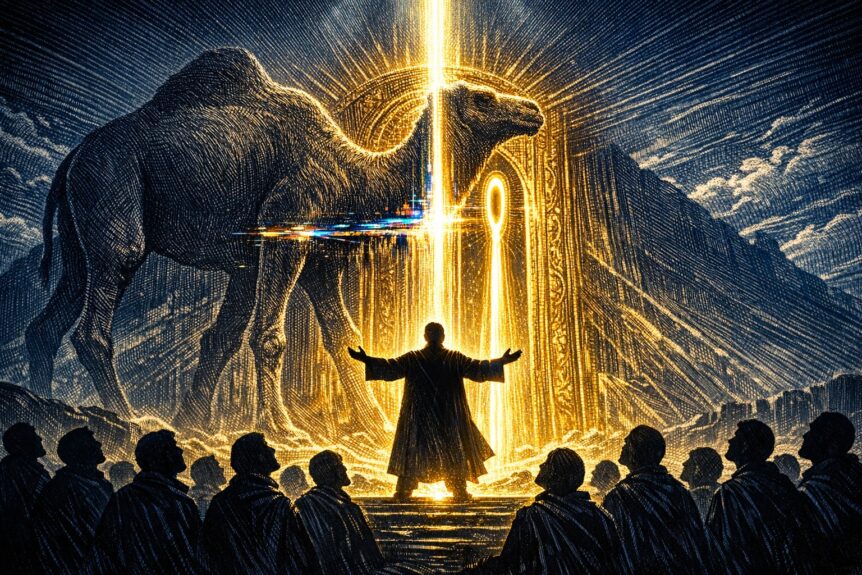
2. Second, understand Jesus’ stunning language of impossibility… a camel going through the eye of a needle. You may have heard the theory that Jesus was referring to a small gate in Jerusalem that camels had to kneel to pass through—a picture of humility. But that’s a medieval invention with zero first-century evidence. The “needle’s eye gate” doesn’t appear in any literature until the 9th century. This is not just about humbling yourself before God. This is about impossibility, not difficulty. So, Jesus uses an exaggerated image to drive home the point, because camels were the largest animals in Palestine. The eye of a needle is the smallest opening that anything could actually pass through. Picture it: the biggest animal trying to squeeze through the tiniest hole. It’s not hard. It’s not challenging. It’s absurd. It’s impossible. The camel and the needle illustrate impossibility, not difficulty.
The disciples’ shock. The word Mark uses here is “astonished,” and it reflects the same reaction people had throughout Mark’s Gospel when they witnessed Jesus’ miracles or heard the power of His teaching. It is literally mind-blowing to them that Jesus would say this. To understand why they reacted this way, we need to understand their worldview and perspective.
From their point of view, someone who is rich is someone who is blessed by God. Wealth was a sign of God’s favor, a reward for righteousness. We can see that in examples from the Old Testament, such as Abraham, who had many riches and flocks of animals, and Job, who was wealthy before his trial and was richly blessed and multiplied once his trial was over. The idea that wealth is a barrier rather than a blessing is completely lost on the disciples.
And it’s not like they hadn’t been warned. Even though Jesus made mention of this time and time again, such as:
• His message on the Sermon on the Mount tells people to store up treasures in heaven and not on earth.
• You cannot serve two masters; it’s either God or money.
• The parable of Lazarus and the rich man, where the rich man ends up in torment.
• The parable of the rich fool who built bigger barns.
The teaching is clear, but the worldview is not. For the disciples, this is groundbreaking and world-shaking news.
Now, before we move on, let’s apply this to ourselves.
We must be clear: money itself is not evil, nor is anyone who has wealth inherently sinful. Many Christians today with great wealth do great things for the kingdom of God. Biblically, Abraham, Job, Joseph of Arimathea, and Lydia—all were wealthy believers God used powerfully.
But we must also recognize the danger of wealth, especially one similar to the disciples’ old worldview — the prosperity gospel — is so rampant today. Money is not always a sign of God’s blessing, especially when so-called “gospel preachers” feed all of your sinful, carnal desires.
What’s really in view here is how wealth functions as a spiritual barrier. The trust the rich young ruler has in his wealth is an idolatrous trust that keeps him in opposition to submitting to God in dependent trust. Therefore, wealth is not evil, but it is spiritually dangerous, and it is dangerous because it competes with childlike dependence on God. Wealth whispers, “You don’t need God… you have resources, security, options, control.” And here’s the principle for us today: anything that creates self-sufficiency: money, education, intelligence, talent, youth, health… can function as “wealth” in your life. Wealth tempts us to trust ourselves instead of God.
II – Who Then Can Be Saved? (vv. 26–27)
The crucial question. This is almost the exact same question that the Rich Young Ruler asked, but thankfully, they’ve been around Jesus enough to leave the ‘do’ out of it. But you can also hear the frustration in their voices. “Well, if that guy can’t get into the kingdom, who on earth can?”
At first, this may seem like a silly question, but when you understand the background of their worldview, you can see why they asked it. If riches are an indication of God’s blessing, and this rich man is a perfect portrait of someone who has been richly blessed by God, then who is left to enter the kingdom if he can’t? Their logic goes like this: If the blessed can’t be saved, then the cursed certainly can’t be. If those with every advantage can’t make it, what hope is there for tax collectors, sinners, fishermen… for us?
The tension in the crucial question is the impossibility of gaining entrance into God’s kingdom… of attaining salvation itself.
Despair and Hope. Can you almost hear the rich young ruler in Peter’s voice? There is a similar kind of despair expressed here. What makes this brief interaction so fascinating is its emotional arc of despair and hope. In this moment, Peter is tempted to act just like that young man did. Clearly, he’s not ready to walk away yet. But the level of frustration over such an impossible task and an immovable barrier to the kingdom is starting to overtake his mind and heart. And the faith that Jesus has continually tried to draw out of them is beginning to be eclipsed by this despair, and you can see it both in this question and in his reply, which we will review in just a moment.
But then Jesus speaks, and His words are both devastating and glorious: “With man it is impossible, but not with God, because all things are possible with God.”
This is an encouragement to Peter and the disciples. Because it’s true, humanly speaking, it’s impossible to attain the kingdom. There is nothing we can do to gain entrance. The keys to the kingdom are controlled by God alone.
Many of us may look at an empty bank account when we’re only halfway through the month. We might be tempted to take this verse as a promise that God will miraculously provide. Or you might have a struggling marriage that is growing cold, and you’re not quite sure how you’re going to rekindle the passion and repair the cracks. Or maybe the odds of getting into the college you want are very low, and you’re tempted to take this verse in your hand like a sword and slay the enemies of worry and doubt. “With man it is impossible, but with God all things are possible!”
Let me encourage you that there are plenty of scripture verses that can help us in those situations. But we must keep in mind that the context of this particular verse has to do with salvation itself. So, if you were going to use this verse, the better context would be for a friend or family member who is far from Christ, who is rebelling against His rule and authority. And your thought is, “There’s no way they’ll ever be saved. They’re too far gone. Too hardened. Too in love with their sin.” In a human context, it is impossible. But God is an infinite God, and with Him all things are possible.
Salvation is entirely the work of God’s grace. The disciples’ worldview, in my opinion, still contained an element of works-based salvation, since you had to be a righteous person to gain God’s favor. And the only way that you can become a righteous person is to follow the law.
And Jesus’ reply is that with man it is impossible. Meaning that there aren’t enough human efforts that can be stacked to reach up to God. Human effort is a literal impossibility for salvation because we don’t play a role in it. It is entirely the work of God’s grace and must be a work performed by Him and Him alone.
And this is a beautiful nugget of truth because it points to the all-sufficiency, sovereignty, and omnipotence of our great God and Savior Jesus Christ. Just as with the rich young ruler, God in flesh, standing face to face, with the person seeking and offering salvation. And here Jesus is God in the flesh, calling Peter to trust in Him because salvation is possible through Him and Him alone.
Remember that twice now Jesus has used a child to demonstrate dependent trust in God as a way to enter the kingdom, and twice Peter has forgotten about it. Had he remembered, perhaps he wouldn’t feel the level of despair that he feels right now. In his commentary on the book of Mark, Rodney Cooper, says this:
“Discipleship makes all equal; none start with the balance loaded in their favour, when it comes to entry into the kingdom of God. Only the humble, the ‘little ones’, find entry to the kingdom”
How true this is!
III – Is Following Jesus Worth the Cost? (vv. 28–31)
Peter voices the disciples’ sacrifice. When Peter used the word “we” in “We have left everything and followed you,” he showed that he was not alone in this thought and was likely speaking on behalf of all the disciples, reminding Jesus of everything they had sacrificed. This likely comes on the heels of his frustrated question about who can be saved. He was also reminding Jesus that they are worthy of salvation because of what they have done and what they have sacrificed.
On the one hand, we can relate because we expect a good outcome for the sacrifices we make, or else we wouldn’t make them. And yet, if you really sit with this for a while, you can see how it devolves a personal relationship with Jesus into a transactional one. “If I give this up for you, then I expect this other thing in return.” And that may not be Peter’s heart behind it, but ultimately this is what it boils down to.
Jesus acknowledges the real cost of discipleship. Though Peter’s statement has a transactional tone, I love how graciously Jesus replies to him and doesn’t avoid answering his question directly. The essence of Jesus’ answer is that there will be a rich reward for all who follow Him, but He does so in a way that avoids the traps of the prosperity gospel and establishes both a short-term and a long-term perspective. Let’s take a closer look.
1. Jesus acknowledges the sacrifice. He knows how much the disciples have given up to follow Him. They have left houses, siblings, parents, children, and lands… and they have done so for the right reasons… for His sake and the sake of the gospel. Jesus and His gospel are the engines that drive their sacrifices.
Jesus doesn’t minimize what they’ve given up. He doesn’t say, “Oh, it was nothing.” He names it specifically: houses, brothers, sisters, mother, father, children, fields. These are real losses. Costly sacrifices. And they matter.
2. What is gained in this life. The disciples don’t have to wait until they die and enter the eternal kingdom to receive the benefits of following Jesus. Right now, in this present age, all of these things are given to the disciples a hundredfold. This term doesn’t necessarily mean exactly 100 times what they gave, but is a phrase used to signify a multiplication of benefit, an exponential increase of what is gained over what is sacrificed.
But we need to be careful as we try to understand what Jesus means by this. It can’t be a literal multiplication of those exact same things they left behind. We know that the disciples did not literally own a hundred houses over and above the one that they gave or a hundred tracts of land over and above the ones that they stepped away from. That would be a prosperity gospel mindset. And to drive this point home, they do not have 100 biological parents or 100 times more biological children or siblings. That would be silly to think.
No, what Jesus is saying here is something far better than what the prosperity gospel tries to hand us. It’s hard for us to understand the true nature of sacrifice here in the Bible Belt South when so many people around us claim to be Christian. But we have brothers and sisters around the world who literally lose everything when they make the decision to follow Jesus. For those in Muslim families, their parents will literally disown them, and they will lose father and mother, brother, and sister in a very real sense. Others are cut off from any inheritance that they would have received. They truly lose every monetary thing that they otherwise would have kept.
And yet, when they receive Jesus, they enter into His global family. So while they may lose a handful of biological siblings, they receive millions of spiritual siblings who will embrace and love them like brothers and sisters. They may lose the relationship they have with their biological parents, but when they receive Jesus, they enter into a family that has many millions of older saints who are like fathers and mothers to them. They may lose their physical house, and yet as they travel around in the first century, countless doors are open to them in Christian households.
Do you see what Jesus is getting at here? He’s talking about spiritual gains, not necessarily physical ones. We may lose biological relationships and physical assets, but we gain all of the spiritual realities, which are far greater and are eternal. What we give up is like five barley loaves and two fish that Jesus multiplies into countless meals. And we don’t have to wait for those benefits until we die and enter heaven. God gives us a greater family and welcoming homes in this life.
But Jesus isn’t finished. He adds one more item to the list of what we receive: persecution. Isn’t it interesting that Jesus promises all of these wonderful things that are vastly multiplied, and then casually drops “with persecutions” into the mix? Persecution is on the list of promised things. As Warren Wiersbe says, “God balances blessings with battles, developing mature sons and daughters.”
Never lose sight of the reality that the persecutions we endure are truly blessings. This is the language of the New Testament. We see that in James, they’re given to us as trials to refine our faith. We see it from Paul in his letter to the Philippians. It is granted to us not only to believe in Jesus but to suffer for His name’s sake. We are strengthened and refined by our trials. So Jesus is saying: “Peter, you think you’ve sacrificed? You have no idea what you’ve gained. You’ll have more family than you can count, more homes than you can visit, more love than you can imagine—and yes, more opposition than you expected. But it’s all worth it.”
3. Eternal life is the final reward. So all of those benefits are what we can have in the here and now, in this lifetime, as we live our life on earth. But that doesn’t answer Peter’s actual question. His question was, “Who can be saved?” which mirrors the rich young ruler’s question of how do we get eternal life? This references what Jesus has been talking about all along, which is entering the kingdom of God.
So to actually answer Peter’s question, Jesus confirms that giving up everything for His sake, for the name of Jesus, and for the spread of the gospel, which is the good news of Jesus’ life, death, and resurrection, is devotion to Him. All who come to Him in dependence and trust will receive salvation, eternal life, and full access to the kingdom of God.
And as a final statement, Jesus reiterates that the kingdom reverses the world’s values: “the first will be last, and the last first.” He brings this full circle back to the child in His arms. The member of society who has nothing to contribute is held up as the model of kingdom citizenship. If you truly want to be great in the kingdom of God, you have to be the least. And to do that, you must humble yourself and consider others as more important than yourself. This is a perfect segue into what Jesus will say next week in the third and final prediction of His death and sacrifice on the cross.
Application: It’s about what we gain
For today, we need to understand that no sacrifice made for Christ is wasted. Let’s not be like that bride and groom who look at the one that we love and can only focus on what we have given up to gain that relationship. May we say, as Paul did, that “Whatever I may have otherwise gained, I consider as a loss for the sake of knowing Christ Jesus.” Let us see Him for who He truly is. The one who brings us from death to life. The one who gives our life meaning and purpose. The one that gives us millions of brothers and sisters and moms and dads and households to dwell in the global kingdom of God.
Let’s look at one another in that way. That everyone within this local church has been given access to a bigger family to live life with.
Count your gains, not your losses. What has following Jesus cost you? Now, what has following Jesus gained you? Make a list. Put it somewhere you’ll see it. And every time you’re tempted to resent what you’ve given up, rehearse what you’ve received: forgiveness, purpose, hope, family, the very presence of God Himself, and eternal life that begins now and lasts forever.
Finally, as you share the gospel with others, remember this: No one can come to Jesus thinking they contribute anything to their salvation. Not money, not power, not youth or ability. We come as children, bringing nothing to Him but our recognition of our sinfulness, our emptiness, and our trust in Him to make us new.
The kingdom belongs not to those who bring the most, but to those who need Him most.
FAQs
1. Is Jesus saying that rich people can’t be saved?
No. Jesus is not condemning wealth itself, but exposing how easily it creates self-reliance. The issue is not having wealth, but trusting in it instead of God.
2. Why does Jesus describe salvation as impossible?
Because no one can earn or achieve it. Sin separates us from God, and no amount of effort can bridge that gap. Salvation must be entirely a work of God’s grace.
3. What does it mean to come to God like a child?
It means coming with dependence, humility, and empty hands—trusting God rather than yourself, your morality, or your resources.
4. Is following Jesus supposed to feel costly?
Yes. Jesus clearly acknowledges real sacrifice. But He also shows that what is gained far outweighs what is lost.
5. What does Jesus mean by receiving “a hundredfold” now?
He is pointing to the spiritual reality of belonging to the family of God—expanded relationships, shared resources, and deep community—not material prosperity.
6. Why does Jesus include persecution as part of the reward?
Because suffering is part of following Him in a fallen world. Yet even persecution is used by God to refine faith and deepen dependence on Him.
7. How should I think about my own possessions and security?
Hold them loosely. Anything that tempts you to trust yourself over God can become a spiritual obstacle, even if it’s not inherently sinful.
8. What should I do if I feel like following Jesus has cost me a lot?
Take inventory not just of what you’ve lost, but of what you’ve gained—Christ Himself, forgiveness, purpose, a new family, and eternal life. Rehearse those truths often.