Highlight Reel
Sermon Summary
In Mark 11:1–11, Jesus enters Jerusalem as the promised King, fulfilling Old Testament prophecy with precision and purpose. The crowd responds with celebration, declaring Him Messiah—but their expectations are shaped by political hope, not spiritual need. While they long for deliverance from Rome, Jesus comes to deliver from sin. As He enters the temple and quietly surveys it, the scene shifts from celebration to coming judgment. The passage warns us: it is possible to praise Jesus while rejecting who He truly is.
Sermon Audio
Shareable Quote graphics
Sermon Text
Welcoming the True King
Nate Roten / Mark / Mark 11:1–11 / August 2, 2026
Main Idea
We are prone to remake Jesus into the Messiah we want, instead of receiving Him as He is.
Throughout the ancient world, conquering rulers knew how to make an entrance. After defeating the Persian Empire, Alexander the Great entered Babylon in a royal chariot, surrounded by armed guards and followed by soldiers, musicians, cavalry, and the spoils of conquest. Centuries later, victorious Roman generals entered Rome in triumph, riding in chariots drawn by four horses. Behind them came their armies, the spoils they had taken, and the captives they had conquered. Every detail proclaimed the same message: The victorious king has arrived. Look upon his power… and submit. The entrance of the victor, whether on horseback or in a horse-drawn chariot, was a sign of military power and victory.
Today, we will see another king enter the capital city in victory and honor, but He looks nothing like these other kings. The crowds are still shouting, and the road is covered with cloaks and branches, yet there is a stark contrast between a militant king like Alexander the Great, who expanded the borders of the Greek empire to the known world, and Jesus of Nazareth, who was bringing His kingdom to the entire planet.
Passage
Mark 11:1–11 CSB
1 When they approached Jerusalem, at Bethphage and Bethany near the Mount of Olives, he sent two of his disciples 2 and told them, “Go into the village ahead of you. As soon as you enter it, you will find a colt tied there, on which no one has ever sat. Untie it and bring it. 3 If anyone says to you, ‘Why are you doing this?’ say, ‘The Lord needs it and will send it back here right away.’ ” 4 So they went and found a colt outside in the street, tied by a door. They untied it, 5 and some of those standing there said to them, “What are you doing, untying the colt?” 6 They answered them just as Jesus had said; so they let them go. 7 They brought the colt to Jesus and threw their clothes on it, and he sat on it. 8 Many people spread their clothes on the road, and others spread leafy branches cut from the fields. 9 Those who went ahead and those who followed shouted: Hosanna! Blessed is he who comes in the name of the Lord! 10 Blessed is the coming kingdom of our father David! Hosanna in the highest heaven! 11 He went into Jerusalem and into the temple. After looking around at everything, since it was already late, he went out to Bethany with the Twelve.
I – Pre-Entry (vv. 1-7)
From Jericho to Jerusalem. The Mount of Olives is exactly as advertised: a tall ridge east of Jerusalem, a few hundred feet higher, filled with olive trees. It offered a beautiful, panoramic view of the city. The town of Bethany is close to this mountain, only about two miles from Jerusalem, and was likely the hometown of Mary and Martha. Between Jerusalem and Bethany was the village of Bethphage.
These towns help Mark’s readers picture the route Jesus took toward Jerusalem, but the Mount of Olives carries deeper biblical significance. There, David wept and worshiped as he fled Jerusalem after his throne was usurped (2 Samuel 15:30–32). Centuries later, Ezekiel saw God’s glory depart from the city and rest on the mountain east of Jerusalem as judgment approached (Ezekiel 11:22–23). Zechariah then envisioned the Lord standing on the Mount of Olives when he came to judge Israel’s enemies and to establish his reign (Zechariah 14:4). Therefore, although the Mount of Olives naturally figures in the geography of Jesus’ journey, Mark’s mention of it may also carry powerful biblical echoes. Jesus approaches Jerusalem along a route associated with rejected kingship, the departure and return of God’s presence, and the Lord’s promised coming in judgment and salvation. The triumphal entry is not simply Jesus arriving in the city; it presents him as the promised divine king coming to reclaim it.
Jesus sends two disciples. This is an interesting part of the story because we don’t know how Jesus knew about the donkey and the colt. Some people suggest that Jesus knew the owners from a past trip, while others say this is another marker of His divine foreknowledge. I tend toward the second opinion because there’s no evidence that Jesus knew the owners, and they’re not named in a way that would make them recognizable. Plus, the owners reacted exactly as Jesus expected and instructed His disciples to reply, which suggests that, just as Jesus knew the hearts of the Pharisees and the people He encountered to heal, He knows the thoughts and intentions of these owners’ hearts, even though He’s not physically present with them. It is a subtle hat tip to His divinity.
The disciples’ obedience. And so these two disciples obeyed. They went where Jesus told them to go and found a donkey and her colt tied by a door. The interaction went just as Jesus had said it would, and the owners allowed the disciples to take the donkey. No doubt Jesus and His disciples were well known in Jerusalem. So these owners, if they had not known Jesus before, would have known who these men were and who was ultimately making the promise to return it. And indeed, they probably thought it an honor that Jesus would have considered them worthy to ride their donkey.
The purpose of this scene. The power of this prequel to the triumphal entry serves many purposes. We’ve already talked about the significance of the Mountain of Olives and the small hat tip to Jesus’ divinity, but it also fulfills Old Testament scripture and prophecy. All the way back in Genesis chapter 49, there is a prophecy given to Judah, the tribe of Judah.
Genesis 49:10–11 CSB
10 The scepter will not depart from Judah or the staff from between his feet until he whose right it is comes and the obedience of the peoples belongs to him. 11 He ties his donkey to a vine, and the colt of his donkey to the choice vine. He washes his clothes in wine and his robes in the blood of grapes.
There’s also a very specific prophecy given in Zechariah 9.9
Zechariah 9:9 CSB
9 Rejoice greatly, Daughter Zion! Shout in triumph, Daughter Jerusalem! Look, your King is coming to you; he is righteous and victorious, humble and riding on a donkey, on a colt, the foal of a donkey.
Matthew and Luke mention Zachariah directly, but Mark doesn’t. It’s baked into the narrative. But seeing these two side by side makes it clear that Mark is driving home the messianic impact of this moment.
This makes me think of foreshadowing. Master storytellers understand its power. They introduce an image, a person, or a promise early in the story, long before the audience grasps its significance. Then, when the story reaches its climax, that earlier detail returns, and everything falls into place.
In The Lord of the Rings, Frodo wishes Bilbo had killed Gollum when he had the chance. But Gandalf tells him, “My heart tells me that Gollum has some part to play yet, for good or ill, before this is over.” For most of the story, we do not know what that means. Then, at Mount Doom, at the crucial moment, Frodo finds himself unable to destroy the Ring. Gollum takes it from him and falls with it into the fire. Only at the climax do we understand why Gollum had been preserved and what part he still had to play.
But no storyteller plants details throughout a story as God does. Centuries before Jesus entered Jerusalem, God had already placed the pieces in Israel’s Scriptures. In Genesis 49, Judah is promised a royal ruler whose scepter will not depart, and the imagery surrounding that ruler includes a donkey tied to a vine. Centuries later, Zechariah announces that Israel’s King will come to Jerusalem, humble and riding a donkey. Then, as Jesus approaches Jerusalem, he fulfills both.
And contrary to what we may think in modern times, a donkey was considered worthy of royalty. There are a few instances in the Old Testament where we see a king mounted on a donkey, but there is a significant difference between what we see here and the grand entrances of pagan cultures, such as the Greeks and Romans. Those are pictures of conquest and military victory.
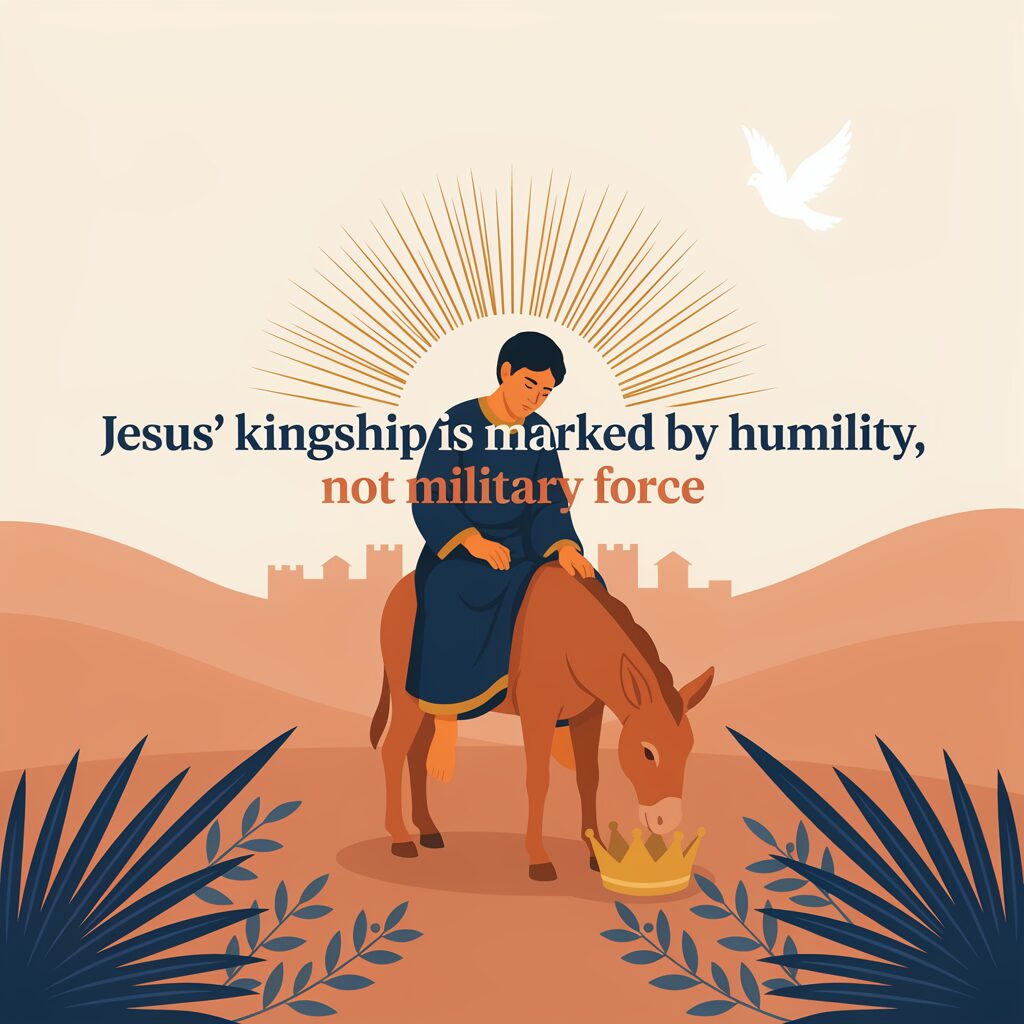
However, as you see from Zechariah’s prophecy, the king is coming, and He is victorious. However, He’s coming peaceably and humbly. He’s not coming for a hostile takeover. He’s coming to bring peace to His people through what He would do on the cross. They just don’t have that perspective, as we will soon find out.
II – The Triumphal Entry (vv. 8-10)
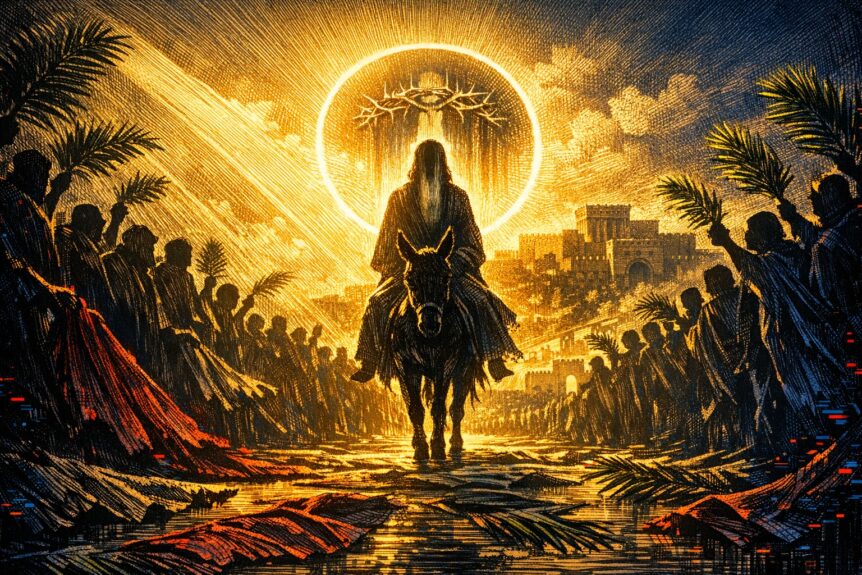
Once the two disciples return with the colt, they lay their cloaks on it as a makeshift saddle, and Jesus begins his approach to Jerusalem. We have considered what these details mean from Jesus’ perspective… how his actions deliberately fulfill the promises about Israel’s coming Messiah. Now Mark shifts our attention to the crowd gathered to welcome him.
The actions of the crowd. The crowd responds to Jesus in two distinct ways. Many spread their cloaks on the road before him, while others cover the road with leafy branches they have cut from the fields. Both actions express excitement, honor, and acceptance. The people are welcoming Jesus as a king.
The branches may carry additional significance. In Israel’s festivals, branches were used to express rejoicing before the Lord (Leviticus 23:40). They were also used during the Maccabean period to celebrate Israel’s military victories and national deliverance. Therefore, the crowd’s actions reflect more than general excitement. They reveal an expectation that Jesus is coming as another victorious deliverer, one who will defeat Israel’s enemies and liberate the nation from Roman rule.
The words of the crowd. The crowd’s declaration has three parts: a blessing bookended by the repeated cry, “Hosanna!”
“Hosanna” is a Greek word derived from a Hebrew expression meaning “Save us, please!” By the first century, it had also become an expression of joyful praise. The crowd is therefore both pleading for salvation and celebrating the one they believe has come to provide it. By shouting this word, they acknowledge their need for deliverance. The only question is what kind of deliverance they have in mind.
Between these cries, the people pronounce two blessings. First, they bless “the one who comes in the name of the Lord”… Jesus himself. Then they bless “the coming kingdom of our father David.” They welcome both the king and the kingdom they believe he is bringing.
Their words are unmistakably messianic. They believe that Jesus is the promised descendant of David, come to restore David’s kingdom. This expectation traces back to God’s promise that one of David’s descendants would reign on his throne and that his kingdom would endure forever.
A portion of the crowd’s declaration comes from Psalm 118:25–26, a psalm that celebrates God’s deliverance and the victory he grants his people. By applying these words to Jesus, the crowd identifies him as the one through whom God’s promised salvation is arriving… only in their minds, He is the greater and better Maccabee who will bring the ultimate hammer down on Rome, and they are throwing a victory-celebration block party in advance.
The heart of the crowd. The scene brims with joy and eager expectation. After centuries of waiting, the people believe their Messiah has finally arrived. It seems to be a beautiful picture of God’s people receiving their promised King.
Yet the events that follow reveal a tragic misunderstanding. Although Jerusalem welcomes Jesus with celebration, the city will soon reject him. We should be careful not to assume that everyone who praised Jesus on Sunday was also in Friday’s crowd demanding his crucifixion. That said, Mark places these two responses in deliberate tension: Jesus enters Jerusalem to the sounds of public praise, but he will leave it under public condemnation.
The people are eager to receive the Messiah they expect: a national deliverer who will overthrow Rome, restore Israel’s independence, and reestablish the glory of David’s kingdom. But they are not prepared for the Messiah Jesus has come to be.
Jesus has indeed come to save his people, but their deepest enemy is not Rome. It is sin. He has come not first to conquer Israel’s political oppressors, but to bear his people’s transgressions, remove their guilt, and rescue them from divine judgment. The crowd wants salvation on its own terms… a political savior… while Jesus has come to provide the salvation they truly need… spiritual and eternal rescue from sin and its consequences.
That is the tension at the heart of the triumphal entry: the crowd rightly recognizes Jesus as King, yet profoundly misunderstands the kind of King He is, the kind of kingdom He will bring, and the kind of salvation He has come to accomplish.
You see, I believe this is the type of tension that leads to a sorrow in Jesus’ heart. They were crying out, “save us”, and blessing Him for the wrong reasons. And there’s a detail in the book of Luke that I think really reveals what’s going on in the heart and mind of Christ.
Luke 19:41–44 CSB
41 As he approached and saw the city, he wept for it, 42 saying, “If you knew this day what would bring peace—but now it is hidden from your eyes. 43 For the days will come on you when your enemies will build a barricade around you, surround you, and hem you in on every side. 44 They will crush you and your children among you to the ground, and they will not leave one stone on another in your midst, because you did not recognize the time when God visited you.”
Jesus enters the city with deep sorrow. He weeps because Jerusalem does not recognize the true path to peace. Many people long for a Messiah who will liberate Israel through military victory, but their pursuit of national freedom will eventually lead to revolt against Rome. In the climactic scene of The Lord of the Rings, Gollum wrestles “his precious” from Frodo’s hands and falls into the river of lava… embracing the ring as he disappears into its infernal flow. Israel will have the war for liberation it longed for, but that revolt will end not in freedom, but in the Roman siege and destruction of Jerusalem in AD 70… the very devastation Jesus describes. The crowd celebrates now because it expects Jesus to defeat Rome, but Jesus grieves because he knows that Jerusalem’s rejection of its true King will place it on a path toward destruction. They miss the reality that Jesus rides into town on a donkey in humility, not on a horse or in a chariot with militant force. In their search for a hardened military general, they miss the coming of the Prince of Peace.
III – Temple Visit (v. 11)
And then all of a sudden, after all that fanfare, after all the celebration, after the proclamations of blessing for Jesus as the coming Messiah, it seems within minutes that it all evaporates. Mark tells us that Jesus goes into the temple, has a good look around, and because it’s late, He goes back to Bethany.
It seems like such an anticlimactic end to such a massive celebration of the long-awaited arrival of their Messiah, doesn’t it? Why does Mark end this scene the way he does?
First, we have to go all the way back to the beginning of Mark. In the second verse, we’re given a prophecy from Malachi chapter 3 that identifies John the Baptist as the messenger who prepares the way of the Lord. But now the Lord is here. What does the Lord do in this verse? To understand that, we must return to Malachi:
Malachi 3:1–2 CSB
1 “See, I am going to send my messenger, and he will clear the way before me. Then the Lord you seek will suddenly come to his temple, the Messenger of the covenant you delight in—see, he is coming,” says the Lord of Armies. 2 But who can endure the day of his coming? And who will be able to stand when he appears? For he will be like a refiner’s fire and like launderer’s bleach.
The Lord you seek will suddenly come to His temple… and He will come to cleanse it. Matthew tells us that Jesus healed the blind and the lame there. Both Matthew and Luke recount a confrontation between Jesus and the Pharisees that will lead to many more throughout the week. The temple was being defiled, and the people loved and celebrated a false version of Jesus they’d crafted into an idol. The adoring ‘crowd’ (not the exact same people, mind you, but the concept we’ve discussed in our studies) we’ve seen swoon over Jesus’ miracles throughout Galilee will stand condemned when they call for His execution.
You see, Jesus didn’t just fulfill prophetic scripture on the cross at the end of Passion Week … He was fulfilling it at the beginning and all the way through. This moment of going into the Temple after all that fanfare is not a sad end to a triumphant entry… It’s the calm before the storm. Jesus came to the temple to survey the sinful and filthy conditions of His Father’s house, because the time of cleansing was almost upon them.
But for now, it’s late, so they went back to Bethany. Next week, however, we will see the cleansing begin.
🔥 Application:
As we come to a close today, we need to wrestle with a few things in the eye of the storm. For anyone familiar with Israel’s Scriptures, the message was unmistakable: the promised King had arrived just as God had foretold. Yet Mark’s presentation of this scene also offers every reader a warning, whether you are encountering Jesus for the first time or have followed him for decades:
Do not mistake enthusiasm about Jesus for genuine faith in Jesus. Do not let the excitement of a crowd become the foundation of your devotion. And do not worship a version of Jesus you built yourself.
Let the finished work of Christ, not the mood of the room, be what launches your joy on Sunday morning into the rest of the week.
The crowd is passionate. They praise Jesus publicly, call upon him to save them, and welcome the kingdom they believe he is bringing. Yet their enthusiasm is shaped by their expectations. They want a Messiah who will defeat Rome, restore Israel’s national glory, and grant them the victory they seek. Jesus has come to bring a far greater salvation, but it will require him to confront their sin and challenge their expectations.
That same temptation still lingers with us. We can become excited about a Jesus who supports our ambitions, affirms our assumptions, advances our politics, protects our comfort, or promises the life we believe we deserve. But what happens when the real Jesus does not conform to the one we have imagined? What happens when he challenges us, upends our expectations, or leads us through suffering rather than around it?
This pattern lies beneath at least some of what is now called deconstruction. Certainly, people reconsider their faith for many reasons, and some respond to genuine wounds, hypocrisy, or serious questions the church has handled poorly. But sometimes what is rejected is a Christianity built on false promises and a Jesus that caters to their desires. When the Jesus of Scripture refuses to conform to that image, their faith collapses, and they walk away from the faith.
That is the warning of the triumphal entry. It is possible to sing about Jesus, celebrate Jesus, and even call Jesus “King” while resisting His authority and rejecting the kind of salvation we really need.
True discipleship begins when we receive Jesus on His terms, not merely as the King we want, but as the King we need. He did not come merely to defeat the enemies around us; He came to defeat the sin within us. He did not come merely to improve our present circumstances; He came to reconcile us to the Father. And He does not ask us simply to join the celebration. He calls us to welcome Him as He is… to deny ourselves, take up our cross, and follow Him through the streets of Jerusalem to the cross.
As we transition into a time of communion, I want to leave you with this question: “Which Jesus are you waving palm branches for this morning: the one you’ve imagined, or the one who’s actually walking toward the cross?”
FAQs
1. Why did Jesus ride a donkey instead of a horse?
A donkey signified peace, humility, and rightful kingship. Jesus wasn’t arriving as a military conqueror, but as the promised King who would bring peace through His sacrifice.
2. Did the crowd truly believe Jesus was the Messiah?
Yes, in a sense—they recognized Him as the promised King. But their understanding was incomplete and distorted by political expectations.
3. Were the same people praising Jesus later calling for His crucifixion?
Not necessarily the exact same individuals, but Mark intentionally places these scenes in tension to show how quickly public enthusiasm can turn when expectations are unmet.
4. What does “Hosanna” really mean?
It originally meant “save us, please,” but had also become an expression of praise. The crowd was both celebrating and pleading—though for the wrong kind of salvation.
5. Why does Jesus weep over Jerusalem?
He sees that they are rejecting the true path to peace. Their desire for political liberation will lead to destruction because they miss the salvation He offers.
6. What is the significance of Jesus visiting the temple and leaving?
It fulfills prophecy (Malachi 3) and signals that judgment is coming. Jesus is inspecting what He will soon cleanse.
7. How does this passage challenge modern Christians?
It confronts our tendency to reshape Jesus around our preferences—whether political, personal, or cultural—rather than submitting to Him as Lord.
8. What does it mean to receive Jesus “on His terms”?
It means trusting Him as Savior from sin, submitting to His authority, and following Him—even when it disrupts our expectations or leads us through suffering