Highlight Reel
Sermon Summary
In Mark 12:18–27, the Sadducees bring Jesus an absurd hypothetical meant to discredit the resurrection. Jesus answers by exposing their deeper error: they have mishandled Scripture and underestimated the power of God. Resurrection life is not merely an extension of life in this fallen world, and God’s covenant relationship with Abraham, Isaac, and Jacob proves that He is the God of the living. The call is clear: stop arranging God’s truth according to your own assumptions, and abide in the whole counsel of His Word.
Sermon Audio
Shareable Quote graphics
Sermon Text
Missing the Big Picture
Nate Roten / Mark 12:18–27 / September 6, 2026
Core Message
Scripture reveals the power of God and the knowledge of God that hinders self-deception.
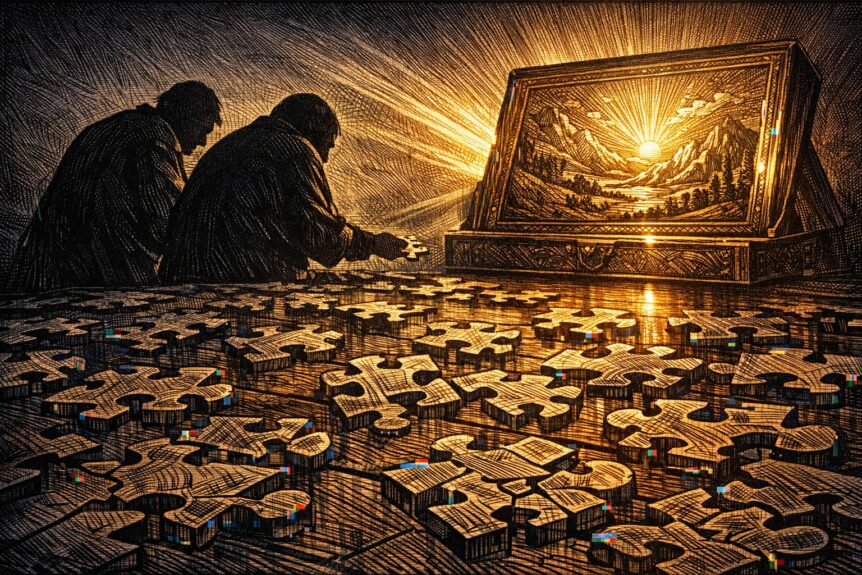
Have you ever watched someone assemble a puzzle? Maybe you’ve visited with grandparents who love puzzles so much that they have a dedicated table for them. Imagine watching their diligence as they look at the picture on the box and then search for the right piece with the right shape and color. But imagine for a moment watching them assemble one without looking at the picture on the box. What would that look like?
They might pick up a dark-blue piece and assume it belongs in the ocean. Then, they find several green pieces and decide they must form a forest. You notice that many pieces are still in the box and not on the table. Then, they begin forcing everything together according to the picture developing in their own mind. But you know something is off, so you look at the box’s image. There, you discover that the blue piece belonged to the night sky, not the ocean. The green pieces don’t belong to a forest, but are a part of a field. Quickly, you realize they had been building something completely wrong and different than the original design.
The problem was not that they lacked real pieces. Every piece on the table genuinely belonged to the puzzle, but they all fit together, and many were unused. The problem was that they were arranging those pieces according to their assumptions rather than the author’s provided picture. By the end, your grandparents had become too confident in their own interpretation, and in doing so, wandered further from the truth of what the real picture was.
In many ways, that is the core issue at the heart of Jesus’ next interaction with the Sanhedrin representatives.
Passage
Mark 12:18–27 CSB
18 Sadducees, who say there is no resurrection, came to him and questioned him: 19 “Teacher, Moses wrote for us that if a man’s brother dies, leaving a wife behind but no child, that man should take the wife and raise up offspring for his brother. 20 There were seven brothers. The first married a woman, and dying, left no offspring. 21 The second also took her, and he died, leaving no offspring. And the third likewise. 22 None of the seven left offspring. Last of all, the woman died too. 23 In the resurrection, when they rise, whose wife will she be, since the seven had married her?” 24 Jesus spoke to them, “Isn’t this the reason why you’re mistaken: you don’t know the Scriptures or the power of God? 25 For when they rise from the dead, they neither marry nor are given in marriage but are like angels in heaven. 26 And as for the dead being raised—haven’t you read in the book of Moses, in the passage about the burning bush, how God said to him: I am the God of Abraham and the God of Isaac and the God of Jacob? 27 He is not the God of the dead but of the living. You are badly mistaken.”
I – The Sadducees (v. 18)
Position. The next group to confront Jesus is the Sadducees. Unlike the Pharisees, who had influence among ordinary Jewish people, the Sadducees were closely associated with Jerusalem’s wealthy priestly aristocracy. They held considerable influence over the temple and included members of the high-priestly establishment. Their position gave them religious authority, political influence, and a strong interest in preserving the existing order. Their power was tied to Jerusalem, the priesthood, and the temple system. If we were trying to translate these groups into modern categories, the Pharisees would be like popular pastors, Bible teachers, and religious commentators whom ordinary people listen to and trust. The Sadducees were different. They were the wealthy and politically connected religious establishment. Think of them as powerful old-money families that control town and church politics, powerful political donors, and government leaders, all rolled into one. The Pharisees influenced the people; the Sadducees controlled the institution.
Beliefs. The Sadducees also differed from the Pharisees in their beliefs. They rejected the Pharisees’ oral traditions and denied the resurrection of the dead. According to Acts 23:8, they also denied angels and spirits. They appear to have placed particular emphasis on the five books of Moses, which they believed contained no clear teaching on bodily resurrection. While the Pharisees and many other Jews expected a future resurrection, the Sadducees, interestingly, held views similar to modern-day atheists… that death brought a person’s existence to an end. There would be no resurrected body, no future judgment, and no reward in the world to come. They claimed to know this through their thorough knowledge of their select scriptures and expressed it with the confidence afforded by their political power.
Purpose of the confrontation. That explains the purpose of their question. Their goal was to embarrass Jesus publicly, discredit a doctrine they rejected, and demonstrate the intellectual superiority of their own position. They aren’t coming to Jesus because they sincerely want to understand the resurrection any more than the Pharisees wanted to genuinely know whether they should pay the poll tax. They have constructed an absurd hypothetical situation, hoping to make belief in a resurrection look ridiculous.
Already, we see how they are at odds with Jesus. They reject the lion’s share of Jewish scripture, leading to a faulty understanding of life after death. This, in turn, feeds their narcissistic lifestyle of power and political prestige. After all, if there is no life after death, then I’d better get the most out of this one, right?
But as with every group that has confronted Him, they are about to discover that Jesus understands both the Scriptures and the power of God far better than they do.
II – Retaliation: Round Two (vv. 19-23)
Designed absurdity. So, in their arrogance, they unpack a story about a woman who was married to a brother, died, and then remarried each of the seven brothers, hoping for an heir, but at the end of her life she had gone through all seven brothers and produced no heir. This is clearly a design by the Sadducees to make it seem utterly ridiculous to believe in a resurrection in which this woman would have seven husbands. So they’re using extreme hyperbolic scenarios to drive home their point about the absurdity of believing in an afterlife.
OT mandates – And one of the reasons people should take this seriously is that there are real Old Testament mandates that are assumed and understood in this story.
The first is the Edenic mandate to be fruitful and multiply. This command was first given to Adam and Eve in the garden and later to Noah and his descendants after the flood wiped out every other family on earth. The Jews took this command seriously. God wants His world populated with faithful followers. Along with being given dominion over the earth and the authority to subdue it, we’re supposed to fill it with God-fearing believers and Yahweh, the one true God.
The second mandate comes from Deuteronomy and is a Mosaic law God gave to provide offspring for a man who died prematurely. In this scenario, if the deceased man has a brother, the brother is supposed to take his widow, marry her, and the firstborn son of their union would be considered the son of the deceased brother, thereby carrying on his family lineage and protecting that family’s allotted inheritance. In other places in Scripture, if there is no direct sibling, the closest of kin can perform the same function, as we see in the book of Ruth, where Boaz becomes the kinsman-redeemer, taking Ruth as his wife to produce an heir and protect their family’s inheritance.
These aren’t invented conditions. The Jews took seriously the command to be fruitful and multiply, and when death interrupted that command early, a brother or a kinsman stepped in to carry the family line forward, the way Boaz did for Ruth. The obligation was real. What the Sadducees did was take that real obligation and stretch it seven times over into a scenario no faithful Israelite would ever actually face, then hold it up and ask the crowd to laugh at the resurrection along with them. It is the doctrine of resurrection held up to a carnival mirror. The reflection starts with something true, but by the time they finish twisting it, they point at the distortion and call it the original. And if there were any Sadducees who heard Jesus predict His own resurrection, it would also be a direct refutation of Jesus’ own words.
I think they can get away with this because they really only hold the first five books of the Jewish scriptures as authoritative. And in those first five, you don’t really get a clear and fully formed doctrine of a resurrection. Therefore, because they don’t accept all of God’s word, they end up way off base in their theology, and worse, they make fun of those who are firm in their faith.
Like the Pharisees, the Sadducees feel they have Jesus in a gotcha moment. This may not have been as dire a circumstance for Jesus as one that would get Him in political trouble or ultimately killed, but it would shame and humiliate Him, thereby diminishing His authority and good standing in the eyes of the crowd. That idea, however, would be incredibly short-lived.
III – Two Points of Self-Deception (vv. 24-27)
Jesus responds to their elaborate scenario with a direct question: “Are you not mistaken because you do not know the Scriptures or the power of God?” Before answering their question, He diagnoses the error behind it. The word translated “mistaken” conveys the idea of straying from the truth or being deceived. This is not merely an innocent misunderstanding due to insufficient information. The Sadducees have reached the wrong conclusion because they have mishandled God’s revelation. Jesus identifies two reasons for their error.
First, Jesus says they don’t know the scriptures. Think about how devastating that charge is against men who built their entire identity on being religious authorities. Of all people, they should have understood what God revealed. But here’s their blind spot: they accepted the books of Moses and rejected everything else: the prophets, the historical books, the Psalms, all of it. So when Jesus says “you don’t know the Scriptures,” he doesn’t mean they never opened a scroll. He means they had drawn a hard line around how much of God’s revelation they were willing to receive, and then mistook the smaller picture inside that line for the whole picture. They created their own puzzle image. Suppose you work for me; we’re employed at a large corporation. My responsibility is to keep all employees informed about company policies and updates to key documents. To do this, I send a weekly memo every Monday. If you only pay attention to the first sentence of my memo and read just one memo a month, how well do you think you’ll perform as an employee?
It’s far easier to rule out any understanding of the resurrection if you rule out the books that talk about it. So you can immediately see the big issue that Jesus is dealing with. You can come up with all sorts of beliefs if you rule out the authority of Scripture. But this led to an even deeper error in their thinking, which leads us to the second point.
Second, you don’t know the power of God. The Sadducees’ second error is that they do not know the power of God. This is closely connected to their ignorance of Scripture, which reveals what God is capable of doing. The God who created life, preserved humanity through the flood, opened Sarah’s barren womb, devastated Egypt with plagues, divided the sea, and sustained His people in the wilderness is fully capable of raising the dead. The Sadducees had read those accounts in the books of Moses. Their problem was not a lack of evidence. Their problem was that they had failed to grasp what those events revealed about the God they claimed to worship.
All of that work, however, pertains to life on earth and to God’s blessings over His people, giving them a physical land. Many of the stories about the powers of heaven, angels, and the Old Testament saints’ awareness of life after death come later in the books they reject. So they see the power of God in physical blessings, the material blessings of houses and vineyards in the promised land, but not so much the eternal rewards that come after we die. But there are so many more things that God has done in Israel’s past, recorded in the historical documents of 1 and 2 Kings and books like those, in the writings of the prophets who prophesied during times of captivity, and in the Psalms of King David and the Proverbs of Solomon. They’re missing out on all of God’s miraculous work in those writings.
Therefore, they mock the idea of life after death, assuming that resurrection life must be nothing more than an extension of life as we presently know it. Because people marry here, they assume people must marry there. Their entire argument depends on carrying the structures of this age unchanged into the age to come.
Here is what they missed… Scripture reveals the power of God and prevents self-deception. Had they not neglected the majority of God’s revelation, they might not have made such a major error. That happened in Jesus’ day, and it still happens today. When we believe we can pick and choose what to believe, it leads to a multitude of errors. For the Bible to be authoritative in my life, I must believe it is reliable and inerrant. If it is inerrant, I must receive all of it. It’s either all true and faithful or none of it is. If it’s inaccurate or false in one area, how can I trust the rest?
And this is where Jesus goes. He’s not going to leave them in obscurity, neither the Sadducees nor the crowd that is listening in on this confrontation.
IV – The Truths They Missed
So Jesus addresses both of these issues.
Regarding their knowledge of Scripture, He corrects their misunderstanding of the nature of marriage. Marriage is a human institution on earth, given by God for procreation within a faithful relationship that reflects God’s devotion to His people. That’s the gist of the understanding we see embedded in their story… the command to be fruitful and multiply, and how to handle that command when one of us dies prematurely.
But they’re mistaken in assuming that our relationships here on earth will be reflected in the life to come. We also know from New Testament Scripture that a core purpose of marriage is for us to reflect the relationship that Jesus has with His church. But when the fullness of time comes, there won’t be a need for that demonstration. We will all have eternal life with God, and we will not need to procreate. At that point, the illustration of Jesus’ love for His church will have been fulfilled because we will all be there together. There will be no one else to demonstrate it to who doesn’t already know Him. At that point, we will have consummated our marriage with Christ at the marriage supper of the Lamb, and we will all be there together. The purposes of human marriage will have been fulfilled. And if you are carrying grief this week for someone you love who has died in Christ, let this comfort you: He is not their God because they are gone; He is their God because they are alive in His presence.
And I think one of the hardest things for us to wrestle with now is the thought of losing the covenant relationship we have with the person we love most. The thought of that not being present in the life to come is disturbing for many of us, but we have to understand that we enjoy this relationship with our spouse now in an imperfect world. In the life to come, we’ll be fully redeemed and complete in our love, which is founded in Christ. With one another, we will all share a perfect love in the light of the perfect love that comes from Christ, and we will be able to enjoy a relationship with Him face to face. There will be no lack in our love. In this way, we’ll be like the angels in heaven. It doesn’t mean that we’re going to have wings and we’re going to be playing harps, but it does mean that we’ll have a body that’s different from the body we exist in now. And we’ll be in the perfect presence of Christ, in the fullness of His love, and we will have everything that we hope for in the here and now.
And concerning His power, God has demonstrated multiple times in the past, even in the Old Testament, that He can resurrect the dead. We see this a few times in Scripture. For example, when Elijah brings the son of the widow he was ministering to back to life. We also have a sense that he continues to live because he was taken into heaven before he died. In terms of Jesus being God and claiming that He is going to die and be resurrected, this is also the claim that is happening in real time, which the Sadducees are denying.
But remember, they don’t believe Jesus is God, and they don’t consider the books of Kings to be authoritative, so Jesus confirms this truth using the scriptures they do accept. When Jesus quotes the verse, “I am the God of Abraham, Isaac, and Jacob,” He is quoting Exodus 3:6, where Moses stood before God at the burning bush. The Sadducees would not have rejected this iconic moment, yet they failed to realize what God was communicating. God didn’t say that He used to be the God of the patriarchs until they died. No, long after they were dead and gone from the earth, God said, “I am.” I currently am their God. How could He make a statement of a current, existing relationship with them if they weren’t still alive? Answer… you can’t! God is not a God of dead people, but of living people. The author of life gives eternal life to His children.
Scripture reveals the power of God and the knowledge of God that hinder self-deception. There is life after this one, and it won’t just be a shinier, mirrored version of our earthly existence. Our minds cannot comprehend the glory of what is to come, but God does give us small glimpses in His word. Our job is to seek them out and lean on the all-powerful God for understanding.
So, in closing…
Application: Avoid self-deception by abiding in the Scriptures
Remember your grandparents at that puzzle table, so confident, so diligent, and so wrong, because they never turned to look at the picture on the box. That’s the Sadducees. That’s any of us, honestly, when we decide which parts of God’s revelation are worth keeping out and which pieces we’d rather leave in the box. The tragedy was never that they lacked real pieces. Every doctrine they held, every command they kept, was a genuine piece of God’s puzzle. The tragedy is that they refused the rest of the box lid, the prophets, the promises, the picture of resurrection life, and so they built something confident, sincere, and entirely wrong. Jesus doesn’t hand the Sadducees a new piece that day. He turns them back to the box lid they already owned and had refused to look at. That is still His invitation to us. Not more effort forcing pieces together, but a willingness to receive the whole picture He has already given.
The remedy for spiritual error is therefore not greater confidence in our own reasoning. It is recognizing our human limitations in comprehending spiritual truths and humbly submitting to God’s Word and guidance. This brings us back to a core theme in Mark’s gospel… dependent trust. Scripture tells us what God has promised, and His power assures us He can accomplish it. The question for us is… will we walk in faith, trusting His word and power to shape us?
One action step for this week: Are you reading Scripture daily? If you aren’t in His word, how will you know what to obey? How will you know what He is asking you to trust? How will you know His power and trustworthiness? This week’s action step is to commit to consistency. Begin that daily rhythm of opening His word and being in His presence, then simply ask Him to guide you in it.
FAQs
1. Who were the Sadducees?
The Sadducees were wealthy, politically connected religious leaders closely tied to Jerusalem, the priesthood, and the temple. Unlike the Pharisees, they denied the resurrection and rejected much of the Old Testament Scriptures as authoritative.
2. Why did the Sadducees ask Jesus about seven brothers and one wife?
They were not sincerely seeking understanding. They created an exaggerated scenario based on the Old Testament law of levirate marriage in order to make belief in resurrection appear absurd.
3. Does Jesus teach that marriage will not exist in the resurrection?
Yes. Jesus teaches that those raised from the dead “neither marry nor are given in marriage.” Marriage is a holy gift for this age, but its earthly purposes—including procreation and its picture of Christ’s love for the church—will be fulfilled in the age to come.
4. Does this mean believers will not know or love their spouses in heaven?
No. Jesus does not teach that redeemed relationships will be erased. He teaches that earthly marriage will no longer define life in the resurrection. In Christ, believers will enjoy perfect love and fellowship without loss, sin, death, or lack.
5. Will believers become angels after death?
No. Jesus says the resurrected are “like angels” in that they do not marry. Christians do not become angels; God promises the resurrection of His people.
6. How does Exodus 3:6 support the resurrection?
When God spoke to Moses, Abraham, Isaac, and Jacob had long been dead. Yet God said, “I am the God of Abraham… Isaac… and Jacob.” His covenant relationship with them was not over, because He is not the God of the dead but of the living.
7. Why is selective belief in Scripture so dangerous?
When we decide beforehand which parts of God’s Word we will accept, we begin arranging truth around our own assumptions. The result may sound religious and confident, but it leads us away from the God who has spoken.
8. What is the practical response to this passage?
Abide in Scripture. Commit to daily time in God’s Word, asking Him to expose your blind spots, teach you what to trust, and shape your life in obedience to Christ.