Highlight Reel
Sermon Summary
Who is Jesus? In Mark 12:35–37, Jesus presses the crowd beyond a partial understanding of the Messiah. He is David’s son, but He is also David’s Lord—the divine Son who died for sinners, rose in victory, and now reigns at the Father’s right hand. Join us as we consider what it means to confess that Jesus is Lord and live like it is true.
Sermon Audio
Shareable Quote graphics
Sermon Text
Is the Messiah Human or Divine?
Nate Roten / Mark 12:35–37 / Sept. 20, 2026
Core Message
The Messiah is not just a man blessed by God; He is God.
When I was seventeen, I had a crisis moment. I had believed I was a Christian since I was seven years old, but for about six months I really had to wrestle with that understanding. In high school, I had two very distinct friend groups: my football buddies, with whom I could be worldly, and my friends with FCA (Fellowship of Christian Athletes), with whom I could be more Christian. My dad ran the local FCA chapter and named me a student leader. About a week before our next gathering, my dad asked me to give my testimony, and it was then that I realized I did not have one. As I thought through my life since I ‘accepted Jesus’ at seven years old, I couldn’t point to anything I could call fruit. That one question thrust me into six months of wrestling with my double-mindedness. I continued living a very worldly life while trying to reconcile that with the faith I professed to have.
By God’s grace, Jesus finally got ahold of me and showed me my sinfulness and need for repentance. I finally came to a place where I could receive the news of my sinful self and of Him as Lord and Savior. But that journey began with a simple question. It was a seed that continued to grow in me, forcing me to see the truth of the gospel and of myself.
Today, Jesus asks a similar question about the identity of the Messiah, a seed that will now grow into a platform for the church to proclaim the gospel to the entire world.
Passage
Mark 12:35–37 CSB
35 While Jesus was teaching in the temple, he asked, “How can the scribes say that the Messiah is the son of David? 36 David himself says by the Holy Spirit: The Lord declared to my Lord, ‘Sit at my right hand until I put your enemies under your feet.’ 37 David himself calls him ‘Lord.’ How, then, can he be his son?” And the large crowd was listening to him with delight.
I – Round 4 – Jesus Speaks
Jesus is now teaching in the Temple. This is Jesus doing what He said He would do and what was prophesied about Him:
- Remember all the way back in Mark 1, when Jesus left the crowd on Peter’s front porch? He told the disciples they were going to the next town so He could preach… that is why He came.
- Remember also that when Jesus began His ministry, He proclaimed the gospel of God, saying, “The time is fulfilled, and the kingdom of God is at hand. Repent and believe in the gospel.”
- In terms of prophecy, remember that Malachi said the Lord of the temple is coming to cleanse His temple. Jesus has done that. He literally cleared the temple of the money changers, and now He’s cleared away misunderstandings and poor theology.
They’ve all had their chance to either entrap or humiliate Jesus with lies and deceit. Now, with a cleaner slate, Jesus is going to ask them a question that will reveal the truth. And not just any truth… but the truth about Himself. Many confess Jesus as the Messiah and believe the Messiah will be blessed by God… but they don’t necessarily believe that the Messiah is God. And, as we have seen over the last few weeks, knowledge about the Messiah is not enough… you must also believe in who He says He is, which leads to a loving relationship with Him.
That is what Jesus intends to correct.
II – Messianic Question (vv. 35-36)
Jesus asks a question about the Messiah’s physical lineage: “How can the scribes say that the Messiah is the son of David?” I believe this was a softball question meant to engage the people (the crowd and the scribes). Everyone anticipates the Messiah as a human ruler who will establish God’s rule over Israel. That’s why the crowd shouted Hosanna just a couple of days earlier as Jesus rode into Jerusalem: they fully believed in the Messiah’s humanity. He may be blessed by God, but he’s a human ruler nonetheless, a literal descendant of King David. The scribes would have readily had dozens of Old Testament passages to offer as an answer to this question.
Here are a few just so we can see it, but no doubt they had many others.
2 Samuel 7:12 CSB
12 When your time comes and you rest with your ancestors, I will raise up after you your descendant, who will come from your body, and I will establish his kingdom.
Jeremiah 23:5–6 CSB
5 “Look, the days are coming”—this is the Lord’s declaration— “when I will raise up a Righteous Branch for David. He will reign wisely as king and administer justice and righteousness in the land. 6 In his days Judah will be saved, and Israel will dwell securely. This is the name he will be called: The Lord Is Our Righteousness.
Psalm 89:1–4 CSB
1 I will sing about the Lord’s faithful love forever; I will proclaim your faithfulness to all generations with my mouth. 2 For I will declare, “Faithful love is built up forever; you establish your faithfulness in the heavens.” 3 The Lord said, “I have made a covenant with my chosen one; I have sworn an oath to David my servant: 4 ‘I will establish your offspring forever and build up your throne for all generations.’ ” Selah
So, as we begin, we can see how this question appeals to what they already believe and accept. Just as people would have said yes and amen to Jesus when He quoted the Shema, pointing to the greatest command, they would have said yes and amen to the Messiah’s identity as the son of David. This is a move I’ve seen skilled communicators use. Get the room nodding yes on something easy, before you ask them to reckon with something hard. Get agreement flowing downhill, so it carries the weight of the real question when it comes.
That’s what Jesus is doing. He’s standing in the Temple, having just survived three rounds of men trying to trap Him in His words, and He is about to ask a question that will do to their whole understanding of the Messiah what He did to the money changers’ tables. He’s clearing the ground first. Everyone nods along on “the Messiah is David’s son.” Nobody in that crowd would argue. That agreement leads to another question everything will turn on.
I’ll call this the hinge question.
Once again, from the scribe’s perspective, this is all knowledge. They know in their minds that the Messiah is a human ruler from the lineage of David, blessed by God. But that alone is only half the picture. They may have cried out with their mouths for physical deliverance, but they haven’t yet rightly understood the depths of their spiritual needs. And if they don’t comprehend their spiritual need, they’ll never cry out to a Messiah who will set them free from spiritual death. A human savior cannot save people from their sins. Only God Himself can do that.
Therefore, Jesus takes the positive momentum in that exact direction.
III – Hinge Question (v. 37)
Next, Jesus lays the foundation of inspired Scripture so He can set the hinge question on top of it. Notice what He says next. He says, “David himself says by the Holy Spirit.” That one statement reveals an important truth about Scripture. No one in the crowd would have disputed that David wrote Psalm 110, but Jesus says these were not merely David’s personal thoughts. David spoke under the inspiration of the Holy Spirit. God communicated His truth through a human author. Therefore, if David said this by the Spirit, the crowd could not simply dismiss it. Jesus is establishing another point of agreement before asking them to reckon with its implications.
To understand Jesus’ argument, we need to examine the verse He quotes. Psalm 110:1 says:
Psalm 110:1 CSB
1 This is the declaration of the Lord to my Lord: “Sit at my right hand until I make your enemies your footstool.”
The declaration comes from the first Lord. In Hebrew, this is Yahweh, the covenant name of the God of Israel. Yahweh speaks and makes a declaration to someone David identifies as “my Lord.” The question is this: Who is this second figure whom David regards as his superior?
The second Lord. The expression translated “my Lord” is Adonai, a title of honor used for someone possessing authority or superiority. They are the head sovereign authority and ruler. Sarah called Abraham “my lord.” Rachel called her father Laban “my lord.” Jacob told his own messengers to call his brother Esau “my lord.” It’s a word for someone above you. A boss. A master. A king. It does not, by itself, mean God. So here’s what makes this strange. David is the king. There is no one above David in Israel, except Yahweh Himself. David does not call his sons “my lord.” Kings don’t do that. And yet here, David looks down the line at his own descendant, someone who has not even been born yet, and calls Him “my lord.”
That’s the puzzle Jesus wants them sitting in.
Originally, Psalm 110 served as a coronation hymn for the kings of Judah and Israel, in which God declared that the earthly king would be seated at God’s right hand as His vicegerent. After the monarchy’s destruction in 586 B.C., when Babylon leveled Jerusalem, Psalm 110 was frequently reinterpreted to refer to the Messiah, whose kingdom (unlike David’s) would not fail. This reinterpretation was already well established by Jesus’ time. Therefore, it’s helpful for us to understand that Jesus’ audience viewed this verse as a messianic psalm. There is no confusion about this, which is why this is such a sturdy platform on which to ask the hinge question.
“David himself calls him ‘Lord.’ How, then, can he be his son?” Put another way, Jesus is essentially asking, “Is this David’s son or David’s Lord?”
Imagine a young boy who knows his dad is in the military. At home, though, the boy simply knows him as Dad. He eats breakfast with him, plays with him, and climbs into his lap. But one day, the boy visits him at work on the military base. He watches as his father walks into a room and expects him to sit among the hundreds of other soldiers. To his amazement, as his dad walks in, everyone stands at attention, and the entire room erupts in strong voices saying in unison, “Good morning, Sir!” For the first time, the boy realizes that the man he knows as ‘dad’ possesses an authority he had never fully understood. He is ‘dad,’ but he is also ‘Commander.’ The boy was never wrong to call him dad. That identity was true, but it was not the whole truth. In the same way, the religious leaders were not wrong to call the Messiah the son of David. He truly would come from David’s family line. But that title did not exhaust His identity. The Messiah would be David’s descendant, yet He would possess such surpassing authority that David himself called Him “my Lord.”
David called the Messiah “my Lord” (Adonai) despite the fact that He would be David’s physical descendant and thus, in Jewish thinking, dependent upon David rather than superior to him. This reversal of the traditional hierarchy is deliberate. The roles in the illustration are reversed. If David never addressed his actual sons with this title of exalted authority, then calling a descendant “my Lord” signals something extraordinary about that descendant’s position. It’s not just a matter of importance but of status. David’s descendant will be exalted to a throne, not an earthly one, but a heavenly one at the right hand of Yahweh. And that matters, because this is an interaction taking place while David is still alive to witness it. The grammar is: in the past, Yahweh declared to my Adonai, sit at my right hand, until I put your enemies under your feet. That never happened with David’s sons. And for this to be a descendant, and yet someone who is transcendent and existing, must be someone more than human.
Then add to that the understanding that after 586 BC, the Davidic throne, in earthly terms, is gone. They were defeated by another pagan nation. They rebuilt Jerusalem for a time, but it again fell to other global rulers. And during Jesus’ day, there was no physical throne of David. That’s why, after Babylon reduced Jerusalem to rubble, this became a messianic psalm. Some misunderstanding seems to exist about the Messiah’s supernatural nature. Perhaps because it was once used as a coronation psalm for human rulers, people stopped looking at it carefully enough to understand the Messiah’s divine nature. David must have regarded this messianic descendant of his as something more than an ordinary man. He called Him “my Lord” because he recognized Him as deity, entitled to sit at the right hand of Yahweh. The argument doesn’t deny Davidic descent, but it does show that the Messiah transcends David as Lord. A human descendant cannot simultaneously be subordinate (as a son) and superior (as a lord) unless that figure possesses a transcendent status that goes far beyond human lineage.
Like the boy who knew his father as dad but not as Commander, the scribes knew the Messiah as a human descendant of David, but not as the Son of God. But this passage, when examined carefully, stretches their understanding. Jesus uses it to help them see that the Messiah is not just a man blessed by God; He is God.
IV – Why Jesus Makes This Point
When you think about it, responding to all these questions designed to entrap and humiliate Him seems like an odd reply on its face. Why would Jesus allude to the divine nature of the Messiah in response to questions about Himself? And why would He do it so covertly?
The answer to that question is simple. This is a core foundational truth the church professes. In a few days’ time, at His faux trial before the Sanhedrin, He will plainly confirm His identity as the Messiah, which will lead to His swift crucifixion. The time is near, but not yet. Jesus still has a few days of work to do. So He gives them this understanding in seed form. Much like the question my dad posed to me when I was 17 years old, which caused me to do some soul-searching and eventually led to my conversion. So Jesus is forcing them to think through the natural implications not only of the Messiah being divine but also of the proclamation that He is this Messiah.
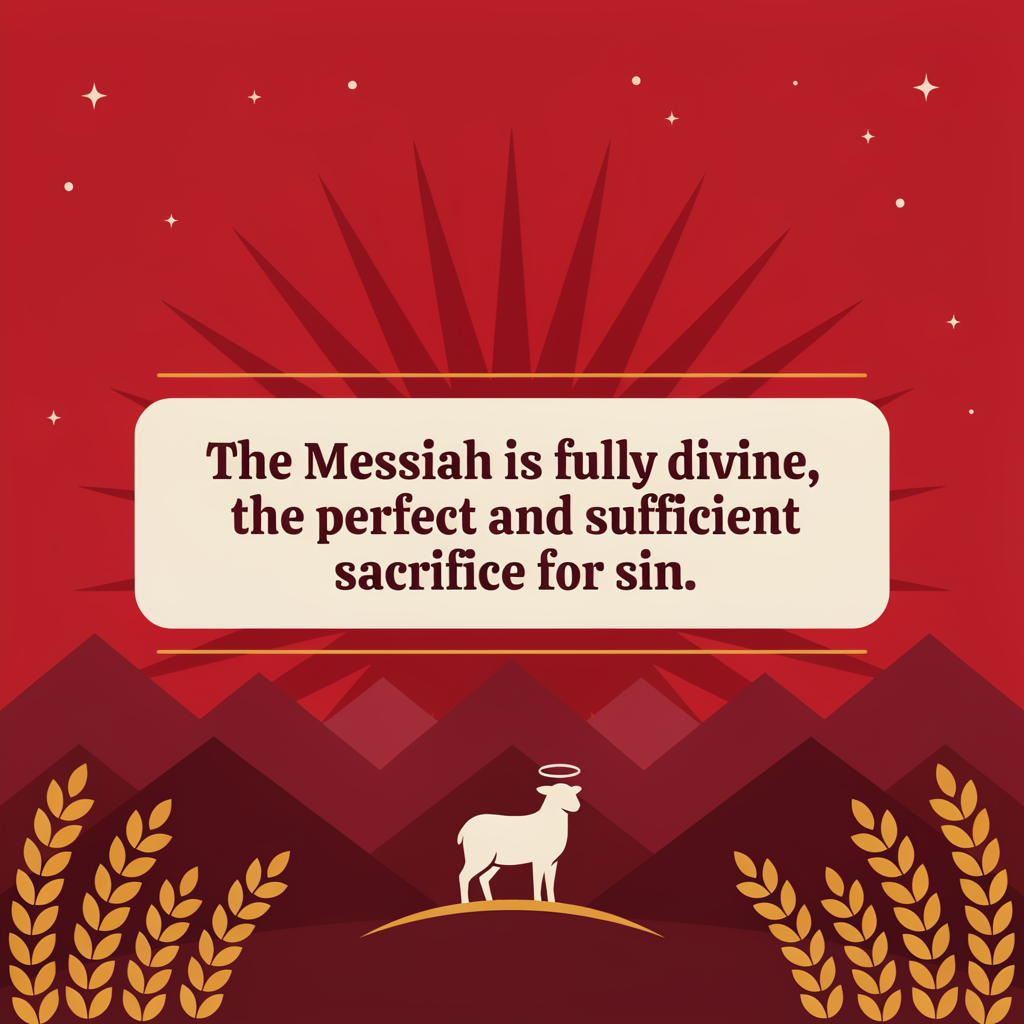
This is immensely important because the Messiah is the eternal ruler of God’s kingdom, and Jesus Himself said He was the only way in. He is the door… He is the way, the truth, and the life. If you want to be with the Father and in His Kingdom, you must receive Him. Therefore, if you are wrong about Jesus and reject this message, it will cost you your soul. Is Jesus human or divine? He is both. He is human so He can be a sacrifice and a relatable High Priest for humans. He is divine because only God can be the acceptable, perfect, unblemished sacrifice. This is the core message of our faith. In fact, Peter will later declare this point at Pentecost and use it as the foundational call to repentance for all.
Acts 2:34–36 CSB
34 For it was not David who ascended into the heavens, but he himself says: The Lord declared to my Lord, ‘Sit at my right hand 35 until I make your enemies your footstool.’ 36 “Therefore let all the house of Israel know with certainty that God has made this Jesus, whom you crucified, both Lord and Messiah.”
When the Jews heard this message, thousands came into the kingdom.
As we come to a close today, let me say this plainly: Jesus’ status is unchanged. Jesus is Lord. He came to us as a man, humbled Himself as a servant, and became obedient to the point of death on the cross, where He paid the penalty for our sins. But He did not remain in the grave. He rose in victory, ascended into heaven, and now sits at the Father’s right hand, possessing all power and authority. He is not merely a good man who received God’s blessing. He is the divine Son, David’s descendant and David’s Lord, the sovereign King before whom every enemy will eventually bow.
That truth demands a response. You can receive Him as Lord, trust in His finished work, have your sins forgiven, and enter His kingdom as a son or daughter. Or you can reject His authority and remain under condemnation for your sin. There is no neutral position before the King. Delaying a decision does not diminish His sovereignty, and refusing to bow does not remove Him from His throne.
If you are seeking the truth or have remained on the fence about Jesus’ identity, Scripture calls you to make a decision. The question is not whether you admire Jesus, respect His teaching, or consider Him an important religious figure. The question is the one Jesus posed to the scribes: Who is He? If He is truly the crucified and risen Lord, He deserves more than your admiration. He deserves your faith, your worship, and your life.
But this truth also applies to those of us who already confess that Jesus is Lord. We may affirm His sovereignty with our mouths while struggling to trust it in the uncertain places of life. We worry about the future as though He were not already there. We cling to control as though everything depended on us. We tolerate sin as though His commands were suggestions, and we despair in suffering as though our pain had somehow escaped His notice.
So ask yourself, right now, honestly: is Jesus the sovereign Lord, seated at the right hand of Yahweh, or not?
Because if He is Lord, that fear you’re carrying belongs under His feet, not on your shoulders. That outcome you keep trying to produce belongs in His hands, not yours. That biblical command you keep negotiating with, He already has the authority to require it. That burden you’re hauling alone, the One who sits at God’s right hand is not too far away to sustain you. He’s not almost enthroned. He’s not working toward authority. He has it. Now.
Jesus is not merely asking us to identify Him correctly. He isn’t asking you to either. He is calling us to live consistently with what we confess. If Jesus is Lord, we can trust Him with everything. The throne is not up for debate.
The only question left is whether you and I will live like it’s true.
FAQs
1. Was Jesus denying that the Messiah is the son of David?
No. Jesus affirms the Messiah’s Davidic descent throughout this question. His point is that “son of David” is true, but it is not the whole truth. The Messiah is David’s descendant and David’s Lord.
2. Why does it matter that David spoke “by the Holy Spirit”?
Jesus grounds His argument in the authority of Scripture. Psalm 110 is not merely David’s private reflection; David spoke as the Holy Spirit carried him along. The crowd must reckon with what God has said.
3. Does Psalm 110 teach that the Messiah is divine?
Yes. David calls his coming descendant “my Lord” and sees Him seated at Yahweh’s right hand. Jesus uses this passage to show that the Messiah transcends an ordinary human king and possesses divine, heavenly authority.
4. If Jesus is God, was He really human?
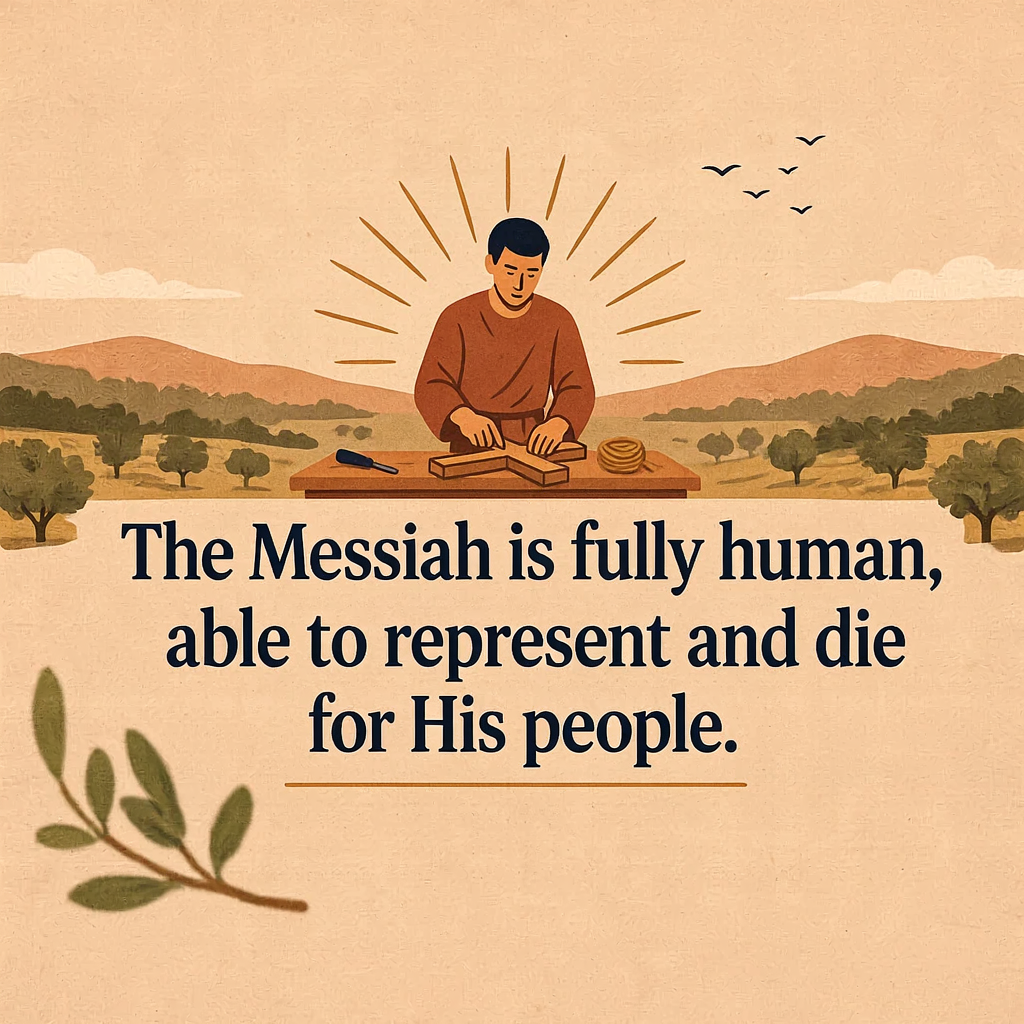
Yes. Jesus is fully God and fully man. He came from David’s line, lived among us, suffered, died, and became the sacrifice for sinners. His humanity is real, not an appearance.
5. Why could not a merely human Messiah save us?
A sinful people need more than a political rescuer or moral example. We need forgiveness, reconciliation with God, and deliverance from sin and death. Only God can provide a perfect and sufficient sacrifice for sinners.
6. Why did Jesus speak indirectly instead of plainly announcing His identity?
The time for His public trial and crucifixion was near, but not yet. Jesus planted the truth in Scripture, forcing His hearers to face its implications. Soon afterward, He would plainly affirm His identity before the Sanhedrin.
7. Is it harsh to say there is no neutral position before Jesus?
It is serious, but it is mercifully clear. Jesus is Lord whether we acknowledge Him or not. The gospel offers full forgiveness and welcome to all who repent and trust Him, but rejecting the King leaves us under condemnation for sin.
8. What does Christ’s present reign mean for everyday life?
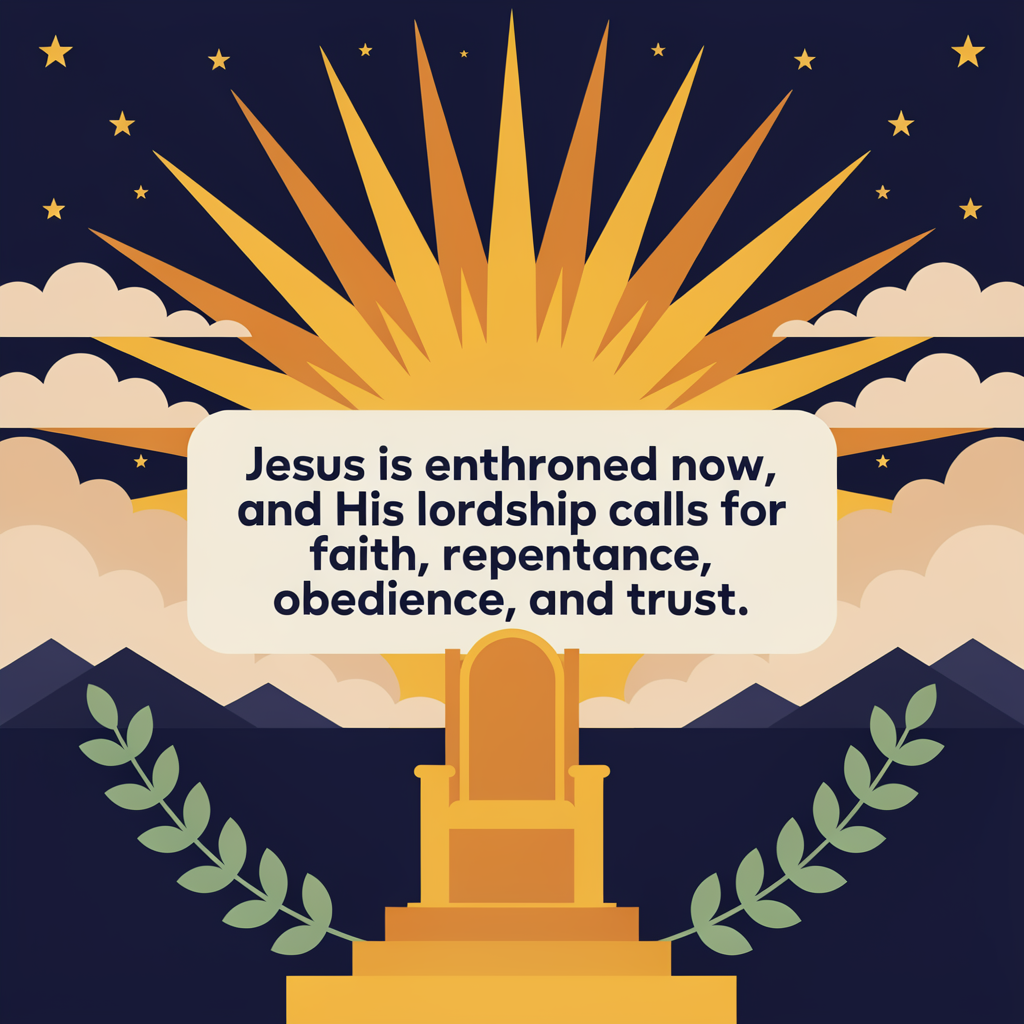
It means our fears, burdens, suffering, obedience, and future are not outside His rule. We do not have to carry what belongs in His hands. Because Jesus is enthroned now, His people can trust Him and obey Him with confidence.