Sermon Summary
Are you ready for the Master’s return? In Mark 13:28–37, Jesus reminds His disciples that His words never fail and His warnings must be taken seriously. Yet Jesus’ command reaches beyond that first-century moment: “Be alert.” We do not know the day or hour of Christ’s final return, but we know He is coming. Until then, His servants are called to make the most of their time, proclaim the gospel, and live in faithful obedience.
Sermon Audio
Sermon Text
Are You Ready for the Master’s Return?
Nate Roten / Mark 13:28–37 / 10.18.26
Core Message
The certainty of Christ’s Word is the foundation of our faithful actions.
In 1964, the Beatles performed before an estimated television audience of 70 million people from the Deauville Beach Resort in Miami Beach. The Deauville was more than a hotel. It was a glamorous beachfront landmark that had hosted celebrities, conventions, and generations of vacationing families.
But after an electrical fire closed it in 2017, the building deteriorated. Inspectors eventually determined it was unsafe, and the city ordered its demolition. Yet for a time, nothing seemed to change. The tower still stood. People could still see it from the beach. Its name remained on the building, and its history was still attached to it. But once the judgment was rendered, its future was settled. In November 2022, explosives were detonated, and within seconds the famous hotel disappeared into a cloud of dust.
That is the difference between condemnation and demolition. Condemnation is the verdict; demolition is the execution of the verdict. When Jesus walked out of the temple and declared that not one stone would be left upon another, the building did not fall that afternoon. The priests continued serving, the sacrifices continued, and the massive stones remained in place. But the Lord of the temple had rendered His verdict. The temple was still standing, but it was already condemned. Within that generation, in AD 70, God used the Roman army as the demolition crew to carry out the sentence Jesus had pronounced.
Today, we will conclude our explanation of this devastating event.
Passage
Mark 13:28–37 CSB
28 “Learn this lesson from the fig tree: As soon as its branch becomes tender and sprouts leaves, you know that summer is near. 29 In the same way, when you see these things happening, recognize that he is near—at the door. 30 “Truly I tell you, this generation will certainly not pass away until all these things take place. 31 Heaven and earth will pass away, but my words will never pass away. 32 “Now concerning that day or hour no one knows—neither the angels in heaven nor the Son—but only the Father. 33 “Watch! Be alert! For you don’t know when the time is coming. 34 “It is like a man on a journey, who left his house, gave authority to his servants, gave each one his work, and commanded the doorkeeper to be alert. 35 Therefore be alert, since you don’t know when the master of the house is coming—whether in the evening or at midnight or at the crowing of the rooster or early in the morning. 36 Otherwise, when he comes suddenly he might find you sleeping. 37 And what I say to you, I say to everyone: Be alert!”
I – Recap 1-27
Timeless principles. Last week we learned that no matter where you place this passage on the timeline of human history, it demonstrates the timeless principles of God’s holy judgment over sin and wickedness, as well as the provision for His people in the midst of His judgment. We also recognize that we are surrounded by temptation in a fallen world, especially when bad things happen around us. But we are called to faithful obedience rather than being negatively affected by the circumstances around us. We keep our eyes on Christ as the anchor of our hope.
Differing views. We also discussed the differing views on this passage when it comes to trying to put this on a timeline. There are those who hold that this is firmly in the past, that it happened in the first century, at the destruction of Jerusalem in 70 AD. There are those who say that this is completely in our future, that it is foretelling the signs to watch for the end of the world before Christ’s return to earth. And then there’s a hybrid of the two, where part of the destruction language happened in the past, but the coming of the Son of Man in the clouds and the gathering of the elect are still in our future.
Warning of Jerusalem’s destruction. Then we reviewed Mark 13 from the perspective that it was fulfilled in the first century, giving five reasons from the text why this is a likely perspective.
Now… Last week, I said there was one more important detail we must recognize and be equipped to address. Today, we will review Jesus’ final remarks concerning this devastating event and discuss this important issue.
Let’s get into it.
II – The Parable of the Fig Tree (vv. 28-31)
Timing Indicator. As a budding fig tree heralds summer’s approach, so too do these signs indicate that ‘he’ or ‘it’ (depending on the translation) is near. We’ve transitioned into autumn. For us, when the weather cools and the leaves turn from green to various colors, we recognize that fall is near and upon us. It’s the same concept. The signs are recognizable, and we should be watching for them. The fig tree is a sign of transition and expected fruitfulness, and when we see it, we should be prompted to act.
These Things. To understand what is going on, we need to look closely at the term ‘these things.’ It appears twice here and is phrased in a way that suggests Mark expects us to know what he is talking about. He is right. This term appears in the disciples’ initial question back in verse 4:
Mark 13:4 CSB
4 “Tell us, when will these things happen? And what will be the sign when all these things are about to be accomplished?”
Therefore, it is clear that this lesson from the fig tree summarizes these events, which serve as discernible signs pointing to the destruction of the Temple, where “not one stone will be left upon another…” You could consider this a bookend to the entire Olivet Discourse, where the disciples commented on the beautiful buildings. Jesus replied that not one stone would be left on another. The disciples asked, “When will these things take place?” Jesus then unpacked the signs that indicate when it is near. He then summarized what He had just said, telling them to learn the lesson from the fig tree and recognize when “these things” are at the front door.
This Generation. This is the point I was alluding to last week when I said we have to understand this and be able to explain it. If you’re sticking with me so far and following my train of thought, Jesus talks about the destruction of the temple. The disciples ask when it will happen and what the signs will be. He unpacks that, and then Jesus says and reinforces the idea that you need to be able to discern the times. Then He makes a vital comment for us to defend. He says, “Truly I tell you, this generation will certainly not pass away until all of these things take place.” Did you catch that? Jesus is speaking to His disciples. He is instructing them that this generation… their current generation, will not pass away until all these things take place. Not part or most of these things. All of these things. Which things? The things that He talked about in this entire discourse, everything He just unpacked, will happen in this generation.
There is no mistaking the seriousness and permanence of this remark, because He follows it up by saying, “Heaven and earth will pass away, but My words will never pass away.” In other words, “you think that the physical universe is a constant, that it will remain? Ok, well My words are more permanent than the physical creation. What I say stands. Eternally.” This is an incredible claim of authority. Who else could say such a thing other than God Himself (Isa. 40:8)?
For your awareness, there is significant debate about what this generation means. Is it the generation that Jesus is speaking to? Is it that generation far off in the future that will see all this come to pass in an apocalyptic end? Or does the word generation not mean one generation… an actual generation, but groups of people like the Jews? But I just want to put before you that when you look back at how Mark uses this term, “this generation,” he’s talking about the generation he’s addressing (Mark 8:12, 38; 9:19), meaning the people he’s talking to, the existing generation of the attending crowds. And we can confidently say that if this happened in the past, Jesus dying… around 30 AD, the destruction of Jerusalem happened in 70 AD. The difference between those two times is 40 years, which we would hold as a generation. But even if you don’t define a generation as exactly 40 years, the generation Jesus was talking to was still alive in 70 AD. Today, we might say, “Gen Z will not pass away,” or “the Boomers won’t all die out before this takes place.”
So if you approach this from the perspective that it has a fulfillment in the first century, then this is not an issue at all. We can say it was fulfilled in the first century, within a generation of those who heard Jesus’ voice, just as Jesus predicted. His Word holds true once more; therefore, the certainty of Christ’s Word remains the foundation of my obedience.
However, if you disagree with me and say this is still off in our future, I encourage you to still have an answer to Jesus’ words. This one verse is used by atheists against the Christian faith to claim that Jesus’ prophecy did not come true, and therefore He is a false prophet and should be dismissed. Brothers and sisters, this is no small issue. These are the words of Jesus, with divine authority behind Him, saying that what He says will come to pass just as assuredly as the world will continue spinning tomorrow. This is a patch of ground that no critic should be able to stand on.
But our responsibility does not end there. We are also told to be alert.
III – Be Alert!
This is said four times in six verses. I think we should pay attention, don’t you?
Be alert for what? It concerns “that day.” What day, you ask? It is the day when “these things” take place. That is why the signs Jesus described are so important! They didn’t know exactly when this would happen, other than that it would occur within their generation. In fact, the angels in heaven don’t know this, and neither does the Son Himself, Jesus. So let me address this for just a moment. It can be perplexing to understand that Jesus is both fully God and fully man. We look at Jesus as the Son of God and say that, being Yahweh Himself, He knows everything. How can He then say that He does not know something that the Father knows if they’re supposed to be unified as one? To that, we have to recognize that this comment would make absolutely no sense at any other point in history. It only makes sense through the lens of the incarnation, when Jesus became fully human. In His humanity, He experienced human limitations. He would run out of energy and get tired. He would run out of food and get hungry. He would run out of water and get thirsty. We must recognize that, in His humanity, Jesus, at least for a time, set aside the free exercise of His divine attributes as He walked the earth. One of those is obviously His omnipresence, but another is His omniscience. Only God the Father knows the exact day and hour of this horrific event. That’s why these signs are so important.
Temptation to doubt and distraction. I’m sure this felt incredibly imminent at the time. But think about how they felt five years later, or a decade later, and then two decades, then three decades go by, and they still don’t see all these signs take place. You would think they were probably getting a little doubtful. Wouldn’t you say? I think that’s why Jesus gives this little parable, so they could have something to hold on to as the decades come and go.
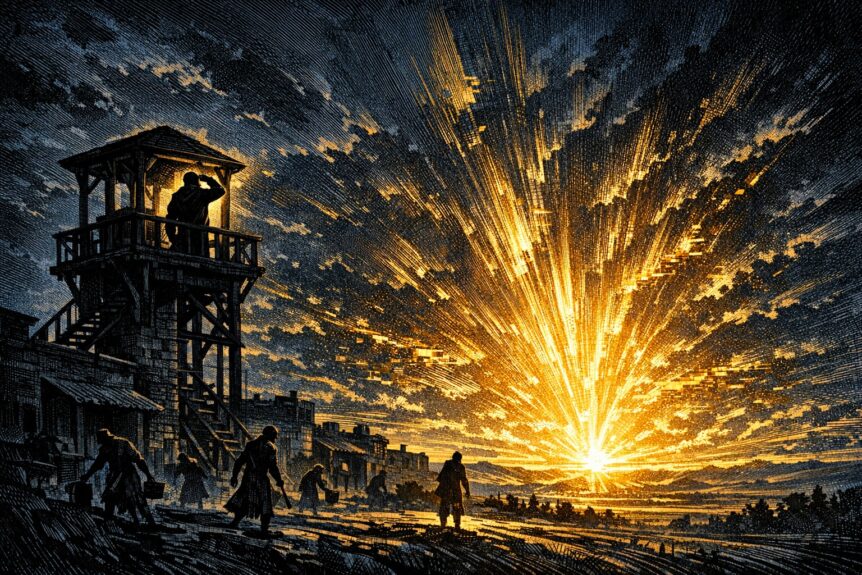
This little parable is about a doorkeeper, a servant in his master’s household, who’s supposed to keep watch and be alert while his master is gone. Mark sets the imagery in this passage during the four watches of the night. Jews have three watches of the night. Romans have four watches of the night. This servant should not be lazy or be tempted to rest. He must remain alert, whether it’s evening, midnight, the crowing of the rooster, or early morning. These are the four watches of the night that Roman soldiers would rotate through, staying alert and watchful while on guard duty.
Again, from the first-century fulfillment perspective, this would have massive implications. As the years passed, they would be tempted to think this wasn’t going to happen. Other New Testament epistles use this exact terminology: “Where’s the promise of His coming?” But they can’t get lazy, and they can’t stop watching. The Master of the house has told them to be alert and to stay alert, because for them, this is life and death. If they missed the window of opportunity to leave before Jerusalem was destroyed, they would be destroyed with it. It has grave implications.
As with the Deauville Beach Resort, the governing authority came to inspect the hotel and declared it condemned. Years later, they returned with a demolition crew and tore the building down. So here, on the Mount of Olives, Jesus has issued a certificate of condemnation. The house and the Old Covenant people who have rejected Him stand condemned. His people need to watch for the signs of the times: when the Roman bulldozers surround the city to knock the Temple down, they don’t want to find themselves inside it when that happens.
But I would say this is another timeless principle that echoes throughout church history. Plenty of other passages speak of Christ’s second coming to earth, and believers of every era and generation need to heed this warning. We are always on alert. We are still called to look for Jesus’ coming. Not a coming in judgment, as He did in the first century, but His second coming to permanently rule and reign on earth and usher in the eternal state. Brothers and sisters, we can’t be passive. We have to recognize that we are servants of the Most High God. He has given us roles and responsibilities to fulfill in the ever-expanding expansion of His kingdom, which continues today. He is still gathering His elect from the four winds of heaven… aka… every nation of the earth, and will continue until He returns. Jesus has all authority in heaven and on earth, and the enemy will not thwart His plans.
So we continue to spread the gospel and the good news of this kingdom. The Great Commission is still operational. We have to be active. We have to be doers of the word, not just hearers. He cannot come back and find us asleep at the wheel or burying our talent in the sand.
But we can only do this if we trust our King. The certainty of Christ’s Word is the foundation of our faithful actions.
Application: Be Alert and Active
We place our faith in a holy and reliable God and can stand on the certainty of His Word. Heaven and earth may pass away, but His promises stand firm forever.
Therefore, when we are told to be alert, observant, and watchful… we can (and must) do so in active obedience, not complacency. Christ is still calling and gathering His elect into His kingdom. And He is working through you and me to reach them. Therefore, we must make the most of every opportunity.
Ephesians 5:15–16 CSB
15 Pay careful attention, then, to how you walk—not as unwise people but as wise—16 making the most of the time, because the days are evil.
Every day Jesus tarries is a day we have to spread the gospel and advance His kingdom. One thing we can know for sure is that the master of the house is coming… Jesus is coming again at a day and time we cannot know. Therefore, if you don’t know Him, I implore you to repent and believe in Him. If you do, know that we must be busy and not fall asleep.
The certainty of Christ’s word is the foundation of our faithful actions. He is faithful and true.
This week, wrestle with this question: “Do my actions fall in line with this belief, and if not… what is one faithful step I can take in being active for His kingdom?”
FAQs
1. What does Jesus mean by “this generation will certainly not pass away”?
In the immediate context, Jesus is speaking about the events connected to Jerusalem’s destruction and the temple’s fall. The sermon argues that this was fulfilled in AD 70, within the lifetime of many who heard Jesus speak.
2. Does Mark 13 only refer to events in the first century?
The sermon understands the destruction language and the signs in Mark 13 as finding fulfillment in the first century. At the same time, the call to alertness remains a timeless command for believers awaiting Christ’s final return.
3. Why does Jesus compare these events to a fig tree?
A fig tree’s budding leaves signaled that summer was near. Likewise, the signs Jesus gave would show His disciples that Jerusalem’s judgment was near and that they needed to respond with watchful obedience.
4. Did Jesus predict the destruction of the temple?
Yes. Jesus plainly declared that not one stone would be left upon another. Though the temple remained standing when He spoke, His verdict was certain, and Jerusalem’s destruction in AD 70 confirmed the truth of His words.
5. How could Jesus say that the Son did not know the day or hour?
Jesus is fully God and fully man. In His incarnation, He truly took on human limitations. The sermon explains that, in His humanity, He did not exercise divine omniscience freely in this matter; the Father alone knew the exact day and hour.
6. If Christ’s words are certain, why do believers still need to be alert?
Certainty does not produce passivity. Because Christ’s word is sure, His people can obey with confidence. Watchfulness means living faithfully, resisting distraction, and being ready to serve when the Master comes.
7. What does it mean to be active for Christ’s kingdom?
It means making the most of every opportunity: walking wisely, sharing the gospel, fulfilling the responsibilities God has given, and refusing to drift into spiritual sleepiness.
8. What should I do if I do not know Christ?
Repent and believe in Him. Jesus is the faithful King, and His word will stand when heaven and earth pass away. Do not delay; come to Him in faith.