Highlight Reel
Sermon Summary
In Mark 13:14–27, Jesus warns His disciples about tribulation, false messiahs, judgment, and the destruction coming upon Jerusalem. While Christians differ over some end-times details, the passage clearly calls God’s people to vigilance, faith, and endurance. Jesus spoke these things beforehand so His disciples would not be deceived or overwhelmed when suffering came. The historical fulfillment of His warnings in AD 70 displays the reliability of His Word, while the timeless principle remains: because God is faithful to His Word, we can remain faithful through every trial.
Sermon Audio
Shareable Quote graphics



Sermon Text
What Did Jesus Mean in Mark 13?
Nate Roten / Mark 13:14–27 / October 11, 2026
Core Message
Because God is faithful to His Word, we can remain faithful through every trial.
You have probably heard the statement, “Those who cannot remember the past are condemned to repeat it.” The philosopher George Santayana wrote those words in 1905. He was not responding to a single war or national tragedy. He was making a broader point about how people grow. Santayana argued that change by itself is not progress. We mature only when we remember what experience has taught us and let those lessons shape our future responses. When we fail to remember, we remain trapped in a kind of perpetual ignorance, repeatedly facing the same dangers as if no one had ever faced them before.
That helps us understand the purpose of Mark 13. Jesus is not merely satisfying the disciples’ curiosity about the future. He is preparing them to remain faithful as everything around them begins to collapse. They will face false messiahs, persecution, war, and eventually the devastation of Jerusalem. When those things happen, they must remember that Jesus told them beforehand. His words will keep them from being deceived, overwhelmed by fear, or drawn to false hope.
Christians may disagree about how much of this chapter was fulfilled in AD 70 and how much may still point toward the return of Christ still in our future. That question matters, but we must not become so preoccupied with and divided over timing that we miss why Jesus gave this teaching in the first place: Do not be deceived. Take His warnings seriously. Remain faithful under pressure. Trust Him when the world appears to be unraveling. And keep your hope fixed on the Son of Man.
The question, then, is not only, “When will these things happen?” The more personal question is, “Is God faithful in dire circumstances, and will I remain faithful to Him when bad things happen?”
Passage
Mark 13:14–27 CSB
14 “When you see the abomination of desolation standing where it should not be” (let the reader understand), “then those in Judea must flee to the mountains. 15 A man on the housetop must not come down or go in to get anything out of his house, 16 and a man in the field must not go back to get his coat. 17 Woe to pregnant women and nursing mothers in those days! 18 “Pray it won’t happen in winter. 19 For those will be days of tribulation, the kind that hasn’t been from the beginning of creation, which God created, until now and never will be again. 20 If the Lord had not cut those days short, no one would be saved. But he cut those days short for the sake of the elect, whom he chose. 21 “Then if anyone tells you, ‘See, here is the Messiah! See, there!’ do not believe it. 22 For false messiahs and false prophets will arise and will perform signs and wonders to lead astray, if possible, the elect. 23 And you must watch! I have told you everything in advance. 24 “But in those days, after that tribulation: The sun will be darkened, and the moon will not shed its light; 25 the stars will be falling from the sky, and the powers in the heavens will be shaken. 26 Then they will see the Son of Man coming in clouds with great power and glory. 27 He will send out the angels and gather his elect from the four winds, from the ends of the earth to the ends of heaven.
I – Timeless Principles
No matter where you are in your eschatology (view of the end times), we cannot lose sight of the overarching, timeless principles this passage offers.
Judgment & Provision. We cannot ignore the language of divine judgment. Jesus warns of coming calamities: wars, false messiahs, kingdom clashes, earthquakes, famines, persecutions, families pitted against one another, cosmic signs of woe, and tribulation so horrific that if those days were not cut short… no one would make it out alive. Since Jesus entered Jerusalem on Palm Sunday, He had been warning the disciples and the crowds about pending judgment on the Temple and the Religious Leaders. Now, He describes it in more vivid detail.
Yet, even as all these terrible things take place, God will always provide for His people. There are signs pointing to when these things will take place, and when they do, there will be a way out. When you are beaten and brought before the governing powers, the Spirit will give you the words to speak. When the abomination happens, there is a safe place to escape to. The days are intense, but they will be cut short for the sake of God’s elect people. When everything seems to fall apart, the Son of Man is right there in the midst of it.
This theme runs throughout Scripture, and when we look back on Israel’s history, we can see it and be emboldened to trust in our great God. Just reflect on a few of these instances:
• Genesis 6–7: The death of all humanity except Noah and his family, who were saved on an ark with one door.
• Genesis 19: The destruction of Sodom and Gomorrah, with angels pulling Lot out of his house by the wrist
• Exodus 12: The plague that killed all the firstborn sons in Egypt, yet those were saved by the lamb’s blood on the doorpost
• Daniel 3: The Hebrew men are thrown into a fiery furnace, yet one like the Son of Man is protecting them within.
In each case, God is issuing judgment. Yet in the midst of that judgment, God protects His people. He makes a way of escape for His elect. That was true back then, and it remains true today: God still judges evil and wickedness and still provides for His children. Because God is faithful to His Word, we can remain faithful through every trial.
Temptation & Faithfulness. Throughout this entire chapter, God’s people are also tempted to worry, despair, doubt, or fear the judgment they see happening all around them. In those temptations, God also orients our minds and instructs our hearts amid these calamities.
• Watch out that no one leads you astray (13:5) // Do not be alarmed (13:7)
• Be on your guard… You’ll stand before governors and kings (13:9) // Don’t worry beforehand… the Spirit will speak (13:11)
• False christs will do signs and wonders (13:22) // Do not believe it (13:21)
• Understand… when you see the abomination (13:14) // Then flee to the mountains (13:14)
• Tribulation like no other (13:19) // For the elect’s sake He shortened the days (13:20)
• One more to review next week…
Tell me, what is the one thing Jesus has continually tried to teach His disciples? Isn’t it to have faith no matter the circumstances? The entire Old Testament teaches the same principle. Their experience with Jesus teaches this principle, and one day they will have to lean on it. Recognize the times, be alert, be watchful, and be ready to act when the time comes. Brothers and sisters, this is true for every believer, in every generation.
Now, I made a promise to you to preach verse by verse through the Scripture, and one reason for that is to ensure I do not skip any of the hard stuff. So I do want to give you an understanding of how this is debated today and share my perspective. However, we must remember to be unified in the essentials.
II – Unity
Our view of this passage, or the end times, should never be an occasion for disunity in the church, though churches often split over this very issue. Before we look at the different viewpoints, I want to remind us what Paul encouraged the Philippian church to do.
Philippians 2:1–5 CSB
1 If, then, there is any encouragement in Christ, if any consolation of love, if any fellowship with the Spirit, if any affection and mercy, 2 make my joy complete by thinking the same way, having the same love, united in spirit, intent on one purpose. 3 Do nothing out of selfish ambition or conceit, but in humility consider others as more important than yourselves. 4 Everyone should look not to his own interests, but rather to the interests of others. 5 Adopt the same attitude as that of Christ Jesus,
We are brothers and sisters in the same family, and we are soldiers serving the same King. Brothers and sisters do not have to agree on everything to remain family, just as soldiers do not have to agree on every tactic or method to lock shields against a common enemy. We can stand shoulder to shoulder in defense of the primary truths that define our faith: the authority of Scripture, the deity of Christ, His death and resurrection, salvation by grace through faith, and His promised return. At the same time, we can extend grace when we disagree on secondary and tertiary matters, including some details about the timing of His return.
As we enter this passage, our goal is not to draw battle lines between believers. Instead, we listen carefully to Jesus together, resolved in our willingness to be corrected by the truth. We may interpret some of these details differently, but we serve the same King, trust the same gospel, and share the same hope. We do not have to stand in exactly the same place on the timeline to stand shoulder to shoulder beneath the same King. Amen?
Okay, great. With that understanding, let’s look at how this is interpreted today.
III – The Debated Timeframe
There are two primary positions with a third in the mix. Those positions are:
1. This is fully in our future. This is the Left Behind series: a dispensational, pre-millennial view of the end times, with a tribulation that is apocalyptic and ushers in Christ’s eternal reign at the end of human history. This passage primarily speaks to believers in Jesus’ distant future.
2. This is definitively in the past. These events are being foretold by Jesus as a warning to the people that He is speaking with; that is, warning them about the coming judgment of Israel that culminates in the Jewish wars against Rome and the complete devastation of Jerusalem that happens in 70 AD.
3. This is a hybrid. Part of it speaks to the disciples and the events leading up to 70 AD, yet a small section toward the end speaks to Jesus’ second coming. So, it’s a both-and approach.
So now the million-dollar question is, which is it? Is it number one, number two, or number three? My view is option two. Could it be more than that? Perhaps. We’ll discuss that. However, I believe it is most certainly no less than a prophetic warning of what is to come in 70 AD. I can explain why this passage doesn’t point to the world’s end and why it’s primarily a warning to Jesus’ audience. Many of you may ask how this ties into the book of Revelation and how it might unpack the end of the world. We can certainly do that when we study together… many years from now.
Until then, let’s focus on this passage of Scripture in its context within Mark’s gospel.
IV – Clues for a 1st-Century Fulfillment
So I want to do this, but I don’t want it to take up the entire sermon, so this will by no means be exhaustive. That said, I want to give you five key clues that show the chapter’s primary function: to warn of what is to come in the lives of those hearing Jesus speak.
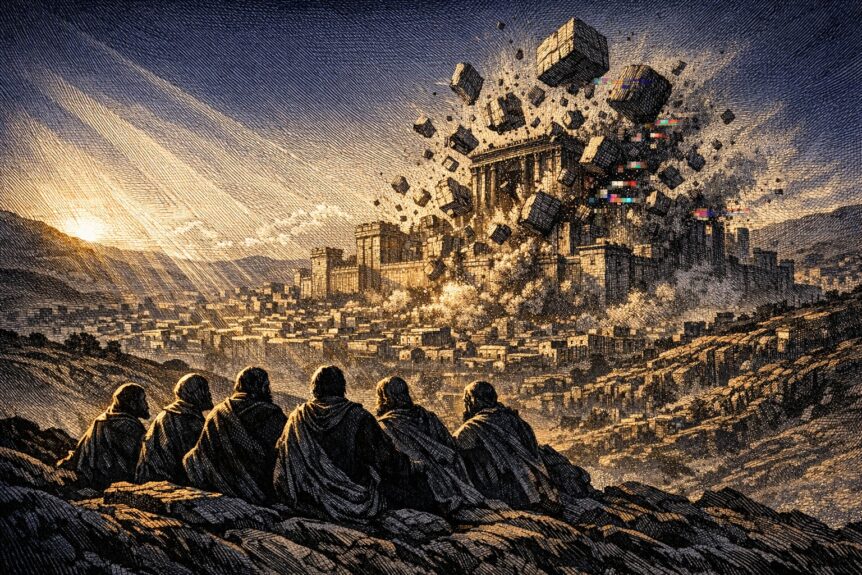
Initial Q&A. The first clue is to recognize the original context of the entire chapter. The disciples made a comment. Jesus replied with one of His own, and then they asked a question about His reply. The disciples said, “Look at these massive stones. What impressive buildings.” They were speaking about the temple and the surrounding buildings. Jesus said, “Okay, yeah, do you see these? Not one stone will be left on another. All of it will be thrown down.” In response, the disciples then asked, “Okay, well, when will it happen, when these stones will not be left on the other? What is the timing of all of this?” So, within context, they’re asking about Jesus’ comment on the destruction of the temple. And all of chapter 13 is an unpacking of that one event.
Receivers of this information. The second clue is who receives this information. I know we read this in Scripture 2,000 years later, but we have to remember there were other recipients before us. In verses 1 through 27, Jesus uses the word “you” 16 times, and in the vast majority of those instances, it is plural. Today in the South, we would say “y’all.” That means Jesus is speaking directly to His disciples and telling them they will see and experience all these things. Beyond that, Mark makes a brief parenthetical statement. When he speaks of the abomination of desolation standing where it should not be, he adds, “…let the reader understand.” Now, I know we’re readers 2,000 years later, but his first-century audience read that statement and were expected to understand what the abomination of desolation was supposed to be. They were supposed to recognize that as a warning sign that would prompt them to flee.
Locality. The third clue is in the local descriptors. Jesus and His disciples are on the Mount of Olives, across from the temple, sitting on the hillside and looking at it. Jesus tells them all of this, so it applies directly to their generation in this place. He says things like, “They will be handed over to local courts. They will be flogged in the synagogues. They will stand before kings.” Those are all things that apply locally. We also have people being on rooftops. In the first century, rooftops were flat and served as porches. We don’t have those in North Carolina. But then he gets very specific, saying that those in Judea specifically are supposed to flee to the mountains. Again, that is very localized. The abomination being talked about, if you go back to the reference in Daniel, happens in the temple (which Matthew also references). Today, there is no temple. Luke also adds that when you see Jerusalem surrounded by armies, you recognize the desolation is near. So as you can see, all these things apply to that local area and that time frame when the temple still exists.
Old Testament Parallels and Allusions. The fourth clue is the familiar OT language. When Jesus describes the sun darkening, the stars falling, and the heavens shaking, He uses language His disciples would have recognized from the Old Testament prophets. Throughout Scripture, God uses cosmic imagery to depict His judgment on nations. The language doesn’t necessarily describe the end of the world, but the end of their world: a kingdom falling, a nation being judged, and an established order coming to an end. This is just one of several Old Testament connections that help us understand what Jesus is saying in Mark 13.
Consider these parallels:
• Cosmic Judgment (Isaiah 13:10; 34:4; Ezekiel 32:7–8; Joel 2:10; Amos 8:9): The prophets described God’s judgment against Babylon, Edom, Egypt, Judah, and Israel using imagery of darkened suns, falling stars, and shaking heavens. All those judgments came to pass in history, and none required the literal destruction of the cosmos.
• Covenant Curses (Deuteronomy 28): Moses warned that Israel’s disobedience would bring a foreign army, siege, starvation, cannibalism, and scattering among the nations. These warnings closely resemble the Roman siege of Jerusalem in AD 70. Luke even records Jesus calling these the days of vengeance, when everything written would be fulfilled (Luke 21:22).
• The Departure of God’s Glory (Ezekiel 8–11): Ezekiel was shown the abominations inside the temple, then watched God’s glory withdraw from it, step by step, through the eastern gate, and finally come to rest on the mountain east of the city, the Mount of Olives. Then Jerusalem fell. Centuries later, Jesus, God in the flesh, walked through the temple, looked around at everything (Mark 11:11), condemned it in the words of Jeremiah’s temple sermon (Mark 11:17; Jeremiah 7:11–14), declared the house desolate (Matthew 23:38), walked out, and sat down on that same mountain, across from the temple (Mark 13:3). In Ezekiel, God’s glory departs before judgment. In the Gospels, God in the flesh departs and announces it.
• Daniel’s Prophecies (Daniel 7:13–14; 9:27; 12:1, 11): Jesus draws on Daniel’s descriptions of the abomination of desolation, unprecedented distress, and the Son of Man coming with the clouds. In Daniel 7, the Son of Man isn’t descending to earth but approaching the Ancient of Days to receive His kingdom. It’s a picture of heavenly enthronement.
• The Gathering of God’s People (Deuteronomy 30:1–6; Isaiah 11:12; 27:12–13; Zechariah 2:6): While Deuteronomy 28 describes Israel’s scattering under covenant judgment, Deuteronomy 30 promises the restoration and gathering of God’s people. This Old Testament background is important for Jesus’ promise to gather His elect from the four winds (Mark 13:27).
Here’s the point: Jesus isn’t introducing an entirely new prophetic vocabulary. He’s drawing on centuries of Old Testament prophecy about judgment, desolation, vindication, and restoration. Just as you don’t need to be reminded of the next line in one of your favorite songs, they didn’t need an interpreter for this language. They would have recognized it immediately because it was familiar. Before we assume He’s describing the end of the physical universe, we need to understand how this language was already used in Scripture.
When we do, we find compelling reasons to consider whether Jesus is describing the end of the world or the end of an age which culminates in Jerusalem’s destruction, the vindication of His kingdom, and the definitive end of the old covenant.
Historical record. The fifth and final clue is to look back at the historical record. In this chapter, Jesus gave the disciples a list of things to watch for. Here is what the next forty years actually held, and much of the historical record comes from men who were not Christians and had no interest in helping us prove Christianity right. Josephus was a Jewish priest who fought Rome in that war, surrendered, and then wrote its history. Tacitus, a Roman senator and renowned historian, called Christianity a destructive superstition. When you add their accounts to the historical record of Acts and the writings of the Christian historian Eusebius, the evidence becomes clear. Below is just a sampling.
• False messiahs. Josephus names Theudas and an Egyptian prophet who drew thirty thousand to the Mount of Olives, and Luke names both men in the book of Acts.
• Wars and rumors of wars. In a single year, Rome saw four emperors, armies fought each other in Italy, and the temple of Jupiter burned in the capital.
• Famines. Agabus predicted one in Acts eleven, and Josephus records that same famine from the other side, down to the foreign queen who shipped grain into Jerusalem. Then came the horrific famine during the siege of Jerusalem in 70 AD.
• Earthquakes. Laodicea was leveled in 60, and Pompeii was wrecked in 62, both recorded by Roman historians, though I’ll grant you earthquakes come every century.
• Persecution. Acts logs the councils, the floggings, the governors and the kings, and Tacitus, who despised Christians, records Nero burning them alive in his gardens.
• The gospel to the nations. Paul writes, before any of this happened, that the gospel had already gone out into all the world (likely meaning the known world of the Roman Empire).
• Signs and terrors. Josephus lists them, and Tacitus reports the same things from Rome with no sympathy for any of it and no access to Josephus.
• Jerusalem surrounded. In November of 66, Rome encircled the city, broke the outer suburb, and then withdrew for a reason no one can explain, leaving room for Christians to escape before Titus’ army returned to lay waste to it.
• The door shut. When Titus returned in April of 70, he walled the entire city in three days, as Luke said he would. At that time, their fate was sealed.
• Tribulation, and days cut short. The siege collapsed in five months instead of years because the Jewish rebel factions burned each other’s grain stores. Josephus records a story about a mother who ate her own child, exactly as Deuteronomy 28 had warned.
• Not one stone. The temple burned in August of the year 70 and was obliterated. Titus ordered that it be disassembled to retrieve the gold that had melted between the cracks. Jesus’ words weren’t exaggerated. There was literally no stone left upon another.
Now, with all that said, does this prove this won’t be repeatable in our future? No. It doesn’t definitively prove that. But hopefully you can understand why I say it cannot be anything less than a prediction of things to come in the first century for the people Jesus is speaking to. We’ll talk about this more in-depth next week, but we should not underestimate how important it is that this passage of Scripture is prophetically accurate. This comes from Jesus’ lips. Therefore, it is supremely important to understand that all of this is reliable and trustworthy.
But to close today, let’s keep our eyes on what affects us today.
Application: Don’t Lose the Principles
If we’re not careful, we can easily miss the forest for the trees. For those who love to study eschatology, this is a chance to dig deep and see how it ties into human history. But I want to end where I began: I want to encourage us to remember that those who forget the past are doomed to repeat its failures. No matter where you place this chapter on the timeline, the principles remain the same and affect every believer of every age. And remember… because God is faithful to His Word, we can remain faithful through every trial. Let’s see and remember God’s faithfulness, and how we respond to it.
We worship and submit to a holy God who is completely just and will judge sin.
As believers, we are not promised exemption from hard things in this world. But we do have the promise of a loving Father who will always provide for His people.
We should never fear because of our circumstances or the conditions around us. Our strength, boldness, and faith come from anchoring ourselves to an unchangeable, righteous, merciful, and loving God.
Because God is faithful to His Word, we can remain faithful through every trial.
As we end today, I invite you to meditate on Psalm 46 now and throughout the week on God’s power to lay waste His enemies and to provide for and protect His people.
Psalm 46 CSB
For the choir director. A song of the sons of Korah. According to Alamoth. 1 God is our refuge and strength, a helper who is always found in times of trouble. 2 Therefore we will not be afraid, though the earth trembles and the mountains topple into the depths of the seas, 3 though its water roars and foams and the mountains quake with its turmoil. Selah 4 There is a river— its streams delight the city of God, the holy dwelling place of the Most High. 5 God is within her; she will not be toppled. God will help her when the morning dawns. 6 Nations rage, kingdoms topple; the earth melts when he lifts his voice. 7 The Lord of Armies is with us; the God of Jacob is our stronghold. Selah 8 Come, see the works of the Lord, who brings devastation on the earth. 9 He makes wars cease throughout the earth. He shatters bows and cuts spears to pieces; he sets wagons ablaze. 10 “Stop fighting, and know that I am God, exalted among the nations, exalted on the earth.” 11 The Lord of Armies is with us; the God of Jacob is our stronghold. Selah
FAQs
1. What is the main point of Mark 13:14–27?
Jesus prepares His disciples for coming judgment and tribulation so they will not be deceived, terrified, or drawn away from faithful obedience. The passage calls God’s people to watchfulness and trust in Christ.
2. Does this sermon teach that Mark 13 was fulfilled in AD 70?
Yes. The sermon argues that Mark 13 is at least a prophetic warning about Jerusalem’s destruction in AD 70, given directly to Jesus’ first-century disciples.
3. Does that mean Jesus will not return in the future?
No. Christians confess that Jesus will return. The sermon’s point is that Mark 13 must first be read in its immediate context, where Jesus is answering questions about the destruction of the temple.
4. Why does Jesus use language about the sun darkening and stars falling?
Jesus uses familiar Old Testament prophetic imagery. The prophets regularly used cosmic language to describe God’s judgment on nations, kingdoms, and established orders—not necessarily the literal destruction of the universe.
5. Why would a good God bring such severe judgment?
God is holy, just, and patient. His judgment against sin is never careless or cruel. Mark 13 reminds us that God takes rebellion seriously, even as He provides mercy and preservation for His people.
6. Are believers promised protection from suffering?
Believers are not promised exemption from hardship, persecution, or loss. But they are promised the presence, provision, and preserving grace of God in every trial.
7. What should Christians do when false teachers or dramatic spiritual claims arise?
Jesus’ command is direct: do not be deceived. Test every claim by Scripture, refuse false messiahs and false hope, and remain anchored to the true Christ revealed in God’s Word.
8. How should this passage shape our lives today?
We should live alert, humble, and faithful. Instead of being ruled by fear over world events, we should trust the God who keeps His Word, submit to Christ, and stand firm in obedience.