Highlight Reel
Sermon Summary
In Mark 12:38–44, Jesus contrasts proud scribes who use religion to gain attention and exploit the vulnerable with a poor widow who quietly gives all she has. God sees beyond appearances: He judges hypocrisy and delights in faith that entrusts everything to Him.
Sermon Audio
Shareable Quote graphics

Sermon Text
What Does God Really Want From Me?
Nate Roten / Mark 12:38–44 / Sept. 27, 2026
Core Message
Your actions reveal your motives, and God sees it all.
Years ago, Kelly and I took a weekend to celebrate our anniversary, and we went down to Charlotte, just the two of us. We got there one evening, and when we woke up the next morning, we went down to a little corner bakery to enjoy breakfast. As we left to enjoy the rest of the day in downtown Charlotte, we noticed that Deadpool was walking across the street. You don’t see that every day, and it really piqued our interest. So, we followed Deadpool down the street, maybe a quarter of a mile or so, where we saw a giant Comic-Con convention. We immediately looked up how much tickets cost, not because we wanted to go in and experience all the booths. We just wanted to people-watch. When we saw the ticket prices, we decided to sit outside on a bench for about an hour and people-watch. It was fascinating to us to see all the fancy costumes, the commitment to character, and the wild portrayals of the most obscure characters in comic book history.
Now, I mention this story because today we’re going to witness Jesus and His disciples’ people-watching. There will be two categories, two types of people, that Jesus wants His disciples to take note of. Not only that, but the contrast between these two people will conclude His public ministry and everything He’s been teaching the crowd. This is what He wants to leave them with. So, before we go through today’s passage, I want to bring this home with a personal, more serious question.
If I pulled up a chair and watched you for a week, what would I see?
Passage
Mark 12:38–44 CSB
38 He also said in his teaching, “Beware of the scribes, who want to go around in long robes and who want greetings in the marketplaces, 39 the best seats in the synagogues, and the places of honor at banquets. 40 They devour widows’ houses and say long prayers just for show. These will receive harsher judgment.” 41 Sitting across from the temple treasury, he watched how the crowd dropped money into the treasury. Many rich people were putting in large sums. 42 Then a poor widow came and dropped in two tiny coins worth very little. 43 Summoning his disciples, he said to them, “Truly I tell you, this poor widow has put more into the treasury than all the others. 44 For they all gave out of their surplus, but she out of her poverty has put in everything she had—all she had to live on.”
I – Beware (v. 38)
After addressing the representative members of the Sanhedrin, Jesus warns them about a subset of them. The warning was to beware of the scribes. To “beware” means to be aware, to see danger you wouldn’t normally see. Think of a janitor’s wet floor sign. The danger isn’t in the water you can see; it’s in what you cannot see and the fall you didn’t expect, because nothing looked wrong. That’s exactly what Jesus is doing here. He’s putting up a caution sign in front of the scribes, because their danger doesn’t announce itself. It looks like robes and rank and religion. Jesus is about to tell us exactly what to watch for.
Jesus is about to unpack the reasons for the unseen dangers. These dangers are hazardous to the rest of the population. But to begin, we need to see one thing that is not on this list, but that comes from our previous warning, namely that the scribes are specifically named in the list of people responsible for Jesus’ execution.
God couldn’t care less about your status or title. He cares about your inward being, and He sees clearly what religious predators do in the dark, even when no one else notices. He will judge it rightly. Jesus is far more scathing in Matthew’s account. Mark only gives us a brief recap. But nobody left the temple that day wondering whether they were dangerous or how. Therefore, we see Jesus model public exposure. There is a time and place to call out the people trying to hurt the flock because one function of a shepherd is to defend.
Good shepherds aren’t vague. They are specific about the dangers.
II – The Dangers (v. 38-40)
We are all probably familiar with the Beatitudes, where Jesus says, blessed are the ones who do this and that. Consider this the list of Beware’s. Beware those who:
Put on a show. They liked to walk around in long, flowing robes and offer long prayers for appearance’s sake. These dignified garments made their status visible and helped distinguish them as respected religious authorities. Matthew adds that they lengthened the tassels on their garments. Imagine college professors wearing their academic regalia every day to remind you of their status and esteemed knowledge. The problem was not the garment itself. The problem was using it to turn ordinary life into a stage. Religious leaders can still fall into that temptation. It may be an expensive outfit selected for the image it projects, a flashy car positioned where everyone will notice it, or a mission trip casually mentioned so that people will admire our sacrifice. The deeper issue is motive: Am I doing this to direct attention toward God, or am I using the things of God to direct attention toward myself? The scribes turned visible signs of devotion into advertisements for their own importance.
Demand acclaim. They want everyone to greet them in the marketplaces. This is public recognition. Wherever they went, they wanted people to recognize them and show public appreciation and acclaim. If they were movie stars today, they would want the paparazzi taking pictures of them all the time.
Position for prestige. Always sat in the best synagogue seats. These were up front and facing the congregation. In many modern-day churches, you may have noticed seats up front on the stage that face the congregation. Sometimes they’re modest, and sometimes they look like giant thrones. But those are seats of authority in the church, meant for esteemed guests or church leadership. That doesn’t mean having those seats is wrong, but always wanting to be the one in them is wrong, because it exposes a heart that always says, “see me, I’m important.”
Must always be the person of honor. They always want to be the guest of honor at banquets, the one cutting the ribbon, or the one being interviewed by a reporter or podcaster. If they wrote best-selling books on being close to God, it’s their face on the cover. They must always be in the limelight.
Therefore, to sum all this up, Jesus is saying, “Beware of people who have to make it all about themselves.” These are the people who put on a show, crave acclaim, insist on the best seat in the house, seek prestige, and must be the person of honor. They are self-serving, and all of these red flags point to the underlying motive of that selfishness.
Four red flags point to one underlying issue. So why do we need to be aware of these types of people? What is the underlying issue that all of these things point to? These are four red flags that speak to one underlying condition. And it is a heart-level issue. They steal the glory away from God so they can have it for themselves. When you have to be at the center of your own universe, you are willing to do anything to get it and keep it. From their perspective, they’re even willing to take advantage of some of the most vulnerable people in their society. Greed compels them to devour and exploit the vulnerable. Scribes were not paid staff. They had to rely on the generosity of others. Therefore, “House” probably means more than a physical building. It can represent a widow’s household, estate, property, or entire means of support. To “devour” it is vivid language for consuming her resources until little or nothing remains. Some English translations therefore render the phrase “devour widows’ property.” The reference to making “long prayers for appearance’s sake” suggests that their outward spirituality helped them gain people’s confidence. Their reputation for piety became a way to access vulnerable people. The very men who knew God’s commands to protect widows were using their religious position to consume the resources of widows.
Therefore, the core warning is to recognize this rotting foundation in people who are always fighting for attention. Outwardly, they portray godly authority and power, but inwardly, they are a black hole of greed and deception.
Outcome. There’s only one outcome for this. Those who have such a corrupt heart, who are willing to exploit others for personal gain, and who make their entire religious expression about the exaltation of their own name and not the name of the God that they claim to serve, there is only harsh judgment for them. They are not the role model for the people. They are an example of what not to become.
Therefore, we need to be on the lookout. We need to heed Jesus’ words just as much as the crowd did during that Passover week. It is not too difficult to draw modern-day parallels. There are those who are in it for themselves, but they’ll point to God to gain your confidence and respect, and they’ll fleece you in the process. Their mouths talk about God, but their actions point to themselves. As Jesus has previously said, bad trees produce bad fruit. Good trees produce good fruit. A tree will be known by its fruit. All of these signs of self-service are bad fruit. If you see that, avoid it at all costs.
This is the first person who stands in contrast with the second. The first one is an example of who not to be: the religious elite, whose hypocritical lives don’t match the devoted life they profess to have. Yet the person Jesus contrasts their hypocrisy with is a representative of the very people they take advantage of.
III – Commend (v. 43)
Moving from the temple to the temple treasury, Jesus now wants to shift their thinking to a positive example. He just finished condemning the showy scribes. Now He’s going to commend a poor widow who tithes what amounts to a fraction of a penny. She tithes almost nothing and everything all at once. This is significant because what she put in, compared to what other rich people put in, was like comparing caterpillars to F-16 fighter jets.
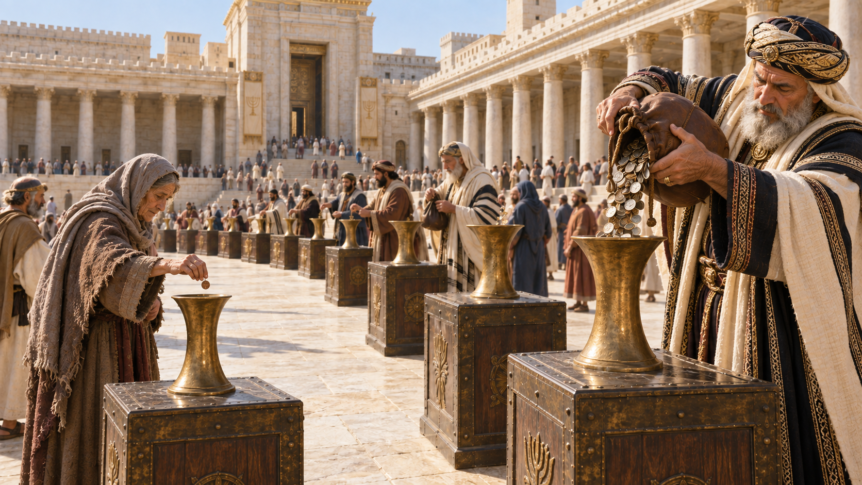
So let’s put ourselves on the scene. At the Temple Treasury, located in the Court of Women, 13 treasury boxes were placed for people to donate and tithe. According to other Jewish documents, these money chests were shaped like giant shofars or trumpets, with the smaller end at the top, where you put in your donation, and a larger opening at the bottom. Part of this was because a smaller opening prevented theft, but the other part was that the money made a lot of noise as it went down. Just as the scribes wanted to be showy in their outward demonstrations of authority and prestige, people would come and donate large amounts of money, pouring metal coins into these giant money-trumpet chests. Just think about how noisy it is if you walk into a casino and you hear the shuffling of the cards, the enthusiastic shouts at the craps table, and the constant clanging of the slot machines as they dispense coins. All of that is designed to gain and keep your attention on the excitement of winning money. Similarly, all of these things are designed for rich donors to be noticed for their righteous giving, which, when framed that way, is not righteous at all.
And that’s when Jesus leans against a wall to people-watch. He watches as the rich pour in all their coins, taking note of who notices their incredible generosity. And then He takes notice of this poor widow, who quietly and humbly works her way through the crowd to deposit her offering.
And just like the scribes, Jesus is going to assess her motives by her actions, but it’s not going to be a condemnation or judgment. It will be a commendation of praise.
So let’s take a look at what she actually does.
IV – Giving More Than All Others (vv. 41-44)
This woman had two copper coins called lepta. A lepton was a small coin worth about one sixty-fourth of a denarius (a coin worth a day’s wage for a common laborer). In stark contrast to the scribes, this poor widow didn’t arrive with flash and pomp. She came in very humble circumstances, giving a modest amount of money. In fact, Jesus points to her and tells His disciples that she has given absolutely everything she has. These final two coins, which total a fraction of a cent, were everything she had to live on. This completely drained her bank account.
Now, from an outsider’s perspective, this was nothing. Even if the room was silent, you could probably barely hear those two coins hit the ring in the trumpet-shaped tithing boxes. Certainly couldn’t hear that amid all the other rich people pouring tithes from their vast wealth. What she gave monetarily was inconsequential and would purchase absolutely nothing. Think about it. If you go to the grocery store, what can you buy for one penny? And yet she is commended where the scribes were condemned. She was said to have given more than all those other rich people who pulled out their giant purses and were pouring coins into the treasury.
Why is that?
Maybe we need to understand that God doesn’t really care about how much we give. He owns it all anyway. What He cares about is our faith. That’s why she put in more than everybody else. She put in everything. She completely entrusted herself to God’s provision, even though she now has no money to buy anything. Not a meal… not even a pack of nabs. She has no more resources; therefore, without help, she will return home and sit down with a growling stomach at an empty dining table with no hope of being rescued from the pains of starvation. She had to return home and fully depend on the God she came to the temple to worship. Why is this such a powerful story? Because she threw herself at the mercy of a God she completely trusted.
Application: Hold nothing back from God
So I want to loop back to my opening question. If I sat on a bench and watched you live your life for a week, what would I see? More importantly, what would God see? Your actions reveal your motives, and God sees it all.
Do your claims to be a Christian hold up to the way you live your life day to day? The scribes professed to be students of the law, gatekeepers of the authority of God’s word. They were the religious elite, yet they were doing evil. When their actions are weighed against the two great commands that Jesus gave, they are not loving their neighbor. In fact, they’re hating their neighbor because they are taking advantage of them. And if they’re willing to do that to the people around them, what does that say about their love for God?
You may not be embezzling money or taking advantage of others for your own financial gain. I pray that’s not the case anyway. But God is still sitting on that bench, watching. He’s watching how you treat the person who can do nothing for you. That’s the test the scribes failed, and the widow passed. Not what you say on Sunday, but what you do on Tuesday when no one’s watching. So let’s take note of what Jesus warns us about: not becoming like the scribes. As Warren Wiersbe wrote:
“If a person is “important” only because of the uniform he wears, the title he bears, or the office he holds, then his “importance” is artificial. It is character that makes a person valuable, and nobody can give you character: you must develop it yourself as you walk with God.”
Instead, we should be like this unnamed outcast. Hmm, where have we heard that before? She is the shining example of the faith Jesus wants His disciples to demonstrate. The real question was never “how much should I give?” It’s “how much of me does God actually want?” And the widow already answered it. All of her. God took that answer and has used it to teach His church for two thousand years. He’s still watching the bench. What will He see this week?
This is the final public teaching He gives. This is what He wants to leave the crowd with. Your actions will reveal where your treasure is. She put all of herself in the hands of a faithful God. Will you do the same?
FAQs
1. What is Jesus warning about in the scribes behavior?
Jesus is warning about religious leadership marked by pride, performance, greed, and exploitation. Their robes, prayers, and public honor were not the problem by themselves; the problem was a heart that used spiritual things to exalt self.
2. Does this mean Christians should avoid all public recognition or leadership?
No. Jesus is not condemning every title, visible role, or position of leadership. He is exposing the desire to be seen as important and the use of spiritual influence for personal gain.
3. Why does Jesus say the scribes will receive harsher judgment?
Those entrusted with spiritual influence are accountable for how they use it. The scribes knew God’s Word and were regarded as religious authorities, yet they used that position to harm vulnerable people rather than serve them.
4. Was the widow wrong to give everything she had?
Jesus does not rebuke her; He commends her. Her gift reveals real faith and dependence on God. At the same time, the passage sharply condemns leaders who exploit widows, so this text must never be used to pressure vulnerable people into giving.
5. Is Jesus saying that the amount we give does not matter?
Jesus shows that God sees more than the amount. The wealthy gave large sums, but the widow gave all she had. God weighs the heart, the cost, and the faith behind our giving.
6. Does this passage command every Christian to give away all their possessions?
The passage does not give a universal command for every believer to empty every account. It calls us to reject self-protective, self-exalting religion and to trust God fully with all that we are and have.
7. How can I tell if I am becoming like the scribes?
Ask what drives your actions. Do you serve, give, pray, or speak about spiritual things so that others will notice you? Consider especially how you treat people who cannot advance your reputation, comfort, or influence.
8. What does it look like to put all of yourself in God’s hands?
It means trusting God with your resources, reputation, relationships, and obedience. Like the widow, we are called to rely on God rather than using religious activity to secure ourselves or impress others.