Highlight Reel
Sermon Summary
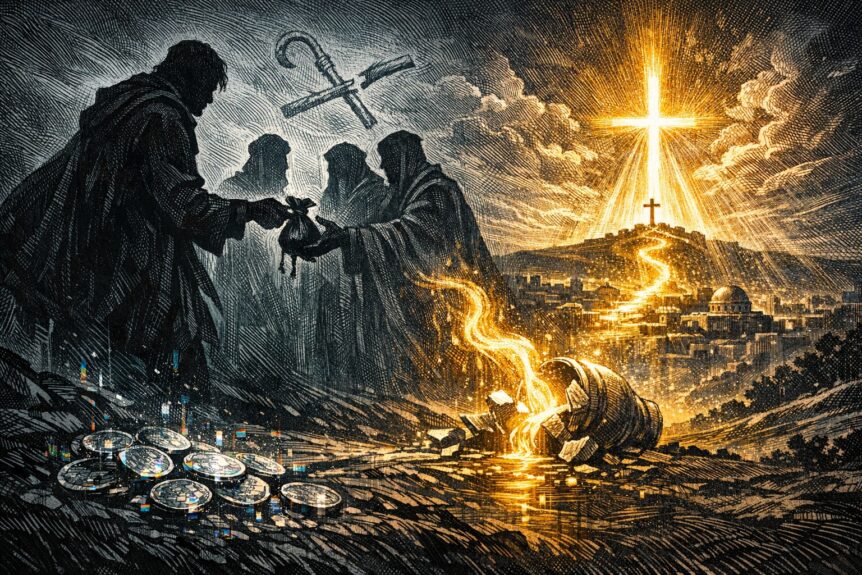
In Mark 14:1–11, Mark deliberately places a moment of costly devotion inside a story of deep betrayal. The chief priests plot to kill Jesus, an unnamed woman anoints Him with expensive perfume, and Judas goes out to betray Him. Mary’s broken alabaster jar displays a heart that sees Jesus as worthy of everything. Judas’s thirty pieces of silver reveal a heart willing to trade Jesus for worldly gain. Yet the gospel presses even deeper: before Christ found us, we were not naturally like Mary. We were sinners who needed the judgment Jesus bore in our place. Because of His mercy, we can now offer ourselves to Him in grateful devotion.
Sermon Audio
Shareable Quote graphics


Sermon Text
Blessings in the Midst of Betrayal
Nate Roten / Mark / Betray; Blessing / Mark 14:1–11 / October 25, 2026
Core Message
Are you willing to suffer loss to gain Jesus?
Who here likes high-contrast meals? Maybe you are a sweet-and-savory type of person, or sweet-and-sour, or salty-and-sweet (wow, we really like our sweets, don’t we?). The reason these pairings are so enjoyable is the contrast in flavors. Because of the contrast, each taste is enhanced against the other.
Today, our next Markan sandwich has two distinct flavors: sweet and bitter… blessings surrounded by betrayal.
I – Betrayal Sandwich
1. The schemes of the religious leaders
2. The blessings from the unnamed woman
3. The betrayal of Judas Iscariot
This is a design feature. Mark isn’t being sloppy; he’s being deliberate, stacking a blessing inside a betrayal so that each one sharpens the other. And here’s why that matters for us: if Jesus could receive the deep blessing of a devoted woman’s love in the very week He was being deeply betrayed by one of His own, then there is no trial you are walking through right now so dark that God cannot still place something sweet in the middle of it. That’s the sandwich we’re eating today.
So let’s read the passage and start taking small bites.
Passage
Mark 14:1–11 CSB
1 It was two days before the Passover and the Festival of Unleavened Bread. The chief priests and the scribes were looking for a cunning way to arrest Jesus and kill him. 2 “Not during the festival,” they said, “so that there won’t be a riot among the people.” 3 While he was in Bethany at the house of Simon the leper, as he was reclining at the table, a woman came with an alabaster jar of very expensive perfume of pure nard. She broke the jar and poured it on his head. 4 But some were expressing indignation to one another: “Why has this perfume been wasted? 5 For this perfume might have been sold for more than three hundred denarii and given to the poor.” And they began to scold her. 6 Jesus replied, “Leave her alone. Why are you bothering her? She has done a noble thing for me. 7 You always have the poor with you, and you can do what is good for them whenever you want, but you do not always have me. 8 She has done what she could; she has anointed my body in advance for burial. 9 Truly I tell you, wherever the gospel is proclaimed in the whole world, what she has done will also be told in memory of her.” 10 Then Judas Iscariot, one of the Twelve, went to the chief priests to betray Jesus to them. 11 And when they heard this, they were glad and promised to give him money. So he started looking for a good opportunity to betray him.
II – Cunning Schemes (vv. 1-2)
Passover and the Festival. Passover is the annual feast that commemorates Israel’s deliverance from Egypt and the slaughter of the Passover lamb for the people’s salvation. Its blood was painted on the doorposts of each Israelite home, and death passed over them. Passover was immediately followed by the seven-day Festival of Unleavened Bread. This commemorated not only Israel’s deliverance from death but also its hurried departure from Egypt. Pharaoh released the Israelites so suddenly that their dough did not have time to rise, so they carried it with them without leaven.
During the festival, they removed every trace of leaven from their homes. Scripture sometimes uses leaven as a symbol of sin or corruption spreading through an entire community, so physically removing leaven also served as a fitting picture of removing sin from among God’s people.
By Jesus’ day, Passover and the Festival of Unleavened Bread were often spoken of together as a single extended celebration. Passover was also one of Israel’s great pilgrimage festivals, so enormous numbers of Jewish worshipers traveled from across the Roman world to worship and offer sacrifices in Jerusalem.
The chief priest’s frustration. The religious leaders cannot do what they want because of this massive, adoring crowd. The crowd loves Jesus. He is their hailed Messiah, come to save His people. Think of it like this. We are currently in mid-term elections. This would be like going to a political rally for a beloved candidate and trying to take them out. The crowd’s riot would overtake you. You would be handcuffed or trampled within seconds. As of now, they can do nothing.
The plot. Mark tells us that the religious leaders are hatching a cunning plot to arrest and kill Jesus. There is someone else in Scripture described as cunning. Satan is, and according to Jesus, these corrupt leaders are Satan’s children, so it is no surprise to see them act like their father. It is also highly ironic that during the feast and festival that represent the removal of and atonement for sin… the religious authorities scheme and plot the most egregious sin of all time… the death of the Son of God!
This is the height of hypocrisy. In their zeal for God, they plotted His murder. May we never be so blind to the hardness of our hearts that we do the very thing we speak against.
Conspiracy to murder, then, is the top layer of the betrayal sandwich. Let’s now see what’s in the meaty middle.
III – The Blessing (vv. 3-9)
Simon’s house in Bethany. Bethany is where Mary, Martha, and Lazarus live, and it’s where Jesus stays the evening while visiting Jerusalem. Simon is mentioned only in this story. Although we don’t have much information about him, Mark and Matthew likely named him because he was well known in the community. Since leprosy wasn’t curable, Jesus likely healed him.
The woman. This woman is not named in Mark’s gospel. Mark has left her anonymous. John’s gospel identifies her as Mary, Martha and Lazarus’s sister. This is the second time we see Mary at Jesus’ feet. However, I believe Mark leaves her anonymous for a reason, which we will get to in a moment.
The offering. The jar is made of alabaster, a type of stone. These containers were carved from the stone, usually with a long neck. Just the fact that the nard perfume was in this type of container meant it was valuable. The nard certainly was. The oil is derived from a native Indian root and is very expensive. Mark says its value is over 300 denarii, which is nearly a year’s wages. We don’t know why Mary has such a luxurious, expensive item like this. Perhaps she had bought it. Perhaps it was an heirloom. That really doesn’t matter. What matters is what she did with it. She broke the slender neck of the stone flask and poured it over Jesus to anoint Him. These stone flasks had a seal on them, so why did she break it? I have a cologne bottle that I’ve owned since high school. It has a cork top, and I use it every time. Why? Because I only use a little dab at a time. If I snapped the neck of that bottle, I’d have to use it all, and (then I’d smell like a teenage boy going to prom). Don’t miss this little detail. She broke it because she intended to use it all for Jesus. In our Savior’s eyes, this was a deeply meaningful and beautiful moment between them. In this incredibly costly act, Mary embodied the greatest commandment to love her Lord with every last ounce.
The disciples’ shocking response. It’s sad, then, to see how some present (the disciples among them) react. They weren’t just disappointed. They weren’t confused. They were indignant. We might say livid. It is the same word used to describe the disciples’ anger when James and John tried to have a secret conversation with Jesus to secure the seats at the right and left of His throne. It is the word used to describe the religious leader’s vitriolic anger when he saw Jesus riding into Jerusalem on a donkey and heard the crowd cry, “Hosanna!” I can understand being shocked… but not indignant… not seething at the idea that she would pay such a high cost to demonstrate her love for her Lord.
Jesus corrects their misguided emotions. How disappointing it must have been to correct His disciples, yet again, for misunderstanding the situation. In response to their anger, Jesus offers four separate defenses of the woman.
1. Leave her alone. This is the only imperative command in the passage, and it was a rebuke to the disciples. This definitively set the tone. Church, as we live in community with one another, we will rub each other the wrong way from time to time. However, may we never be so blind to the intention behind an action that Christ would need to rebuke us so sharply!
2. Why are you bothering her? This question highlights how unreasonable their reaction is and forces them to account for their actions. Sometimes we react without thinking, and this proverb is a good reminder: “All a person’s ways seem right to him, but the Lord weighs motives.” – Prov 16:2. Clearly, they missed the motivation in Mary’s heart.
3. She has done a noble thing for me. Feel how off-base the disciples are. They were doing math. Dividing three hundred denarii among the poor is good stewardship and a defensible budget line. But Jesus looks at their spreadsheet and says, you’ve missed it entirely. The poor will always be with you. I will not. Mary wasn’t choosing against the poor. She was choosing the one window she had left to pour herself out on the only Person who was about to be taken from her. Her sister Martha was a worker bee, always moving. Mary wanted to sit at His feet, and now she wants to show the height of her devotion.
4. She has done what she could; she has anointed my body in advance for burial. Technically, this is the 4th prediction of his death. Did she know this? Was she privy to previous death predictions? Scripture is silent on how much she knew, but that doesn’t necessarily matter. This is another prophetic statement Jesus makes about what is to come. Whether she knew it or not, it is what she is doing, and her devotion would be infamous for all generations.
Before we move on to the bottom slice of bread, what can we learn from this middle section of the betrayal sandwich? There are many takeaways, but let’s focus on one or two.
First, as Paul will later say, “consider everything to be a loss in view of the surpassing value of knowing Christ Jesus my Lord” (Phil. 3:8). The worth of something lies in what you are willing to pay for it. Mary didn’t uncork the alabaster jar… she broke it, intending to use it all for Him. I pray that we can be more like Mary by finding the balance between working for Christ and being with Christ. I like what Daniel Akin says about this. In his commentary, he writes, “Some are willing to be poor in their possessions in order to be rich in their devotion to Jesus.” That’s a good word for us to keep in our hearts this week.
The second thing I want you to see is in circling back to Mary being anonymous in Mark’s gospel. There are many such women in Mark’s gospel, and each demonstrates a kingdom principle that Jesus is trying to teach His disciples.
Faith. The woman with chronic bleeding. “Your faith has saved you.” Her faith is held up as an example for Jairus, the Jewish synagogue leader who just lost his daughter to illness. The Syrophoenician woman who asks for table scraps is an example for non-Jews to have faith in the God of Israel.
Dependence. The poor widow gives her final two pennies to the treasury. “She has given more than everyone.” Her faith and dependence on God’s provision are held up as an example for the disciples to follow.
Devotion. This woman. Mary was fully devoted to Jesus and showed it by spending so much. And notice how the widow gave very little, while she gave a great deal, but the monetary cost is never the point. The heart behind it always is.
For the vast majority of us, our names will eventually be lost to history. Remember… in 100 years… all new people. Let’s expend ourselves for the only name that truly matters… Jesus, the name above all names.
Now, let’s clean our plate by finishing the sandwich.
IV – Betrayal (vv. 10-11)
It would seem that Judas is among those feeling indignation, because after this instance takes place, Judas did what he is most notorious for. He acted on the motivation of his heart, which was contrary to Mary’s. He betrayed his Lord. Notice who is doing what.
1. Judas went. It was Judas who went and sought out the chief priests to betray Jesus, not the other way around. We already know from the top layer of the sandwich that they wanted to kill Jesus, but we can’t mistake their murderous intentions for Judas’s deliberate betrayal. They did not seek Judas out. Judas went to them.
When he did find them, they were elated. They were so grateful to have an insider who could finally give them what they wanted that they offered Judas a bunch of money in return for his treachery. Mark doesn’t record the amount, but Matthew does. 30 pieces of silver.
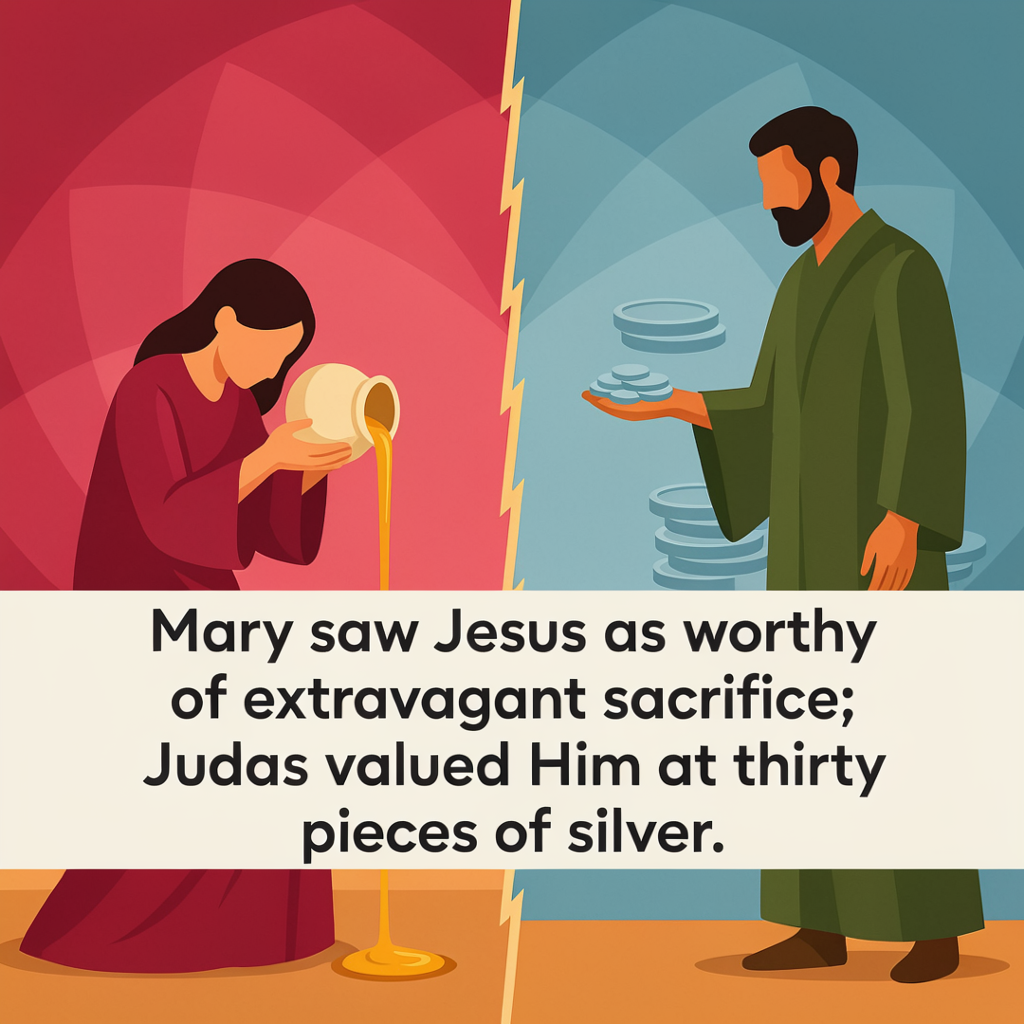
These were likely shekels, and if so, the overall cost of what Judas took is about two and a half times less than what Mary spent. This is why Mark places Judas’s betrayal beside the woman’s act of devotion. She pours out perfume worth more than three hundred denarii because she believes Jesus is worthy of extravagant sacrifice. Judas agrees to hand Jesus over for thirty silver coins because he believes Jesus is worth more to him betrayed than followed. She gives up something valuable to honor Jesus; Judas gives up Jesus to gain something valuable. One demonstrates the surpassing worth of knowing and following Christ, while the other reveals that physical proximity to Jesus is not the same as genuine discipleship. She will always be remembered for her devotion, and Judas will forever be remembered for his betrayal.
This number also has Old Testament significance. In Zechariah 11, the Lord sets shepherds over His flock and eventually breaks one of His staffs called ‘Favor’, and in doing so, He declares the end of the covenant with that flock. Then, in light of this annulment, wages are given, and the wage paid was 30 pieces of silver. Without knowing it, Judas was fulfilling prophecy (and is referenced by Matthew in chapter 27).
Thirty pieces of silver is also the cost of reparations from Ex. 21:32, payable to a slave owner if the slave is accidentally gored by an ox. Imagine that for a moment. To Mary, Jesus was worth far more than a year’s salary. For Judas, Jesus was worth no more than the death of a slave.
2. Judas sought. Once the deal was struck and he was paid for his treachery, Judas began looking for a suitable opportunity to betray Jesus. He wasn’t coerced. The chief priests didn’t suggest any means. Judas himself intentionally sought ways to deliver his rabbi, his teacher, into the hands of the corrupt religious leaders. People speculate about Judas’ motives for betraying Jesus. Some say Judas was trying to force Jesus to be the political ruler everyone thought He was coming to be. Others say that, as the money-keeper of the 12, his greed and shock over the woman’s offering compelled him to abandon Jesus. Scripture isn’t clear on the details, but it is clear on one thing. It was wicked. It was satanically inspired, and he will forever be known as the anti-disciple.
And so ends the sandwich of blessings surrounded by bitter betrayal.
Application: See the Contrast and Count the Cost
Now that you have seen and tasted the contrasting flavors, pretend you are a food critic. What is your critique of the betrayal sandwich?
- The value of knowing Jesus is worth suffering loss. That’s a good one.
- Am I willing to sacrifice my treasured position (unlike the religious leaders) or my personal gains (unlike Judas) for the sake of publicly demonstrating my devotion to Jesus? That’s another good one.
- Do I praise God that I am not a betrayer like Judas, not a hypocrite like the priests, and that I am becoming more like Mary? That’s a good recognition. But be careful, because that is also the exact prayer of the Pharisee in Luke 18, standing alone and saying, “God, I thank you that I am not like other men.” He was right about the facts and wrong about his heart.
So before we leave the sandwich, let’s be honest about something. Before Jesus found us, none of us were Mary. We were the priests, plotting to protect our own kingdoms. We were Judas, willing to betray Jesus for worldly pleasures. We were not less guilty, only less caught. And the staff called Favor, the one Zechariah says breaks over a people under judgment, isn’t broken over us. Not because we earned it, but because Jesus took that judgment on Himself.
This week, as we strive to become more like Mary and the other unnamed women, let’s first reflect on the contrast between who we were in our sin and who we are now in Christ, and praise Him for His abundant mercy and grace.
Then, let’s ask the harder question: like Mary, what alabaster jar… what costly thing do I have that God is asking me to offer Him this week?
FAQs
1. Why did Mark place the woman’s anointing between two accounts of betrayal?
Mark’s structure sharpens the contrast. The leaders and Judas reveal what it looks like to reject Jesus, while the woman shows costly devotion to Him. Her act shines even more brightly against the darkness surrounding it.
2. Was the woman wrong to spend so much when there were poor people to help?
No. Jesus did not dismiss care for the poor; He affirmed that His people would have ongoing opportunities to do good for them. But this was a unique moment before His death, and the woman’s act honored the One who was about to give His life for sinners.
3. Does this passage mean Christians should sell everything they own?
The passage does not give a universal command to duplicate this particular gift. It does call every believer to hold possessions, comfort, status, and security beneath the greater worth of Christ.
4. Why was Judas’s betrayal so serious if it fulfilled prophecy?
Judas acted willingly and wickedly. God’s sovereign purpose was fulfilled, but Judas was not forced into sin or excused from responsibility for betraying the Lord.
5. Did the woman understand that she was preparing Jesus for burial?
Scripture does not tell us how much she understood. Jesus makes clear that her act pointed forward to His burial, whether she grasped every implication or not.
6. What does Jesus mean when He says, “You always have the poor with you”?
Jesus is not minimizing the poor. He is recognizing the ongoing reality of poverty in a fallen world while also declaring the unique urgency of His approaching death. Christians should honor Christ and faithfully care for those in need.
7. How can I know whether I value Jesus like Mary or use Him like Judas?
Ask what you are unwilling to surrender when obedience becomes costly. Mary saw Jesus as worthy of her treasure; Judas saw Jesus as a means to personal gain. Honest repentance begins when we bring our competing loves into the light.
8. What is the “alabaster jar” God may be asking me to offer?
It may be a treasured position, a personal ambition, financial comfort, a hidden sin, or the approval of others. The question is not whether you can earn Christ’s love, but whether His love has made Him more precious than what you are clinging to.