Highlight Reel
Sermon Summary
Mark 14:12–21 brings us into the upper room as Jesus prepares to share His final Passover with the Twelve. The preparation itself shows His control: the disciples find everything just as He told them. But the meal is pierced by the announcement that one of His closest companions will betray Him. In fulfillment of Psalm 41, Jesus is wounded by someone who eats at His table.
Sermon Audio
Shareable Quote graphics



Sermon Text
Can Human Sin Stop God’s Plan?
Nate Roten / Mark / Mark 14:12–21 / November 1, 2026
Core Message
What God plans, God will bring to pass.
Psalm 41 CSB
For the choir director. A psalm of David. 1 Happy is one who is considerate of the poor; the Lord will save him in a day of adversity. 2 The Lord will keep him and preserve him; he will be blessed in the land. You will not give him over to the desire of his enemies. 3 The Lord will sustain him on his sickbed; you will heal him on the bed where he lies. 4 I said, “Lord, be gracious to me; heal me, for I have sinned against you.” 5 My enemies speak maliciously about me: “When will he die and be forgotten?” 6 When one of them comes to visit, he speaks deceitfully; he stores up evil in his heart; he goes out and talks. 7 All who hate me whisper together about me; they plan to harm me. 8 “Something awful has overwhelmed him, and he won’t rise again from where he lies!” 9 Even my friend in whom I trusted, one who ate my bread, has raised his heel against me. 10 But you, Lord, be gracious to me and raise me up; then I will repay them. 11 By this I know that you delight in me: my enemy does not shout in triumph over me. 12 You supported me because of my integrity and set me in your presence forever. 13 Blessed be the Lord God of Israel, from everlasting to everlasting. Amen and amen.
Psalm 41 places us beside David during one of the most vulnerable seasons of his life. He is sick, weakened, and surrounded by people waiting for him to die. Some visit him, pretending to care, but their concern is hollow. They gather information, leave his presence, and spread it to others. David is not simply battling illness. He is enduring rumors, scheming, and enemies who see his suffering as an opportunity to remove him from the throne.
But the deepest wound comes from someone David trusted: “Even my close friend in whom I trusted, one who ate my bread, has raised his heel against me.” The psalm does not identify this friend, but Ahithophel is a plausible candidate (2 Samuel 15–17). Ahithophel had been David’s trusted counselor before abandoning him to support Absalom’s rebellion. He had shared David’s confidence and enjoyed a place in his inner circle, yet he turned his wisdom against David and advised Absalom on how to destroy him. Whether or not they’ve been referring to the specific person, the hurt of betrayal remains. An enemy can attack you from a distance, but a betrayer must first come close enough to be trusted.
Passage
Mark 14:12–21 CSB
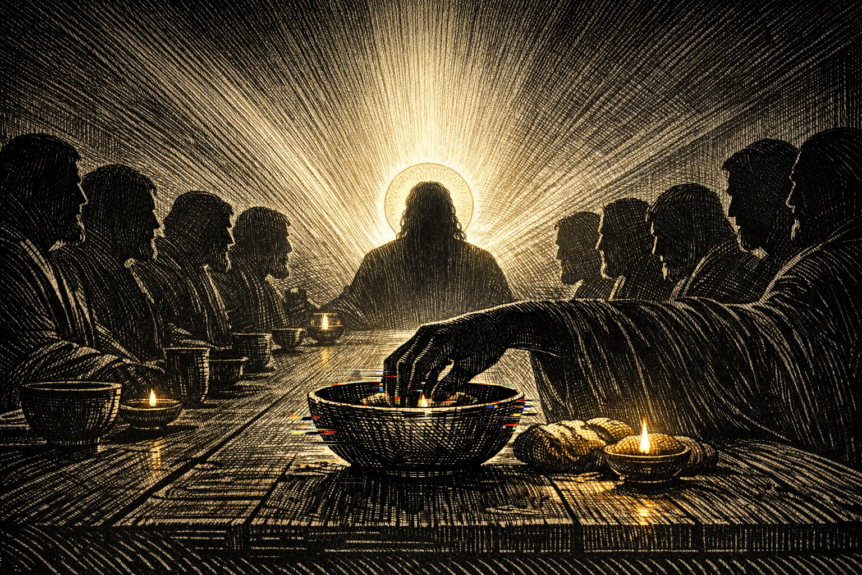
12 On the first day of Unleavened Bread, when they sacrifice the Passover lamb, his disciples asked him, “Where do you want us to go and prepare the Passover so that you may eat it?” 13 So he sent two of his disciples and told them, “Go into the city, and a man carrying a jar of water will meet you. Follow him. 14 Wherever he enters, tell the owner of the house, ‘The Teacher says, “Where is my guest room where I may eat the Passover with my disciples?” ’ 15 He will show you a large room upstairs, furnished and ready. Make the preparations for us there.” 16 So the disciples went out, entered the city, and found it just as he had told them, and they prepared the Passover. 17 When evening came, he arrived with the Twelve. 18 While they were reclining and eating, Jesus said, “Truly I tell you, one of you will betray me—one who is eating with me.” 19 They began to be distressed and to say to him one by one, “Surely not I?” 20 He said to them, “It is one of the Twelve—the one who is dipping bread in the bowl with me. 21 For the Son of Man will go just as it is written about him, but woe to that man by whom the Son of Man is betrayed! It would have been better for him if he had not been born.”
I – The Covert Mission (vv. 12-16)
Passover. Thursday evening is the day of Passover, since Jews follow a lunar calendar. This is the day when the priests slaughter the Passover lamb in Jerusalem. According to Jewish law, all Jews must observe Passover within the walls of Jerusalem (an amazing feat, given the vast number of pilgrims), which is why Jesus needs a place to celebrate there rather than at Simon the leper’s house.
The covert mission. Jesus tells two disciples (Peter and John, according to Luke’s gospel) to go and find a man carrying a water jar. This might seem like a random detail, but in that day and culture, women carried the water jars, not men (remember the woman at the well). So it would have been much easier to find this person in the crowded streets of Jerusalem. The way Jesus describes this suggests that the man should also be looking for the disciples, and that he would lead them to a house where the Passover meal has already been set up for Jesus and His disciples. They were to tell the owner of the house that the teacher was asking for the guest room, which again implies that he was already aware of Jesus’ expectation. Some may say this is because of Jesus’ supernatural foreknowledge, but it could just as easily have been a prior arrangement Jesus made that He is now acting on. Once the introductions were made and the upper room was secured, Peter and John were instructed to prepare the Passover meal, which they did.
So the reason I call this a covert mission is that Jesus is both very popular with the crowd and very hated by the religious leaders. Jesus essentially has a hit out on Him, so He can’t just freely roam about the city. You’ve seen this in movies. Two people need to meet without anyone else knowing. So one of them carries something recognizable, a signal, so the other can find them in a crowd without ever approaching and asking. That’s what’s happening here. The water jar is the signal. Jesus has arranged it in advance, precisely so He never has to walk the streets of Jerusalem asking out loud for a room. Powerful people want Him dead. He’s in control of that too. He is supposed to die, but not tonight, and not like this.
Parallel to the Triumphal Entry. What’s interesting about this first section is how it parallels Jesus’ Triumphal Entry on Sunday. If you remember, Jesus instructed two disciples to go find a donkey, talk with anyone who questioned what they were doing, and then bring that donkey to Him. Here the pattern is much the same. Jesus tells them to go find the man with a water jar, follow him back to the house where he works or lives, ask about having Passover there, and then prepare it.
Jesus is in control of the situation. Why do I bring that up? First, I think it’s a parallel Mark is drawing because of the sequence of events, so we should pay attention to it. Jesus has plans, and He’s working through His disciples to carry them out. The same thing happens today.
But just as importantly, we need to recognize that Jesus is in control. He has prepared these things in advance, whether by divine intervention or prior conversations, and things come to pass just as He planned. The text emphasizes this in verse 16, which says the disciples went out “and found it just as He had told them.” And we need to see that now, even in this small instance before we get to the Passover meal, the same principle works on a much larger scale.
God is a God of the details. As Isaiah said, “He knows the end from the beginning… from ancient times what is to come.” The text today proclaims this reality. Christ is in control! If He can control moments like these, how much more can He work in and through your current hardship for your good and His glory?
Now, let’s see how this works on a larger scale.
II – The Start of the Last Supper (vv. 17-20)
Top Layer of the next Markan Sandwich. The verses describing this sandwich are abundant, so I am splitting it over two weeks. We’ll call this the Passover Sandwich, which includes Jesus announcing His betrayal to the disciples, then the Passover meal, then Jesus’ announcement of Peter’s denial and betrayal.
Table Fellowship. Mark mentions ‘the disciples’ and ‘the Twelve’ a combined total of 6 times. The weight of this section is on the intimate nature of Jesus’ meal with those closest to Him. As it is today, a special bond is created at the dinner table. You open yourself to others when you open your home and pantry. We call this table fellowship, and it signifies deep relationships. This passage reinforces this concept in a couple of ways. Verse 18 speaks of “the one who is eating with me,” and verse 20 says “the one who is dipping bread in the bowl with me.” In Luke’s gospel, Jesus says, “I have fervently desired to eat this Passover with you before I suffer. For I tell you, I will not eat it again until it is fulfilled in the kingdom of God.”
And to add to the intimacy of this moment is the reality that this is a Passover meal, the final one He will have with His disciples on this earth. Remember, this meal commemorates God’s salvation and liberation of His people, which, of course, is what Jesus is currently doing. He is celebrating the Old Testament reality while declaring the New Testament reality by instituting a new covenant in His blood at this very table. It previews the ultimate sacrifice Jesus is making for them and the gift God is giving to a rebellious people He’s calling to Himself. So the elements of the Passover meal come first, and then the actual meal follows. It was a special celebration with a special group of people, with the Lord of creation, which makes it all the sadder to hear Jesus announce His betrayal during this important moment with the people He has drawn close.
The announcement. Once again, Jesus begins with the words, “Truly I tell you.” In other words, listen carefully, because what I am about to say will certainly come to pass. “One of you will betray me, one who is eating with me.” This is not an enemy waiting outside the room. It is one of the Twelve, someone sitting at His table and sharing His bread. The disciples are deeply distressed. One after another, they ask, “Surely not I?” You can almost feel the fear settling over the room. If Jesus said that to me, my stomach would drop. I would immediately begin examining my actions, wondering whether I had done anything that could be considered an act of betrayal.
This brings us back to Psalm 41. David wrote, “Even my friend in whom I trusted, one who ate my bread, has raised his heel against me.” We saw how this may have reflected Ahithophel, David’s trusted counselor who abandoned him and joined Absalom’s conspiracy. Now the same pattern is unfolding around the greater Son of David. Jesus is also being betrayed, not by a distant enemy but by a trusted companion who has walked with Him, ministered beside Him, and now eats at His table. John makes the connection explicit by recording that Jesus quoted Psalm 41:9 at the supper: “The one who eats my bread has raised his heel against me.”
Mark has already told his readers that Judas is the betrayer, but he does not name him here. Instead, Mark places us in the disciples’ uncertainty and grief. Remember, Jesus says the betrayer is “one of the Twelve” and “one who is dipping bread in the bowl with me.” That detail underscores the vileness of the act. Again, sharing a meal was an expression of fellowship, friendship, and loyalty. Judas receives Jesus’ hospitality while secretly arranging His arrest. His hand is close enough to share the bowl, yet his heart is far from Christ. This is the horror of betrayal: Judas appears to be a disciple and close friend, yet is the exact opposite.
Control. Watch what Jesus does with this knowledge. He doesn’t posture; He doesn’t interrogate the table; He doesn’t call Judas out by name. He announces the betrayal, and then He keeps eating. He still shares the Passover meal. He still declares the new covenant. He still sings a hymn with the very men who will abandon Him in a few hours. That’s command under control. Only someone fully in control of His own fate can hold both the grief of betrayal and the peace of the table.
I believe the Passover scene is why so many in church history link Mark’s gospel account to the human face of the Tetramorph (one of the 4 faces of the cherubim throne guardian in Ezekiel). He lives out the humanity God originally designed us to have before the fall. Yet, being fully God, He still controls the timing of His death to coincide with the slaughter of the Passover Lamb. He is truly worthy of all our praise!
So, let’s end today’s discussion on a praiseworthy high note of Christ’s sovereignty over the plan of salvation.
III – The Sovereignty of Christ and Sinfulness of Man (v. 21)
The Sovereignty of Christ. This passage ends with one of the most explicit descriptions of both God’s sovereignty and human responsibility. This is a doctrine we struggle with today because it’s hard to accept that God can do as He pleases, decree whatever He wills, and that it will come to pass through human decisions for which they are responsible. They still have autonomy, and they still face consequences for whatever heart’s desire they act on. Here, Jesus says, “The Son of Man will go just as it is written about Him.” As we’ve discussed before, the Son of Man refers to Daniel chapter 7, where the Son of Man approaches the Ancient of Days on His throne in heaven and is given a kingdom, authority, and eternal rule. Jesus has often referred to Himself as this Son of Man figure, which is synonymous with the title of the Messiah.
While many passages speak of the Messiah’s eternal rule, others describe His substitutionary death in stunning detail, which will atone for the sins of His people (see Isaiah 53 and Psalm 22). As Peter would later declare, the Father planned the cross from eternity past, before the world was created. This was always the plan of redemption and the salvation of God’s people. What God plans, God will bring to pass.
The Sinfulness of Man. And yet, Jesus also issues a woe over His betrayer, a lament, a heartfelt pity for the person who’s doing this evil. He says, “Woe to that man by whom the Son of Man is betrayed; it would have been better for him if he had not been born.” In other words, the punishment that will come upon the betrayer of the Son of Man, the Messiah, the Son of God, the initiator of the new covenant, and sovereign ruler of creation, will be so intense and horrible that it would be better if this person had never existed in the first place.
The plan put in place from the foundation of the world does not let Judas off the hook. He remains responsible for his actions. God didn’t hold a gun to Judas’ head and force him to betray… he wanted to betray, and he will be held accountable. God simply allowed him to act on the wickedness of his heart, as James describes as a series of births: evil human passions give birth to sin, which eventually gives birth to death… and we all know Judas’ ultimate fate.
Things are rarely as they seem. This is why we keep coming to the same conclusion: keep your eyes and hearts on Christ, not on the crisis.
Application: Don’t Let Pain Cancel Your Praise
There will be times when people hurt us, use us, take advantage of us, and conspire against us. Today, you might have an Ahithophel in your life, someone who ate at your table and then turned. Here’s what Jesus shows you to do with that: He named the betrayal honestly, out loud, and then He kept passing the bread. He didn’t let Judas’s treachery cancel the meal or the hymn or the new covenant He was establishing that very night.
So this week, don’t pretend the hurt isn’t real; Jesus didn’t. But don’t let it be the last word either. Keep showing up to your own table. Keep singing. Keep praising.
Because human sin will never stop God’s purposes, we can have confidence that what God plans, God will bring to pass. And in that security, you can lift your head and say with the saints:
Revelation 5:12–13 CSB
12 They said with a loud voice, Worthy is the Lamb who was slaughtered to receive power and riches and wisdom and strength and honor and glory and blessing! 13 I heard every creature in heaven, on earth, under the earth, on the sea, and everything in them say, Blessing and honor and glory and power be to the one seated on the throne, and to the Lamb, forever and ever!
FAQs
1. Did Jesus know Judas would betray Him?
Yes. Jesus clearly announces that one of the Twelve will betray Him, and He speaks of His coming death as something already written in Scripture. Judas’s betrayal did not catch Christ off guard.
2. If Judas’s betrayal fulfilled God’s plan, was Judas really responsible?
Yes. Jesus says both that the Son of Man will go as Scripture foretold and that woe belongs to the man who betrays Him. God’s sovereign purpose does not remove human responsibility.
3. Does God cause people to sin?
No. Judas was not forced against his will. He acted from the wicked desires of his own heart and remains accountable for his betrayal. God sovereignly accomplishes His purposes without becoming the author of sin.
4. Why did Jesus continue to eat with Judas?
Jesus did not minimize Judas’s treachery, but neither did He surrender the table to it. He continued the Passover meal and moved forward with the new covenant because His mission could not be interrupted by human sin.
5. What does Psalm 41 have to do with Jesus?
Psalm 41 describes the pain of betrayal by a trusted companion who shared bread with David. Jesus fulfills this pattern as the greater Son of David, betrayed by Judas at the Passover table.
6. What does “the Son of Man will go just as it is written” mean?
Jesus is saying that His suffering and death are not accidents or defeats. They are the fulfillment of God’s revealed plan for the Messiah, including the suffering described in passages such as Isaiah 53 and Psalm 22.
7. How should Christians respond when someone close betrays them?
Name the hurt honestly before God. Do not pretend it is small or unreal. But do not let betrayal become the final word over your life; keep trusting Christ, keep worshiping, and keep walking in obedience.
8. Does God’s sovereignty mean my suffering does not matter?
No. Christ Himself entered real suffering and experienced real betrayal. God’s sovereignty means your pain is not meaningless, not unseen, and not beyond His power to use for His glory and your good.