Highlight Reel
Sermon Summary
What happens when our promises to follow Jesus meet real pressure? In Mark 14:22–31, Jesus reveals the limits of human willpower, the certainty of His coming sacrifice, and the hope of His resurrection. This message calls us away from self-reliance and toward the strength Christ provides through His Spirit.
Sermon Audio
Shareable Quote graphics

Sermon Text
Why Willpower Is Not Enough to Follow Jesus
Nate Roten / Mark 14:22–31 / November 8, 2026
Core Message
Without Christ, I can do nothing, but in Him, I can do all things for His glory.
A few months ago, I was flipping through social media and saw a video of one of those people who dress up as statues. This guy was bronzed, sitting on a park bench, with a little dog statue beside him. The video showed a dozen or so people coming up to him, mostly to pose for a picture, or children wanting to pet the dog. One girl, however, stuck out. She looked to be about 7 or 8 years old, and instead of petting the dog or sitting down, she kicked the man in the leg. It was clear from her approach that she thought she was tough stuff, but when the statue stood up, she ran away screaming.
It’s easy to act tough and confident when there is no perceptible danger, but talk is cheap, as they say. The real test of a person’s strength, physical, mental, or otherwise, is shown in the decisions they make when danger arrives. Adversity reveals your true character.
Today, we will finish the Passover sandwich we started last week, and this one is seasoned with the bitterness of strong talk but weak action.
Passage
Mark 14:22–31 CSB
22 As they were eating, he took bread, blessed and broke it, gave it to them, and said, “Take it; this is my body.” 23 Then he took a cup, and after giving thanks, he gave it to them, and they all drank from it. 24 He said to them, “This is my blood of the covenant, which is poured out for many. 25 Truly I tell you, I will no longer drink of the fruit of the vine until that day when I drink it new in the kingdom of God.” 26 After singing a hymn, they went out to the Mount of Olives. 27 Then Jesus said to them, “All of you will fall away, because it is written: I will strike the shepherd, and the sheep will be scattered. 28 But after I have risen, I will go ahead of you to Galilee.” 29 Peter told him, “Even if everyone falls away, I will not.” 30 “Truly I tell you,” Jesus said to him, “today, this very night, before the rooster crows twice, you will deny me three times.” 31 But he kept insisting, “If I have to die with you, I will never deny you.” And they all said the same thing.
I – The Passover Sandwich
1. Betrayal Announced – Judas
2. The Last Supper Observed
3. Betrayal Announced – Peter (and everyone else)
Today, we will discover the limitations of human willpower. Like the little girl who walked up to the man she thought was a statue and ran away in terror when he moved, the disciples will confidently say they will stand with Christ no matter what… then hide in fear.
We must remember that without Christ, we can do nothing, but in Him, we can do all things for His glory.
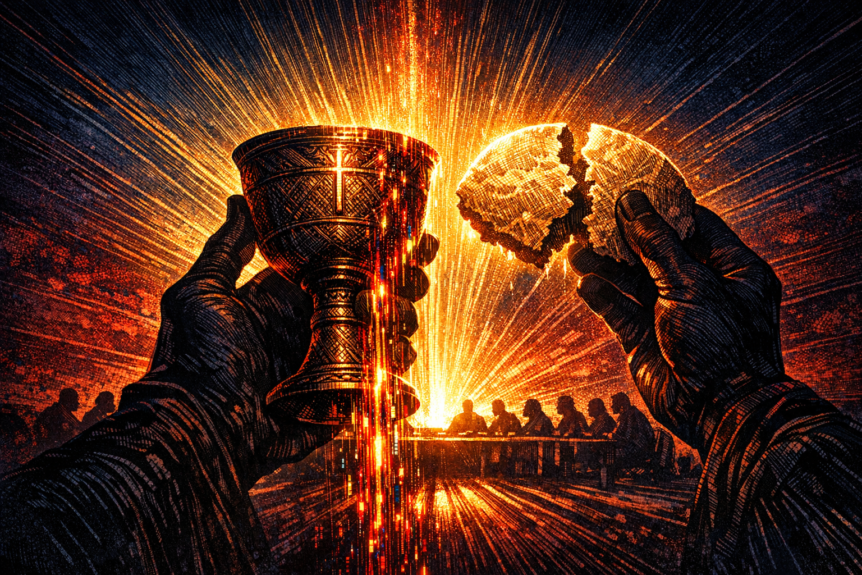
That truth is for the good times and the dark times… both of which are represented here.
II – Betrayal Announced (Judas)
Forewarned. We saw that Judas was not called out by name but was forewarned about his plans. The Son of David used the description of King David’s betrayer from Psalm 41 and told him that his fate would be far worse than if he had never existed.
Distress. This distressed the other disciples, who were innocent of this betrayal, though, as we will see, they will not be innocent of another sort.
Table Fellowship. The egregiousness of this act is heightened by the intimate nature of the table fellowship they were sharing and the depth of meaning the Passover meal held for Jesus’ fulfillment of it. As we said last week, Judas receives Jesus’ hospitality while secretly arranging His arrest. His hand is close enough to share the bowl, yet his heart is far from Christ.
III – The Kingdom Advances (vv. 22-26)
Progress in Pain. Though the sting of betrayal lingers and the disciples continue to fight over positions of power (as seen in the other gospel accounts), Jesus doesn’t waver in His mission. He still teaches, still loves, and still points forward to the reality of the cross and empty tomb.
The Passover Meal Reenvisioned. For more than a thousand years, the Jewish people gathered around the Passover table to remember how God delivered their ancestors from Egypt. Every element told part of the story. The bitter herbs recalled the bitterness of slavery. The unleavened bread recalled their suffering and the haste with which they left Egypt. The lamb reminded them that a substitute had died and that its blood had sheltered their families from judgment. Together, the meal proclaimed, “We were slaves, death was coming, God provided a sacrifice, and God brought us out.”
By Jesus’ time, wine had also become part of the Passover celebration. Jewish tradition eventually associated four cups with four promises God made in Exodus 6: “I will bring you out. I will rescue you. I will redeem you. I will take you as my people.” Each cup marked another stage in God’s salvation. He separated His people from Egypt, broke the power that enslaved them, redeemed them with His mighty arm, and brought them into a covenant relationship with Himself.
Whether or not all four cups were in use at this time, we can still see these elements at play when Jesus takes the cup and declares, “This is my blood of the covenant, which is poured out for many.” He announces that the greater redemption has arrived. Jesus takes that familiar story and reveals where it has been pointing all along.
God will bring His people out, not merely from Egypt but from the kingdom of darkness. He will rescue them, not merely from Pharaoh but from the rule of sin and death. He will redeem them, not through the blood of an animal but through the blood of His Son. He will take them as His people through the new covenant established by Christ. The first exodus brought Israel out of Egypt; through the cross, Jesus begins the greater exodus, bringing His people out of sin and death and into the kingdom of God.
Therefore, these elements are familiar, but Jesus reveals their ultimate meaning. Keep in mind that what Jesus is saying here is not the standard way to lead through Passover. These are entirely new ideas that Jesus is unpacking, not to replace the Passover story… but to fulfill it. The bread, the blood, the sacrifice, and the deliverance were all preparing the disciples to understand what Jesus was about to accomplish. The Passover had always looked back to Egypt, but it had also pointed forward to Jesus.
So, when we take communion together, we recognize these same truths.
The bread is Christ, taking on our suffering at the cross and bearing the cost of our deliverance. And like the miraculous feeding of the 5,000 and 4,000, His provision is enough for all His people. He is the spiritual bread that feeds our souls.
The wine that represents God’s promise to bring us out of slavery, to rescue us, to redeem us, and to take us as His people is fulfilled when His blood is poured out. When we take it, we acknowledge that this atoning work is for us. The term “blood of the covenant” comes from Exodus 24:8, which describes the Covenant made at Mt. Sinai and the giving of the 10 Commandments, sealed with the sprinkling of blood over them. The term “poured out” also references Isaiah 53:12, which describes the Messiah “pouring out His soul to death” for the sins of His people.
Announcement of Victory. This is subtle, but it’s powerful when you see it. After everyone present participated in the fulfillment of Passover, Jesus predicted the ultimate victory He would win both on the cross and at His second coming. After He drinks the wine, He says He won’t drink it again until the day He drinks it with them in the kingdom of God. This means the kingdom of God must advance and be victorious for them to turn around and celebrate its fulfillment. This is not only a prophecy and prediction of what is to come; it is a declaration of victory over the enemy!
Worship. After the announcement of victory, they worship together before leaving the upper room. Historically, this would be Pss. 115-118, known as the Egyptian Hallel, though Mark doesn’t tell us precisely what they sang. All we know is that it was a song of praise to the Most High God, in gratitude for His love that compelled Him to rescue and redeem His people. I can’t think of a more beautiful way to end the evening and to recognize this as a model for all Christian communities. Perhaps this is what Paul had in mind when he asked the Ephesian church not to be filled with wine, but to be filled with the Spirit…
Ephesians 5:19–20 CSB
19 speaking to one another in psalms, hymns, and spiritual songs, singing and making music with your heart to the Lord, 20 giving thanks always for everything to God the Father in the name of our Lord Jesus Christ,
The Kingdom Still Advances. This is the confidence Jesus gives His disciples. He speaks of the future kingdom as betrayal, abandonment, suffering, and death closing in around Him. From a human perspective, everything is about to fall apart. From God’s perspective, everything is moving forward exactly as He planned. The cross will not stop the kingdom. The cross will secure its victory.
But this victory will come with the sting of betrayal and abandonment from His own people.
IV – Betrayal Announced – Peter (and everyone else) (vv. 27-31)
All will fall. Now comes the final round of betrayals, when Jesus predicts the falling away of ‘all.’ Just as Judas’ betrayal would come to pass because it was written about in the Old Testament, so would the remaining disciples abandon Jesus in the hour of His greatest need. Thankfully, this wasn’t the same type of betrayal as Judas’, but saying you will stand with your Lord and Rabbi only to run away when the heat gets turned up is still a betrayal. To show where this was written, Jesus quotes Zech. 13:7, which appears in the midst of a promise to cleanse the people and to “wash away sin and impurity” (v.1), but this will be one who is receiving “wounds in the house of my friends” (v.6).
Could you imagine how much this must have grieved Jesus? Judas has betrayed from a greedy, corrupted heart. He was close enough to Jesus to dip his bread in the same bowl, yet his motives were clearly dark. The others, however, wounded Him without even realizing it. The very people who are being washed from sin and cleansed from impurity are the ones with daggers to stab their Cleanser. It has been written, and no amount of willpower or gusto can change what God has ordained.
Peter’s fall. In response to what I’m sure is a shocking prophecy, Peter responds with false confidence in his own willpower to stay by Christ’s side. He is blind to the reality Jesus is stating. Therefore, he is in denial about his own denial of Jesus. Even though Jesus said Peter’s actions were grounded in scripture, he thinks he can move forward in his own strength when he says, “Even if everyone falls away, I will not.”
To counter his false confidence, Jesus reassures Peter that he will indeed fall away. In fact, before the rooster crows twice, he will deny his allegiance to his Lord three times. Right now, Peter is walking up to the statue to kick it with a sense of false strength, thinking it won’t fight back, but when he moves… Peter will run away and hide. And this won’t be a momentary lapse in judgment followed by a strong stance for Christ when he remembers this moment. No, he will persistently deny his Rabbi and friend. Three times it will happen within a span of a fistful of hours. Before the rooster can make multiple wake-up calls, it will come to pass… it has been written, and Jesus uses His trademark phrase to confirm it… “Truly, I tell you.”
As Peter does, he puts his foot in his mouth again. He doubles down. He digs in his heels and says, “If I have to die with you, I will never deny you.” I’m sure he meant it in the moment. He really does love Jesus, but he has already forgotten the valuable truth that you don’t win spiritual battles with human might. Right now, Peter’s misplaced trust in his own strength makes him think he is the exception to the rule. Even if everyone else abandons the fight and he stands alone on the front line, he will stand.
I wonder what the other disciples thought of that statement that practically threw them under the bus. We don’t know how that phrase landed, but we do know how the last one did. Once Peter expressed his ultimate allegiance, they followed suit. Everyone agreed to lay down their lives. And when the statue moved, and a Roman legion came to take Jesus away, they all ran away, just as Jesus said they would.
We cannot win spiritual battles in the strength of the flesh. Our war isn’t against flesh and blood, but against spiritual powers and authorities. If that’s true, why do we think we can win with carnal strength? You can’t take a swing at a spiritual authority. A human being whose nature and faculties have been thoroughly affected by sin and the fall cannot endure constant spiritual attack. You can try all you like to withstand the enemy’s attack in your own power, but in the end, you will fall away, just like they did.
V – Jesus Predicts the Victory of His Resurrection
Now, that sounds very dark. If I cannot stand against the enemy, then why hope? Why struggle and fight when I know I can’t win? You might be thinking, “Nate, this is far from an encouraging and uplifting message!”
If that is you… hang tight. Hope is coming. This wasn’t the end of the discussion. After predicting their desertion, Jesus foretold another event. Did you catch it? He said, “After I have risen, I will go ahead of you to Galilee.” Have you ever looked up into the sky at dusk and seen a few faint stars twinkling, still hard to make out because they were veiled by the sunset’s fading light? But then, a few hours later, when it is really dark, they are shining brilliantly. The truth about the church is that it grows and is strengthened in difficult times. During the Last Supper, Jesus’ love and compassion for His disciples shines even brighter against the darkness of their selfishness, betrayal, and impending desertion. When they could come alongside to comfort Him in the garden, they all fell asleep. When He went to the cross, they scattered.
But this isn’t the end.
Application: Whose strength are you operating in?
Just as surely as the cross is coming, so is the empty tomb. Just as Judas’s betrayal and their desertion were written, so is Jesus’s victory over the grave. So if you’re asking yourself right now, where is the hope when human strength fails? It’s in the reality that we don’t operate in our own strength. Jesus said He will rise, and after He has risen, He will go ahead of them to Galilee. He will lead His people in a triumphal procession over sin and death. He is the God of the Exodus story who will rescue and redeem His people. The first time it was from physical slavery, but this time it will be from sin and death! The Old Covenant was repeatedly broken.
Jesus promises to bring them full circle. He called them to become disciples three years ago on the shores of the Sea of Galilee, and He will lead them there again after the resurrection to empower and strengthen them.
The dark background of the Last Supper shows how they all acted. They all drank together. All claimed unwavering fidelity. Then they all scattered (v. 50). That, however, was in their own strength. In our own strength, we are all like that little girl who runs away when our false sense of strength drains out as real spiritual conflict arises. Today’s passage shows what we are all like without the presence of Christ or the empowerment of the Holy Spirit. That is the dark sky.
But the bright-shining hope is found in another “all” statement. These same disciples who had all scattered were gathered again by the risen Christ. Then Pentecost came… they were filled with the Holy Spirit, and everything changed. Acts 4:31 says, “They were all filled with the Holy Spirit and began to speak the word of God boldly.”
Do you see the difference? At the Last Supper, they all claimed they had enough courage to remain faithful, but when the pressure came, they fled. After the resurrection, they no longer operated in their own strength. They were all filled with the Holy Spirit, and the men who had scattered in fear began proclaiming Christ with boldness. History tells us that most of them ended up fulfilling their initial vows after all… they were martyred for their faith.
This week, when you stand face-to-face with adversity, ask yourself this one question: “Whose strength will I operate in?”
The answer to our weakness is not greater confidence in ourselves. It is the presence of the risen Christ and the power of His Spirit working within us. In our own strength, we may all fall away. But through Christ, “in all these things we are more than conquerors through him who loved us.”
FAQs
1. Why did Jesus connect the bread and cup to His body and blood?
Jesus was showing that the Passover meal ultimately pointed to Him. Just as God delivered Israel through the blood of a substitute, Christ delivers His people through His own sacrificial death.
2. What does “blood of the covenant” mean?
It points back to the covenant God made with Israel through blood at Mount Sinai. Jesus announces that His blood establishes the new covenant, securing forgiveness and bringing His people into a lasting relationship with God.
3. Did Jesus know the disciples would abandon Him?
Yes. Jesus plainly tells them that they will fall away, and He grounds that prediction in Scripture. Their failure did not surprise Him or derail God’s plan.
4. Was Peter’s failure the same as Judas’s betrayal?
No. Judas betrayed Jesus from a hardened and corrupt heart. Peter’s denial was grievous and sinful, but Peter was restored by Christ. The passage warns us not to minimize any failure while also showing that Christ is merciful toward repentant sinners.
5. Why wasn’t Peter’s love for Jesus enough to keep him faithful?
Peter truly loved Jesus, but love mixed with self-confidence cannot withstand spiritual pressure. He needed more than sincere intentions; he needed the sustaining power of Christ.
6. Does this mean Christians will always fail when tested?
Christians are weak in themselves and must not trust their own strength. But Christ does not abandon His people. Through His Spirit, believers are strengthened to endure, obey, repent when they fall, and stand firm in faith.
7. If God ordained that the disciples would scatter, were they still responsible?
Yes. God’s sovereign plan was working through real human choices, and the disciples were accountable for their fear and failure. Scripture never treats God’s sovereignty as an excuse for sin.
8. What should I do when I recognize self-reliance in my own heart?
Bring it into the light through repentance and prayer. Stop treating spiritual growth as a matter of personality, discipline, or determination alone. Depend on Christ, seek the help of His Spirit, and walk faithfully with His people.