Sermon Summary
What happens when our confident promises meet real pressure? In Mark 14:22–31, Peter promises unwavering loyalty to Jesus, but Christ knows he will soon deny Him. This message explores the limits of human willpower, the saving meaning of the Lord’s Supper, and the hope found in the risen Christ who strengthens His people by His Spirit.
Shareable Quote graphics
Sermon Text
How to Stand Firm in Dark Times
Nate Roten / Mark 14:32–42 / November 15, 2026
Core Message
The key to standing firm is not to stand at all, but to kneel in prayerful submission.
As we begin today, let me tell you two stories that I think will help frame the passage.
The first took place the week after Hurricane Helene hit. Kelly’s brother and sister-in-law had visited us to help however they could. We had also just moved into our house. For about a month prior, we had been making repairs and moving boxes into the basement. By the time we finished, the entire basement was filled with columns of boxes. I remember going down the stairs one morning after processing the hurricane damage, and all I could do was stare at those boxes. I couldn’t move or think. This was the first time in my life I had been completely frozen in indecision. My sister-in-law had to tell me what to do next: how to break tasks down and start with one box at a time. Never in my life have I felt such overwhelm.
The second story takes place years earlier. Our sister church held a funeral in the gym for a family who had lost one of their teenage daughters. It’s a very well-known and loved family, so many people were there. A small lobby sits just outside the gym’s entrance. As we stood at the double doors, I remember hearing these guttural cries of grief, a type of moaning that expresses extreme loss but fails to formulate words to truly express it. I knew the family, the husband in particular, and while I wanted to go in and comfort them, I found it incredibly difficult to walk through those doors because I knew how heavy the atmosphere was on the other side of those doors. It was truly a house of mourning, where the very air was weighted and charged with sorrow. Up until that time, I had never witnessed such grief.
Overwhelm and grief are at the center of today’s passage. Much like the family who couldn’t find the words to express what they truly felt, I know I will fall short of finding the right words to explain what Jesus was going through in the garden of Gethsemane. Therefore, today, I want to encourage you to feel just as much as you learn. Maybe then, you can more fully appreciate what Christ has done for you.
Passage
Mark 14:32–42 CSB
32 Then they came to a place named Gethsemane, and he told his disciples, “Sit here while I pray.” 33 He took Peter, James, and John with him, and he began to be deeply distressed and troubled. 34 He said to them, “I am deeply grieved to the point of death. Remain here and stay awake.” 35 He went a little farther, fell to the ground, and prayed that if it were possible, the hour might pass from him. 36 And he said, “Abba, Father! All things are possible for you. Take this cup away from me. Nevertheless, not what I will, but what you will.” 37 Then he came and found them sleeping. He said to Peter, “Simon, are you sleeping? Couldn’t you stay awake one hour? 38 Stay awake and pray so that you won’t enter into temptation. The spirit is willing, but the flesh is weak.” 39 Once again he went away and prayed, saying the same thing. 40 And again he came and found them sleeping, because they could not keep their eyes open. They did not know what to say to him. 41 Then he came a third time and said to them, “Are you still sleeping and resting? Enough! The time has come. See, the Son of Man is betrayed into the hands of sinners. 42 Get up; let’s go. See, my betrayer is near.”
I – The Storm Before the Storm (vv. 32-34)
Gethsemane. Gethsemane means olive press. It’s fitting, because that’s exactly what is about to happen to Jesus here, under the weight of this press.
Division of disciples. Notice first that Jesus divides His disciples into two circles. Eight stay at the entrance. Peter, James, and John go further in with Him. This is the third and final time He has pulled these three aside, and we’ll come back to that pattern in a moment, because it matters. But don’t let the pattern distract you yet from what’s happening right in front of us: Jesus brings His closest friends in close, because He is about to be crushed, and He does not want to be crushed alone.
Jesus is distressed. That’s deeply human of Him. When we are overwhelmed, when grief has us by the throat, we want the people we love nearby. Jesus wanted that too. And what He is feeling here goes so far beyond anything I described to you earlier that my stories can barely serve as a shadow of it. We don’t sweat blood when we grieve. He did. There is a monumental interplay between Jesus’ human desire to avoid these things and the divine part of Jesus that set His mission in place from the foundations of the earth.
So hold that. We’ll come back to the pattern of three in a moment, because God doesn’t waste details, but first I want you to just sit in this olive press with Jesus for a minute.
Closing Patterns of Three. As I said earlier, this is the last of three times Jesus takes His inner circle aside, and it’s also the final time Jesus prays alone. So before we move into the next section, we need to see the cumulative effects of these patterns.
Jesus’ three secluded prayers:
This isn’t the first time Mark has shown us Jesus slipping away alone to pray. He did it first after a long night of healing, before He moved on to preach in the next town, settling His priorities. He did it again after feeding the five thousand, before He walked out onto a storming sea, refusing the crowd’s attempt to crown Him and refocusing on the mission instead. And He does it here a third time, before the cross, submitting to the Father’s will to die as Isaiah’s Suffering Servant.
Three times, prayer comes right before Jesus has to know exactly who He is and what He’s here to do. That’s worth noticing, because it shows prayer was never optional or secondary for Jesus. It was how He stayed aligned with His Father when the moment demanded clarity. Remember what we said last week. These battles are not won on your feet. They are won on your knees.
That’s the pattern of His prayers. There’s a second pattern too, this same inner circle of three, and I’ll let you hold both of these loosely as we move forward rather than camping here, because the real weight of today is still ahead of us in verse thirty-five.
Jesus’ three secluded meetings with the inner three:
• The raising of Jairus’ daughter (Mark 5) – Restoration of life (power of resurrection)
• The Transfiguration (Mark 9) – Unveiling the divine nature
• The distress in the Garden (Mark 14) – Sharing in suffering (preparation for death)
The pattern reveals Christ’s power and the mission he came to fulfill: as God, He came to suffer and die for the sins of His people and would rise victoriously from the grave. The first is a model for us to live out. The second is a reality for us to believe. This is also perfectly captured by Paul in Philippians 3:10, where he expresses his desire to relate to Jesus:
Philippians 3:10 CSB
10 My goal is to know him and the power of his resurrection and the fellowship of his sufferings, being conformed to his death,
As we get started today, we must consider what the culmination of these patterns means for us. As we see the divinity of Christ, recognize our sharing in His suffering and death, and know that we are also raised to spiritual life in Him, we must understand that He has given us new life for a purpose. We need to establish our priorities in the mission He has given us, reject the temptations the world brings, and, as we see Christ do today, submit our will to the Father’s will so the mission is carried out successfully.
Armed with that vantage point, let’s zoom in on Jesus’ unprecedented time of grief.
II – The Humanity of Jesus (vv. 35-36)
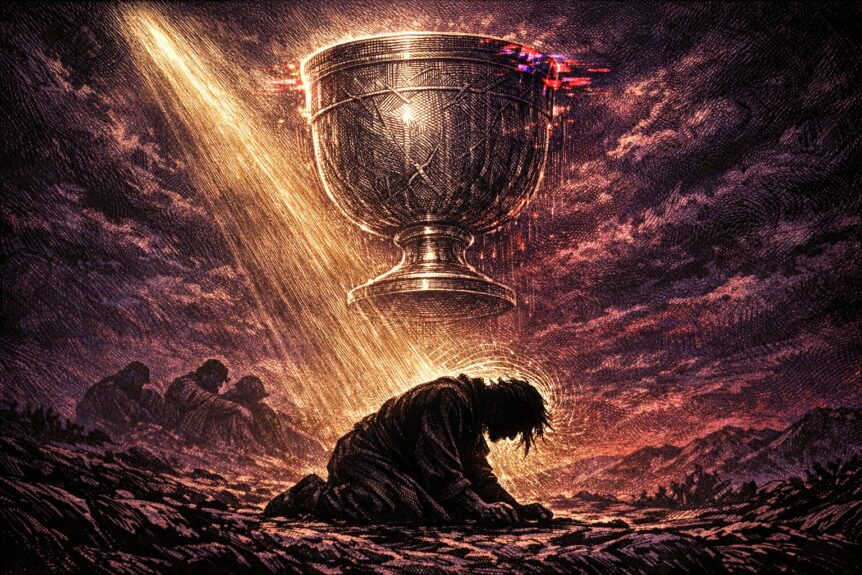
Jesus collapses and prays. This goes far beyond the human desire to avoid pain, hurt, betrayal, or embarrassment. Mark tells us that Jesus physically falls to the ground. Let me ask you, have your knees ever buckled so that you literally collapsed under the weight of the grief you were carrying? Jesus does. He falls to the ground under this intense wave of grief, knowing that He not only has to suffer physically in all its forms (which He clearly doesn’t want to do), but also that He is going to soon endure the full wrath of the Father on behalf of every single one of His people. The timing of this event is now imminent, which is why Jesus uses the terminology of the hour and the cup.
• The hour. If you have ever seen documentaries about the Holocaust, you’ve likely watched scenes where children were ripped from their parents’ arms and taken away. It is gut-wrenching to see loved ones separated under such horrible circumstances. If you can understand that, then you can understand that at no time in all of existence, from eternity past, was Jesus ever out of perfect fellowship and communion with the Father. Yet He knows the time is near when that communion will be severed as they take on the roles of sacrifice and Judge. Jesus knows the Psalm He will soon quote, which cries out, “My God, why have you forsaken me?” He knows the words mentioned by Isaiah that say, “the LORD was pleased to crush him severely. When you make him a guilt offering…” The hour of separation is upon Him, and the time of wrath.
• The cup. My earlier illustration fails to capture this because the Father here is the one who pours out wrath on His Son. This means Jesus will have to endure the complete and utter wrath of the Father for the sins of billions of people throughout time who will one day call on His name for salvation. If a single sin required the death of an animal… and if the sins of one human earn eternal punishment in hell, then it is impossible for us to comprehend what it was like for Jesus to endure punishment for billions. This wasn’t like the Old Testament. There wasn’t one stroke of a knife followed by 60 seconds of struggle before the animal died. This was hours of agonizing punishment. The wrath of God is likened to a cup of wine, and Jesus had to drink it down to the dregs. Not a single sin of all His people could go unpunished. The knowledge of enduring these two things is what pulled Jesus to His knees and made Him feel as though He was about to die of grief.
Jesus models how to pray in anguish. This model is similar to what He taught in the Lord’s Prayer:
a. Exaltation of the Father. Just as Jesus taught the disciples to exalt God’s name as holy, so He cries out to His Father using the term of endearment — Abba — used by a child for his loving dad. This also acknowledges that His Father has all power and authority to remove the cup and let this hour pass if He so chooses.
b. Make the request. It is human nature to avoid pain and seek what is pleasing. Jesus shows us the depths of His humanity in His prayer, in which He does not want to experience the pain of crucifixion and the Father’s wrath. His desire is to be spared this horrific event and to maintain the deep connection with His Father, yet…
c. Submit to His will. Nonetheless, He subjects His will to that of the Father. Jesus knows this is why He came. He knows what He must give to achieve the plan of redemption, and He knows that this is the Father’s will. It’s important to see that Jesus is not in rebellion against this plan. He is not telling the Father to change strategy. He is wrestling with the desire to avoid pain while also modeling for us the best way to stand firm in dark times.
It is not sinful to wrestle with things. When we seek to avoid pain and heartache, we aren’t revealing our sin nature; we are showing our human nature. Whether or not we sin in these moments depends on whether we act on those heavy emotions. No doubt, Jesus was tempted to save himself and abandon the plan, just as the disciples will be tempted to desert Jesus instead of standing with Him. The power to stand comes with submission.
Jesus’s success in avoiding temptation is starkly contrasted with the way the disciples handle it.
III – Sleeping Saints (vv.37-41a)
As Jesus agonizes over what it will take to be the Passover Lamb for His people, He longs to share that burden with the three men closest to Him. And here, we see another pattern of three in a pattern of three.
1. Jesus predicts this moment (His death) three times
2. Peter will deny Jesus three times
3. The call to stay awake and pray is given three times.
1. The first rebuke was to Peter. Jesus found all three sleeping, but in this first rebuke, He approached Peter alone and asked, “Why are you sleeping? Couldn’t you stay awake for a single hour?” You might ask why Jesus approached Peter alone the first time. I believe the answer is Peter’s strong commitment not to fall away. Remember, he said that if everyone else fell away, he would not… and here he is, unable to stay awake for even one hour while his Rabbi is in utter distress! It is fitting for Jesus to call him Simon in this moment rather than Peter, since Peter means ‘the rock.’ He certainly wasn’t one for Jesus right now.
After Jesus’ question, He offers some spiritual advice and a command. The command was to stay awake and pray. The purpose of those two actions was to prevent Peter from falling into temptation. Clearly, in his spirit, Peter was willing to stay awake and pray… he was willing to stand with his Lord and not fall away… but the flesh is weak. Like a house built out of popsicle sticks, it is insufficient to carry the load of faithfulness and spiritual warfare.
2. The second was to all three. Mark tells us that Jesus went away to pray as He had earlier, then returned to find them all sleeping again. This time, He woke Peter, James, and John. Surely the grief and sorrow on Jesus’ face were evident, and they had clearly fallen short of His expectations and His desire for companionship during this dark hour. We can see this when Mark says that they didn’t know what to say in response. All they could do was hang their heads in shame. Weren’t these the very same men who asked Jesus to sit at His right and His left in His kingdom and claimed that they were indeed able to drink from the same cup that Jesus was to drink? And here they are, sleeping while Jesus agonized over this very cup, wiping away blood from His forehead as He asked them to simply stay awake with Him as He committed to taking the cup from the Father’s hand.
3. The third rebuke was again directed to the inner three. It is hard to imagine the shame of abandoning Jesus in this extreme hour of need, yet when He goes off to pray, they fall asleep again! The flesh is indeed weak! Good intentions will only get them so far, and it wasn’t far at all! The third time completes the cycle of inability, so Jesus says, “enough!” No more. Jesus is done trying to share this burden. They clearly cannot do what they say they can, and besides… Judas is approaching.
The key to standing firm is not to stand at all, but to kneel. We need to remember Jesus’ teaching points in this passage: that the spirit within us, the human spirit, is willing, but the flesh is weak, and that all the good intentions in the world can’t produce spiritual fruit. Peter and the disciples cannot be our role models in this passage; rather, Jesus models the way to stand firm in dark times. We worship the Father, recognizing the closeness of our relationship with Him. We boldly make our requests known to Him, but then we submit our will to His.
And Jesus’ submission to the mission is set in this final verse.
IV – The Time Has Come (vv. 41b-42)
The betrayal Jesus announced at dinner is happening now. The hour Jesus had prayed to be spared from is upon them. The time has come for the Son of Man to be betrayed into the hands of sinners. Not only is Judas the betrayer coming, but he is bringing a mob of Chief Priests, scribes, elders, and Roman soldiers to arrest Jesus.
Get up, go see. This is the last instruction in this passage, and it is significant simply because of the direction Jesus told them to go. They had failed to obey the previous commands to stay awake and pray, and they had utterly failed to grasp the gravity of this moment in redemptive history. Now, danger looms, and Jesus knows it is time for His capture, arrest, and crucifixion. The time of the Lamb’s slaughter is imminent, yet Jesus doesn’t tell them to run out the back door and escape. Jesus doesn’t do that either. No, Jesus stays true to the mission and leads them to confront it head-on.
We must show the same resolve in our trials.
Application: Exalt, Ask, Submit
Even if we attended 1,000 funerals and experienced 5,000 overwhelming moments, we couldn’t begin to imagine the depth of overwhelm and grief Jesus felt. His suffering in the garden is inexpressible in human words. And yet, even under the crushing weight of those emotions, the temptation to escape such a burden and fate, and to enter into the darkest time of human history, Jesus remained faithful.
The rebellion that plunged humanity into sin and death occurred in a garden. How poetic, then, that Jesus’ submission to death by taking on sin, resulting in the liberation of His people from that curse, should also occur in a garden.
This was the most trying time for Jesus, when He felt the furthest from His Heavenly Father, yet it was also the moment when He was living out the final stage of the redemptive mission. If Jesus could be at the center of God’s will and still feel disconnected, how much more so for fallen sons and daughters? Feeling far from God does not mean you are outside His will. It might even be the exact opposite.
How can we do the same thing in our times of suffering and trial? We need to see how trial and temptation were handled in both ways and be resolute in following the right pattern.
1. The disciples did not pay attention. They did not obey Jesus’ instruction to stay awake and pray. As a result, they grew weak in their own fleshly resolve and quickly abandoned Jesus.
2. Jesus remembered His mission. When temptation came, He fell to the ground, acknowledged His struggle, and set His heart firmly and fully on His Father’s will.
So here is what I want you to carry out of this garden. The next time you feel the ground buckle under you, the diagnosis, the phone call, the grief that has no words, don’t reach first for the strength to stand. Reach for the ground. Fall to your knees the way Jesus fell to His. Say the hard thing out loud to the Father… the thing you actually want… the cup you actually wish would pass. Then say the harder thing after it: not what I will, but what you will.
That’s it. That’s the whole pattern. Exalt Him as Father. Ask Him plainly. Decisively submit. It will not feel like standing firm. It will feel like collapsing. But in that collapse, on your knees, Christ’s own resolve becomes available to you, because He did not stay in the garden alone. He walked out to the cross and out of the grave so that you would never have to endure anything by yourself.
FAQs
1. Why did Jesus connect His death to the Passover meal?
Passover remembered how God delivered Israel from slavery through the blood of a substitute. Jesus shows that He is the greater Passover sacrifice whose blood delivers His people from sin, death, and judgment.
2. Does the Lord’s Supper replace Passover?
Jesus fulfills what Passover anticipated. The exodus, the lamb, the blood, and the deliverance all pointed forward to Him and His saving work on the cross.
3. Was Peter insincere when he said he would never deny Jesus?
Peter likely meant what he said in that moment. His problem was not a lack of affection for Jesus but misplaced confidence in himself. He did not yet understand how weak he was apart from Christ’s sustaining grace.
4. Is Peter’s denial the same as Judas’s betrayal?
No. Both were grievous failures, but Judas’s betrayal flowed from a hardened and corrupt heart. Peter fell in fear, was later restored by Christ, and became a bold witness through the power of the Holy Spirit.
5. If the disciples’ scattering was foretold, were they still responsible?
Yes. God’s sovereign plan does not excuse human sin. Their failure fulfilled Scripture, yet each disciple was still responsible for abandoning Jesus in His hour of suffering.
6. Does this mean Christians will always fail when pressure comes?
Christians are weak in themselves and remain dependent on God’s grace. Yet Christ does not leave His people in their weakness. By His Spirit, He strengthens believers to endure, repent when they fall, and walk in faithful obedience.
7. Why does Jesus mention going ahead of the disciples to Galilee?
Jesus’ words are a promise of restoration. The Shepherd who is struck will rise again and gather His scattered sheep. Their failure will not cancel Christ’s purpose or His love for them.
8. What should I do when I realize I have been relying on my own strength?
Confess your weakness honestly, turn from self-reliance, and look to Christ. Depend on His Word, prayer, the fellowship of the church, and the strength the Holy Spirit supplies rather than trusting in your own resolve.