
Highlight Reel
Sermon Summary
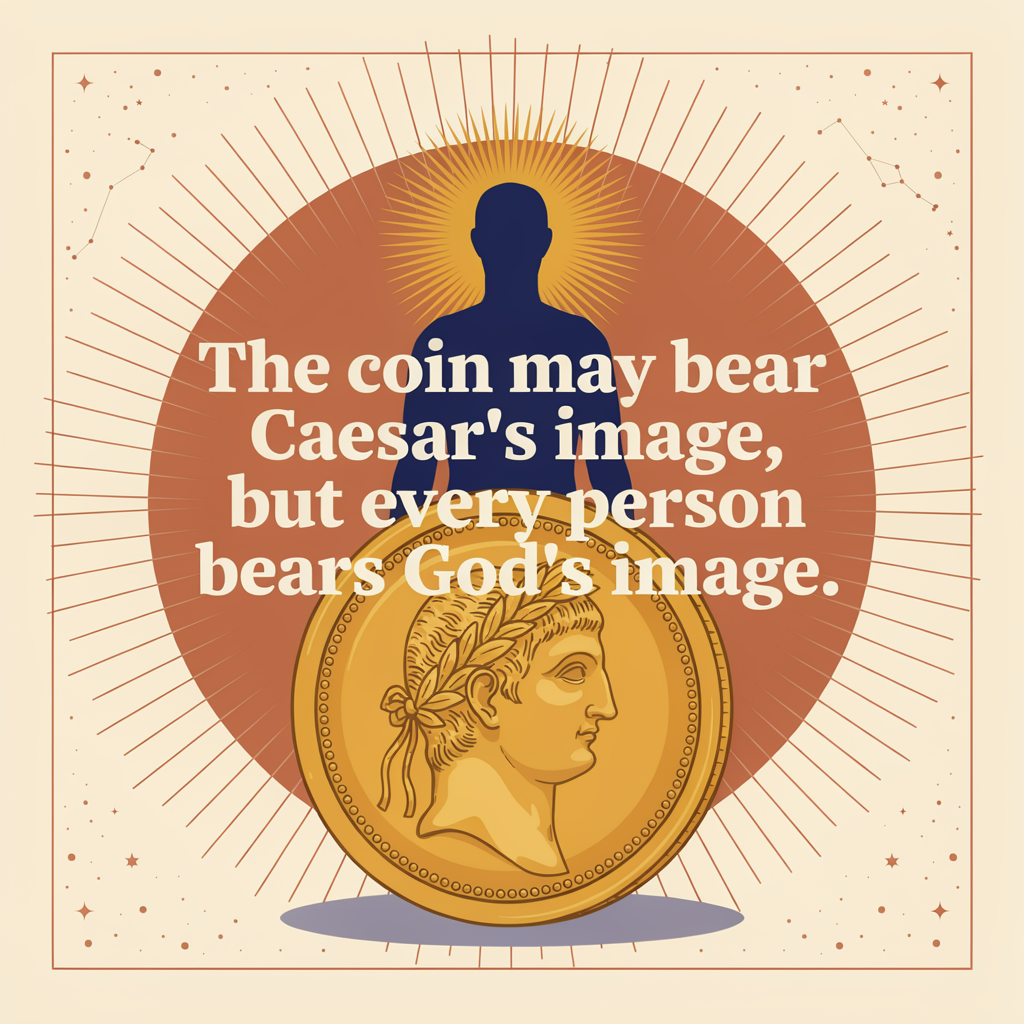
In Mark 12:13–17, Jesus exposes a trap set by the Pharisees and Herodians and refuses their false choice between Caesar and God. The coin may bear Caesar’s image, but every person bears God’s image. Therefore, Christians can live faithfully under earthly governments while belonging fully to Christ.
Sermon Audio
Shareable Quote graphics


Sermon Text
Where Does Your Allegiance Lie?
Nate Roten / Mark / Mark 12:13–17 / August 30, 2026
Core Message
Live in the world, but devote yourself fully to God.
If you have ever watched an X-Men movie, you know that Professor Xavier and Magneto are usually on opposite sides. Both want a future for mutants, but they have radically different ideas about how to achieve it. Xavier believes humans and mutants can live together peacefully, while Magneto believes conflict is inevitable and that mutants must dominate before humanity destroys them. Again and again, their competing visions put them at odds.
But in X-Men: Days of Future Past, a greater threat emerges. The Sentinels are hunting mutants to extinction, and suddenly the conflict between Xavier and Magneto is no longer the top concern. These two rivals must cooperate because they have found something they fear more than each other. Their alliance is not built on newfound agreement. It is built on a common enemy.
That is the kind of unlikely alliance we find in Mark 12 in the unfolding battle of wits between Jesus and select members of the Sanhedrin.
Passage
Mark 12:13–17 CSB
13 Then they sent some of the Pharisees and the Herodians to Jesus to trap him in his words. 14 When they came, they said to him, “Teacher, we know you are truthful and don’t care what anyone thinks, nor do you show partiality but teach the way of God truthfully. Is it lawful to pay taxes to Caesar or not? Should we pay or shouldn’t we?” 15 But knowing their hypocrisy, he said to them, “Why are you testing me? Bring me a denarius to look at.” 16 They brought a coin. “Whose image and inscription is this?” he asked them. “Caesar’s,” they replied. 17 Jesus told them, “Give to Caesar the things that are Caesar’s, and to God the things that are God’s.” And they were utterly amazed at him.
I – Retaliation: Round One (v. 13)
Two weeks ago, we witnessed a confrontation between Jesus and representatives of the Sanhedrin. In the verbal debate, they tried to entrap Jesus with a lose-lose question. They thought they had Him cornered. However, He easily sidestepped their trap and let them fall into it, asserting His authority over theirs. That led Jesus to unpack a parable before them and the entire Temple crowd, pronouncing judgment over them. They obviously didn’t like that, so now they will take turns trying to ensnare Jesus again. But instead of doing it as a united front, they change tactics. Now they separate and come at Him individually and from different vantage points:
- The Pharisee’s question: political
- The Sadducee’s question: spiritual
- The Scribe’s question: theological
Today, the Pharisees step out as the first contender, but they have a partner in crime this time… the Herodians. It’s an unlikely pairing that outnumbers Jesus 2-to-1. Why do I say “unlikely?” Because the Pharisees and the Herodians were not natural partners. The Pharisees were deeply concerned with religious faithfulness and the purity of Jewish culture, and they resented Rome’s influence over Israel. The Herodians, however, loved Herod. They are pro-Rome all the way. They care far more about their political allegiance to the Herod dynasty than about maintaining Jewish culture, tradition, and rule. They disagreed about some of the most important issues facing their nation. But they agreed even more deeply about one thing: Jesus had become a threat. They are like Professor X and Magneto… normally pitted against one another, but who must now cooperate and fight together against the one they consider a greater threat. Their shared desire to eliminate Him was powerful enough to unite people who would ordinarily oppose one another.
Hmmmm, where have we seen this before? Oh yes, they’ve been doing this the entire time (see Mark 3:6).
This is the world in which Jesus has to live. He has adversaries who want to fight against the mission He came to accomplish. But that doesn’t mean His devotion to His heavenly Father has to change.
Jesus stands His ground against another attempt from the opposition to trap Him in His words, an attempt that they hoped would lead to His removal and death.
II – Attempted Entrapment (vv. 14)
In a stunning lack of creativity, they do exactly what they tried to do before. They ask a question as a trap. And, as before, they arrogantly think they have Jesus cornered with this question, dripping with pandering and hypocritical flattery:
“Teacher, we know you are truthful and don’t care what anyone thinks, nor do you show partiality, but teach the way of God truthfully. Is it lawful to pay taxes to Caesar or not? Should we pay or shouldn’t we?”
Their words are insincere, yet ironically, everything they say about Jesus is true. He is truthful. He is not intimidated by human opinion. He does not change His message to please powerful people but teaches God’s way faithfully. But their insincere comments were a Trojan horse carrying a hidden attack. This comment about the tax wasn’t innocent, because it wasn’t just your run-of-the-mill, standard tax. It was likely the Roman poll tax, imposed after Judea came under direct Roman rule in AD 6. It was assessed through a census and paid directly to the imperial government. The tax itself may not have been financially crushing, but what it represented was deeply offensive. Every payment reminded the Jewish people that they were living in the land God had promised them while being ruled by a pagan empire. In effect, collecting the tax reinforced the reality that Rome was counting them, claiming authority over them, and requiring them to fund the government occupying their land.
To understand why this tax was so offensive, think about the Boston Tea Party. The colonists did not dump crates of tea into the harbor simply because they disliked tea or could not afford the tax. The issue was what the tax represented. Paying it meant acknowledging that the British Parliament had the authority to tax them even though they had no representation within it. The tea had become a symbol of foreign control, and throwing it into the harbor was their way of protesting that control and claiming autonomy. That is what made the Pharisees’ question so explosive. They were not asking Jesus for a lesson in tax policy. They were forcing Him to answer questions about allegiance. If Jesus says, “Yes, pay the tax,” the Pharisees can portray Him as a friend of Rome who has betrayed Israel’s hope. If He says, “No, refuse the tax,” the Herodians can report Him as a revolutionary opposing Caesar. Either answer gives one group the accusation it needs.
The first trap the religious leaders set was a loaded question. This time, the unlikely alliance of Pharisees and Herodians used what’s called a false dilemma. It’s a trap that only offers you two doors when a third door is standing right there the whole time. “Which side are you on, Jesus? God or Caesar? Israel or Rome?” Pick one. Reject the other. That’s the game.
Now, Scripture does give us real either-or choices. Jesus said we cannot serve both God and money. That one is a genuine either-or, because money and God are both trying to sit on the same throne in your heart. But Caesar and God were never competing for the same throne. Being a citizen under Rome and being a subject of God’s kingdom are not the same category of allegiance. You can pay a tax to a government and still belong, body and soul, to God. We are called to live faithfully in the world without being shaped by its rebellion. That is a crucial truth for us to grasp today, because it is a foundational truth Jesus builds on.
It is true that the Pharisees are trying to put Jesus’ allegiance on trial by forcing Him to choose between God and Caesar. However, before this is all over, these loud-mouthed accusers will be left utterly speechless.
III – Jesus’ Reversal (vv. 15-16)
As we’ve seen countless times, Jesus is sovereign. He knows the thoughts and intentions of the human heart, so He knows these men’s hypocrisy. He doesn’t hesitate to call it out, saying, “Why are you testing me?” This is another way of saying, “I know what you’re up to.” I wonder if that statement made them swallow hard. Did they know then that they were about to fall into their own trap again, or were they too arrogant to admit it?
Regardless, if Jesus’ opponents want Him to distinguish between Caesar and God, He will do it without hesitation. He asks them to fetch a denarius so He can address their question plainly. “If you want to talk about Caesar, let’s talk about Caesar.” It’s a little funny that they were trying to trap Jesus by supporting the tax, and yet they have in their possession the very coin that represents it… But I digress. Once the coin is handed over to Jesus, He asks one question about two aspects of the coin: whose image is on it, and what is the inscription on it?
A denarius was the Roman currency equivalent to a standard day’s wage. The coin mentioned here is likely the Tribute Penny, a denarius that circulated widely during this time and was used effectively in the tax system for this sort of tax. And much like today’s coins, this coin has three basic elements to it:
1. Front Image. The front bears the emperor’s image. In Jesus’ day, Tiberius was the emperor, so the coin he asked for likely bore his image. Tiberius was the Roman Emperor from AD 14–37, so he ruled during Jesus’ lifetime. He was known as an emperor of great ability but poor character. He started his career well but ended poorly. He gained popularity and power through military might, which is why he wears a wreath around his head, a symbol of military might and authority.
2. Back image. The back depicts an aspect of his rule. For Tiberius, it is a woman (presumably his mother, Livia) seated in authority, portrayed as Pax – the divine personification of peace. His military might secured divine peace for the empire.
3. Phrase. Both sides have a phrase. In this case, the words around his image read, “Tiberius Caesar Augustus, son of the divine Augustus.” On the other side was the title, “High Priest.” This is what would have upset faithful Jews the most. This coin attributed divinity to Caesar and the religious authority of High Priest.
So, let’s put all this together for the proper perspective. The emperor’s image proclaimed his political authority and military might. The seated figure associated with Roman peace celebrated what his military power achieved. The inscriptions identified Tiberius as the son of the divine Augustus and as Rome’s supreme high priest. In one small piece of silver, Caesar was presented as the powerful, divine son, the highest religious authority, and the wartime ruler through whom peace came to the world.
To grasp how offensive this would be, imagine receiving an American coin bearing the president’s face, with the words “Son of God and Supreme Pastor.” Then imagine the other side declaring, “Through his power comes peace.” It would no longer feel like ordinary currency. It would be government-issued religious propaganda, placing divine titles and spiritual authority on a human ruler. Now imagine being required to use that coin to pay taxes to the government occupying your homeland. Every payment would seem to reinforce its claims.
That is what makes this moment so ironic. This is exactly who the Jews wanted their Messiah to be. Yet their current ruler is a pagan and a Gentile oppressor, not a Jewish savior. The trap in this question lies in how the coin presents Caesar as a counterfeit savior: the divine son, the high priest, and the giver of peace through power. He demands the people’s worship and allegiance.
Yet, who are they trying to lure into their snare? It is the true Son of God, the true High Priest, and the true King who brings peace by conquering sin and death. Caesar’s peace is enforced by the sword. Jesus’ peace will be accomplished through the cross. That is the real trap they walked into. They came to test a teacher and found themselves standing before the very King the coin in their pocket was pretending to be.
They hated Him too much to see it. All they could see was the vineyard owner’s son, standing in the way of an inheritance they wanted for themselves.
IV – The Jaw-dropping Response (v. 17)
Give back to Caesar what’s his. This raises the question, “What is his?” The first and most obvious answer is what the coin itself and what it represents: worship and allegiance.
However, it could extend to the money paid in exchange for living in Roman society. Much like today, taxes pay for civil services. Today, we pay taxes so that we have public schools, paved roads, public transportation, and local law enforcement. It wouldn’t have been much different then, except for the tension of the Jewish people being ruled by a pagan government.
And in doing so, Jesus teaches everyone to obey civil authorities. This is the opposite of what the Pharisees wanted Jesus to say, but since God’s kingdom is spiritual and thus doesn’t have sovereign borders to protect, it can exist within earthly kingdoms and systems. For those living under Rome’s control, this meant obeying their laws, paying their taxes, and even paying respect where it is due (see Romans 13).
This coin, then, represented everything the Jews hated. They held a coin that proclaimed Caesar the son of a divine father and the highest religious authority in the empire. It represented a tax that enforced Rome’s dominance over them and demanded their obedience. So Jesus took this coin and asked them, “Whose image and inscription is this?” The answer was Caesar’s. The coin bore Caesar’s image, so give it back to Caesar. He can have his self-glorifying currency. If it’s his to begin with, then let him have it back. That has no negative impact on how I relate to God. This reply would shut down any accusations the Herodians were ready to hurl at him.
But it doesn’t address the opposing threat… the spiritual faithfulness of the crowd. This is why Jesus adds the counterbalancing remark.
Give back to God what’s His. If the coin that bears Caesar’s image and exalts him as the powerful divine ruler and bringer of peace, then what do we have that should be given back to God? That is exactly the question we should be asking right now. Or, to simplify, we can ask, “What bears the image of God?”
Answer?
You do. I do. We all do! Genesis 1 said it long before Tiberius ever minted a coin. You were made in the image of God, and that image was never erased, only defaced by sin. So when Jesus says “give to God what is God’s,” He is not asking for your spare change. He is asking for the coin itself. He is asking for you.
That means worship and allegiance do not stay in a building on Sunday morning. They go home with you. As God’s image-bearer, your schedule gives worship and devotion. Your bank account gives worship and devotion. Your marriage, your scrolling habits, your ambitions at work, the way you talk about people who aren’t in the room, all can give or withhold worship and devotion to God. True devotion is a heart issue, and the heart shows up everywhere the coin goes.
…and that is entirely the point for us today.
Application: Live Worthy of the Gospel in the World
Like Professor X and Magneto, or the Pharisees and Herodians, a host of enemies is forging sinful, hypocritical alliances against us. They must, because Christ in us is more powerful than they are. He has already overcome the world, so we don’t need to worry when we see this unfold today. They unite as evil, trying to overcome good, but it doesn’t work that way. In fact, the opposite is true. When we unify under the name that is above all other names… the name in which every knee will eventually bow, we have the victory.
That doesn’t mean we rebel against every worldly authority. We still obey the laws of our lands (as long as they don’t force us to disobey Christ). We live as radiant witnesses in a broken and dark world. There is no false dilemma here.
Our eyes are to be fixed on the true Son of God… rightful ruler… Prince of peace… and our faithful High Priest. Let me ask you one question in closing, and then I’d like to end with a passage of scripture for you to meditate on this week.
Take 20 minutes this week to ask yourself this question, “What is one area of my life that does not give worship and demonstrate allegiance to Jesus?” Then ask this follow-up question, “Who in the church will I ask to come alongside me and help me give it to God?”
Why? Because we must live in the world, but still devote ourselves fully to God. In other words, we live worthy of the gospel of Christ.
Philippians 1:27–28 CSB
27 Just one thing: As citizens of heaven, live your life worthy of the gospel of Christ. Then, whether I come and see you or am absent, I will hear about you that you are standing firm in one spirit, in one accord, contending together for the faith of the gospel, 28 not being frightened in any way by your opponents. This is a sign of destruction for them, but of your salvation—and this is from God.
FAQs
1. What does “give to Caesar what is Caesar’s” mean?
Jesus teaches that civil authorities may rightly receive lawful obedience, taxes, and honor. Christians are not called to treat government as ultimate, but neither are they called to reject every earthly authority.
2. Does this passage require Christians to obey the government no matter what?
No. Christians should obey civil authorities as part of their obedience to God, but no government has the right to demand what belongs to God. When earthly rulers require disobedience to Christ, believers must remain faithful to Christ.
3. Is Jesus separating faith from public life?
No. Jesus does not reduce faith to private worship or Sunday gatherings. He teaches that believers can live under earthly governments while every area of their lives remains devoted to God.
4. Does “give to Caesar” mean Christians should support everything their government does?
No. Paying taxes or honoring lawful authority is not the same as affirming every policy, leader, or action of a government. Christians should exercise wisdom, truthfulness, and courage while refusing idolatrous loyalty to political power.
5. Why was the Roman tax so offensive to the Jewish people?
The tax represented Rome’s rule over God’s covenant people in the land God had promised them. The coin itself added to the offense by presenting Caesar with divine and religious titles.
6. Why did Jesus ask whose image was on the coin?
Jesus used Caesar’s image on the denarius to answer the immediate question about taxes. But His answer pointed beyond the coin: if Caesar’s image marked what belonged to Caesar, God’s image marks what belongs to God.
7. What does it mean that people bear God’s image?
Every human being has been created by God to reflect Him and belongs to Him. Though sin has defaced that image, it has not erased it. God’s claim on us reaches far deeper than our possessions—it reaches to our whole selves.
8. How can I examine where my allegiance lies?
Ask God to reveal one area of life that does not presently give Him worship and obedience—your schedule, money, speech, ambitions, relationships, habits, or fears. Then invite a trusted believer to help you walk in repentance and faithfulness.