Highlight Reel
Sermon Summary
In Mark 12 as Jesus faces continued opposition in the temple, He tells a parable that brings Israel’s history into sharp focus. God planted and cared for His vineyard, sent prophets to call His people back to faithful fruitfulness, and finally sent His beloved Son. The religious leaders understood that Jesus was speaking about them—and they responded by seeking to arrest Him. But their rejection would not derail God’s plan. The stone they rejected would become the cornerstone. This passage calls every listener to receive Christ as He truly is, submit to His rightful rule, and bear fruit that belongs to the Owner of the vineyard.
Sermon Audio
Shareable Quote graphics

Sermon Text
Out With The Old, In With The New
Nate Roten / Mark 12:1–12 / August 23, 2026
Main Idea
God entrusts His kingdom to those who receive His Son and bear fruit for His glory.
Have you ever listened to a story and slowly realized it was about you? Perhaps someone was trying to help you see something you had been unwilling to recognize, so instead of confronting you directly, they told a story that let you see the truth from a different angle. Before you realized where it was going, you had already reached a conclusion. Then the story turned toward you, and suddenly you were confronted by your own words.
That is what the prophet Nathan did to King David. After David committed adultery with Bathsheba and arranged for her husband, Uriah, to be killed, Nathan came to him with a story. He told of a wealthy man with enormous flocks who stole the only beloved lamb of a poor man. David was furious. He condemned the rich man’s cruelty and declared that the man deserved judgment. Then Nathan looked at David and said, “You are the man!” The story slipped past David’s defenses and exposed the sin he had refused to see.
Jesus is about to do something similar in Mark 12. He tells Israel’s religious leaders a story about a vineyard, some wicked tenants, and an owner who sends his beloved son. At first, it sounds like a familiar tale of corrupt farmers. But as Jesus adds each detail, the truth becomes unavoidable. This is not merely a story told to them. It is a story about them.
And before it is over, it will confront every listener with a different decision to be made.
Passage
Mark 12:1–12 CSB
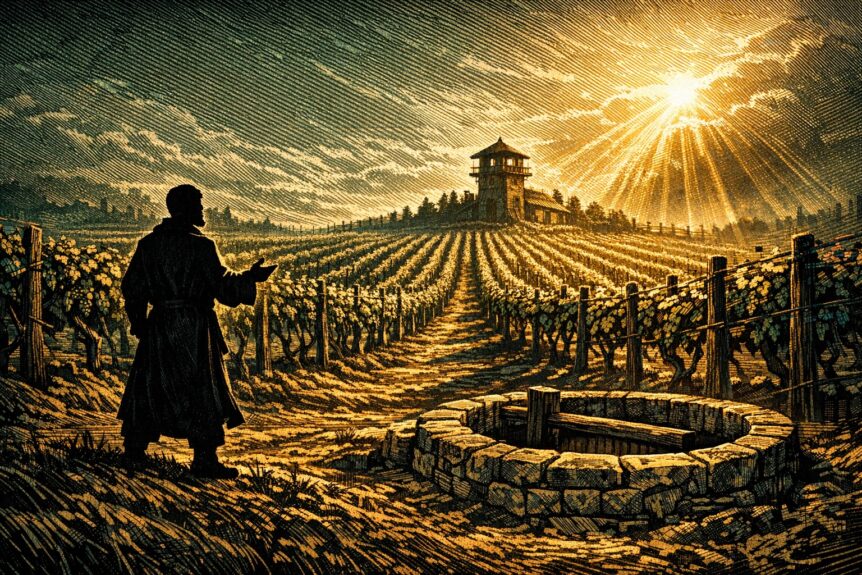
1 He began to speak to them in parables: “A man planted a vineyard, put a fence around it, dug out a pit for a winepress, and built a watchtower. Then he leased it to tenant farmers and went away. 2 At harvest time he sent a servant to the farmers to collect some of the fruit of the vineyard from them. 3 But they took him, beat him, and sent him away empty-handed. 4 Again he sent another servant to them, and they hit him on the head and treated him shamefully. 5 Then he sent another, and they killed that one. He also sent many others; some they beat, and others they killed. 6 He still had one to send, a beloved son. Finally he sent him to them, saying, ‘They will respect my son.’ 7 But those tenant farmers said to one another, ‘This is the heir. Come, let’s kill him, and the inheritance will be ours.’ 8 So they seized him, killed him, and threw him out of the vineyard. 9 What then will the owner of the vineyard do? He will come and kill the farmers and give the vineyard to others. 10 Haven’t you read this Scripture: The stone that the builders rejected has become the cornerstone. 11 This came about from the Lord and is wonderful in our eyes?” 12 They were looking for a way to arrest him but feared the crowd because they knew he had spoken this parable against them. So they left him and went away.
I – Recap
Where we are on the timeline. The Pharisees confront Jesus on His way into Jerusalem (Sunday), the Temple (Monday during the Temple cleansing), and again at the Temple the next day (Tuesday – discussion about authority).
Now, that confrontation continues with Jesus’ authority being established. Everyone in the crowd knows Jesus has far more authority and superiority over the Sanhedrin’s representatives. This is important because when Jesus used the fig tree as an illustration of divine judgment on these same people, it was only with His disciples. That was a private judgment with His followers. Now, it must be made known to everyone, publicly.
Jesus does this with a parable that mixes three Old Testament ingredients, giving it a distinct and undeniable flavor. And, like David, it will invoke a response, but with a drastically different outcome.
Let’s start by thinking of this like making a pie. I love pumpkin pie, which has three main ingredients: cinnamon, nutmeg, and cloves. This makes a good analogy. First, we’ll go through the pumpkin filling itself, then examine these three ingredients to see how they season the filling, highlighting the unique flavors Jesus wants everyone to taste.
II – The Parable
Familiar Story
Many in this day would have related to this story either as an owner with large tracts of land who needed to rent out that space so that it could be profitable, or they’re on the other side of that who are attending to other people’s vineyards. And as was often the case, the owner would have expected part of the harvest as payment or rent from the tenants. So that’s why we see the owner sending people to the vineyard at harvest time to collect the payment or rent that is due.
Cast and setting
• The vineyard is Israel… God’s covenant family. He has done all of the hard preparation work… the planting. The security measures of the fences and the watchtower. The winepress that will manage the result of their desired fruitfulness. All of this is done so that Israel can be fruitful for the vineyard owner.
• The vineyard owner is God the Father. This is clear enough.
• The sent servants are the OT prophets. In the parable, the owner sends His own servants to the tenants to check on the harvest and to collect what is rightfully His. During the time of the prophets, this is a pretty accurate summary of what happened to them. They were sorely mistreated. In this parable, we see the escalating violence against them. First, they were beaten and sent away. Then, it was a beating on the head and emotional damage. Then it was murder. And this happened repeatedly. In Israel’s history, the prophets were mistreated, humiliated, and some were outright murdered. One was even killed at the Temple’s altar!
• The vineyard owner’s son represents Jesus. If the owner represents God the Father, then the beloved son He sends represents God the Son.
• The hired tenants are the corrupt religious leaders. These are the original bunch that the owner sought out and put in charge. They were given the responsibility to tend to God’s vineyard and make it fruitful. However, they became corrupted. They attacked and killed the owner’s representatives and even thought they could get ownership of the vineyard by killing the heir. These are Israel’s corrupted leadership throughout time, even up to Jesus’ day. And His current accusers know it.
With the stage now set, we can look at the recipe card and focus on the ingredients list:
III: Ingredient #1: The Phrase
I want to go back to something the tenants said about the owner’s son. As they schemed, they said this sentence: “Come, let’s kill him.” This is ingredient number one. It is subtle, but there. Some phrases are so memorable that they immediately bring an earlier scene to mind. Fans of The Avengers recognize, “I can do this all day.” Fans of Gladiator immediately picture the scene when they hear, “Are you not entertained?” In much the same way, a Scripture-saturated listener may have recognized an echo of Genesis 37, where Joseph’s brothers said, “Come, let’s kill him.”
That connection is significant. Joseph was the beloved son his father sent to his brothers. His brothers rejected him because they resented the authority revealed in his God-given dreams. They plotted his death, stripped him, and threw him into a pit. Yet the one they rejected was eventually exalted and became the means God used to preserve Israel through a devastating famine. Joseph’s story therefore provides an important pattern that points forward to Jesus: the beloved Son sent by the Father, rejected by His own people, handed over to suffering, and ultimately exalted as the Savior of those who had rejected Him.
On a macro scale, this parable summarizes nearly all of Israel’s history, painted in vivid colors for the people. It alludes to a savior from their past who points to one in the present. It shows the vineyard’s current spiritual state … fruitless and barren. And it exposes why: awful and wicked stewardship.
The parallels are clear. The connection to Joseph is highlighted, but there is still an important connection we must see if we are going to feel the full weight of this moment, which leads us to ingredient #2…
IV: Ingredient #2: Parallel to Isaiah 5
I want to read this aloud so you can see it in its proper context. Now that we have unpacked a lot that already exists in this parable, I think you’ll be able to see the connection straight away.
Isaiah 5:1–7 CSB
1 I will sing about the one I love, a song about my loved one’s vineyard: The one I love had a vineyard on a very fertile hill. 2 He broke up the soil, cleared it of stones, and planted it with the finest vines. He built a tower in the middle of it and even dug out a winepress there. He expected it to yield good grapes, but it yielded worthless grapes. 3 So now, residents of Jerusalem and men of Judah, please judge between me and my vineyard. 4 What more could I have done for my vineyard than I did? Why, when I expected a yield of good grapes, did it yield worthless grapes? 5 Now I will tell you what I am about to do to my vineyard: I will remove its hedge, and it will be consumed; I will tear down its wall, and it will be trampled. 6 I will make it a wasteland. It will not be pruned or weeded; thorns and briers will grow up. I will also give orders to the clouds that rain should not fall on it. 7 For the vineyard of the Lord of Armies is the house of Israel, and the men of Judah, the plant he delighted in. He expected justice but saw injustice; he expected righteousness but heard cries of despair.
Isaiah 5:13–14 CSB
13 Therefore my people will go into exile because they lack knowledge; her dignitaries are starving, and her masses are parched with thirst. 14 Therefore Sheol enlarges its throat and opens wide its enormous jaws, and down go Zion’s dignitaries, her masses, her crowds, and those who celebrate in her!
Just notice how this parallels. This is nearly the same thing, repackaged. Picture it: a landowner who did everything right, cleared the stones, planted the finest vines, dug the winepress, built the tower, and then stood back expecting a harvest worth celebrating. Instead, he got sour, worthless fruit from ground he had prepared with his own hands. The joyful expectation of what it could be has now been ruined by the reality of what it is, and therefore God will destroy it. He’ll remove His protection. The walls will come down. It will be trampled. It will be made into a wasteland. Nothing fruitful will come from it. Isaiah makes the connection here. The vineyard of the God of Israel is the house of Israel. Once the vineyard is destroyed, the people will be exiled and sent away from God’s presence.
Serious students of Scripture would have recognized and felt this parallel. Dread would ensue. The visual is the same, and the outcome… though expressed in different ways… is also the same. The inhabitants of Isaiah’s day were attacked by the Assyrians and carried away later by the Babylonians. Now, the same pattern of covenant rebellion and covenant judgment is happening again. Could the current inhabitants be removed because they were fruitless? It happened before. Could the dread of that generation be felt again?
The crowd may have been questioning what type of Messiah is developing before them. I imagine some of them are looking at their neighbor, saying, “This is not what I expected. This is not the Messiah that I anticipated. I wanted a warrior king to take out Rome… not one that would be rejected and die.”
If Jesus had stopped there, it would have left everyone in despair, because judgment is coming and only destruction lies over the horizon. But thankfully, Jesus doesn’t leave it there. After He gives the parable that ties back to Joseph and Isaiah chapter 5, He asks the religious leaders a question that leads to the seasoning of our third and final ingredient.
“What then will the owner of the vineyard do?”
V – Ingredient #3: The Cornerstone
The first and most obvious point is that the owner will deal with the current wicked tenants. He’ll kill them. He’ll get rid of them. That’s even more severe than what the Lord says in Isaiah chapter 5 about their exile. So this is really bad news for all the religious leaders Jesus is confronting.
And Jesus expects everyone to make the connection to the third ingredient. He asks, “Haven’t you read this scripture?” Then He proceeds to quote from Psalm 118.
Psalm 118:22–23 CSB
22 The stone that the builders rejected has become the cornerstone. 23 This came from the Lord; it is wondrous in our sight.
Why does He do this? I think it is for two reasons.
First, it comes from the same Psalm the crowd chanted during the Triumphal Entry. They cried out verses 25-26: “LORD, save us (Hosanna)! LORD, please grant us success! He who comes in the name of the LORD is blessed.” Jesus quotes from the two verses just before that. He is the answer to their plea, but He doesn’t look like what they anticipated.
Secondly, He did this because it was known among the Jewish people as a Messianic psalm. It describes the people appealing to Yahweh for help when their enemies surrounded them and records their cries of praise after the resulting deliverance. And curiously, it establishes this rejected foundational cornerstone as the very stone God will use to achieve this end, a marvel for those who embrace it. And, by its own nature, a cornerstone that is not used in the existing structure will be used to establish a new one. God entrusts His kingdom to those who receive His Son and bear fruit for His glory.
Hang on to that line. It is crucial for the crowd and for us today.
Can you see it now? This parable teaches and declares many things at once… to multiple groups of people. To get the full flavor of these ingredients, let’s take a bit from each plate.
VI. How the Parable Lands
When all three ingredients come together, this parable delivers a different message to each group listening.
For the religious leaders, it is a warning of condemnation: God will hold His stewards accountable. They had been entrusted with His vineyard, but instead of producing fruit, they used their position to gain power and rejected everyone God sent to correct them. Now they were preparing to murder His Son. Their authority would be taken from them because of their unfaithfulness and rejection of the only way of hope. Their murderous intent would play out in a few days. The wicked tenants would kill the Son and cast Him out of their sight. And when they do this, their fate is sealed.
For the crowd, it is a call to choose: What will you do with the Son? It was not enough to sing “Hosanna” when Jesus entered the city. They must receive the King God actually sent. From Isaiah 5, it is clear that God is the vineyard owner, so the Messiah is the divine, rightful heir of the vineyard. As the heir, He has every right to pronounce judgment and condemn the wicked tenants. The rejected stone would become the cornerstone, but they could not receive the salvation He brought while continuing to reject Him. They must choose to accept the true identity of the Messiah.
For the disciples, it is a word of hope: The rejection and death of Jesus would not mean God’s plan had failed. The Son would be rejected, but the Father would vindicate Him. What appeared to be defeat would become the foundation for something new. Jesus would build a new-covenant people from every nation, with Himself as the cornerstone and every believer made a living stone in His spiritual house.
Application: And that brings the parable directly to us.
We must not hear this merely as a condemnation of religious leaders who lived two thousand years ago. We are in a long line of believers who have also been entrusted with God’s truth, God’s gifts, and God’s mission. This entire parable is about the decisive end of the Old Covenant and the establishment of the New Covenant. Jesus was cast out of the vineyard, nailed to a cross outside the city, treated exactly as the wicked tenants treated every servant before Him. But God did not leave Him there.
Jesus’ victory over sin and death is the foundation stone of a new people… new tenant workers in His vineyard, and the signal of condemnation for the wicked ones.
The question is whether we recognize this and take our new roles seriously. The Christian life isn’t a novelty. It’s not meant for our comforts or passivity. This parable forces us to seriously inspect whether our lives are producing the fruit that belongs to Him.
- Are we building our lives on Jesus as He truly is, or on a version of Him that supports what we already want?
- Are we using what God has entrusted to us for His glory, or treating it as though it belongs to us?
- Do we receive God’s Word when it corrects us, or resist anyone who threatens our comfort and control?
- Are we merely occupying space in the vineyard, or are we producing fruit for its Owner?
The tenants wanted a kingdom without the Son. The gospel announces that there is no kingdom without the Son. Nathan told David a story until David could no longer look away from himself, and he said, “I am the man.” He repented and turned to God for life and forgiveness.
Jesus has just told you a story about a vineyard, a father, and a beloved son. All who work in His vineyard will be held responsible for their stewardship. God entrusts His kingdom to those who receive His Son and bear fruit for His glory.
Will you be one of them?
FAQs
1. What does the vineyard represent in Mark 12?
The vineyard represents Israel, God’s covenant people. Drawing on Isaiah 5, Jesus shows that God had graciously prepared, protected, and provided for His people with the expectation that they would bear the fruit of justice and righteousness.
2. Who are the wicked tenants?
The tenants are Israel’s corrupt religious leaders, especially those confronting Jesus in the temple. They had been entrusted with responsibility among God’s people but used that position for power while rejecting God’s messengers.
3. Who are the servants in the parable?
The servants represent the Old Testament prophets whom God sent to call His people back to covenant faithfulness. Israel’s history included the mistreatment, humiliation, and even murder of many prophets.
4. Why does Jesus call Himself the beloved Son?
Jesus identifies Himself as uniquely related to the Father. He is not merely another messenger; He is the rightful heir, the divine Son sent by the Father and deserving of honor, worship, and obedience.
5. Is this parable saying God has rejected all Jewish people?
No. The parable announces judgment on unfaithful leaders and on those who reject God’s Son, not a rejection of Jewish people as an ethnicity. God’s kingdom is established around Christ and includes all who receive Him by faith, from every nation.
6. Why is God’s judgment on the tenants so severe?
Their sin is not simple ignorance. They were entrusted with God’s vineyard, rejected His repeated warnings, abused His servants, and sought to kill His Son. The passage shows that rejecting Christ is a serious and accountable rebellion against God.
7. Does bearing fruit earn a place in God’s kingdom?
No. We are received into God’s kingdom through Christ, not by our works. But those who truly receive the Son are changed by Him. Fruit does not purchase salvation; it reveals the life of faith and obedience that flows from belonging to Christ.
8. How should this parable confront Christians today?
It calls us to examine whether we are treating God’s gifts, truth, and mission as our own possessions. We must receive Christ as He is, welcome the correction of His Word, repent where we resist Him, and faithfully bear fruit for His glory.