Highlight Reel
Sermon Summary
Mark 14:43–52 brings us into the darkness of Jesus’ arrest: a betrayer’s kiss, a fearful mob, a disciple’s sword, and the flight of those closest to Jesus. Every human source of strength fails in this moment. Judas relies on deception. The mob relies on numbers and weapons. Peter relies on force. The disciples rely on their own courage. But Jesus alone remains steady because He is fully submitted to the Father’s will. His arrest was not an accident or a defeat. The Scriptures were being fulfilled, and the Savior was willingly giving Himself for His people. When adversity comes, believers are called not to trust themselves, but to yield to Christ and stand in His strength.
Sermon Audio
Shareable Quote graphics
Sermon Text
Why Is Surrender Stronger Than Self-Reliance?
Nate Roten / Mark 14:43–52 / Nov. 22, 2026
Core Message
Because Christ gave Himself to save us, we can yield our will to His and stand firm in His strength.
Picture a frightened village after dark. Rumors have spread that something dangerous is nearby, and fear has hardened into determination. One by one, the villagers leave their homes, carrying torches, clubs, and farm tools. Before long, they form a mob marching through the darkness. They are convinced that a monster threatens their community and that the only way to restore peace is to hunt it down and destroy it. No one stops to ask whether fear has distorted their judgment. The village mob has reached its verdict and now moves with a single purpose: eliminate the threat.
You have probably seen some version of this scene before. It comes from the classic story of Frankenstein. The image of angry villagers marching with torches and pitchforks has become so familiar that we recognize it almost instantly. They believe they are protecting themselves from a monster, so they arm themselves, gather a crowd, and set out into the night, unaware that they are the ones acting like monsters.
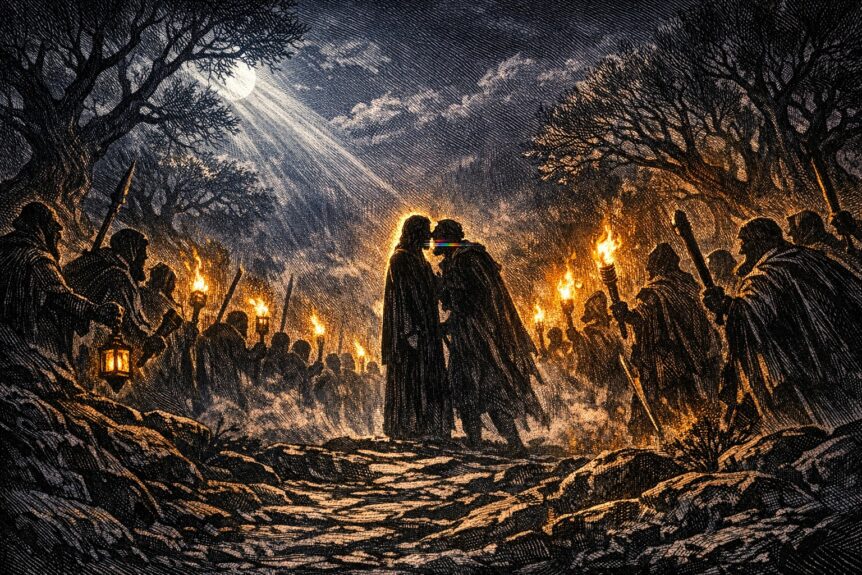
Mark 14 presents a similar picture. Jesus is praying and instructing His disciples in the garden when Judas arrives, leading an armed crowd carrying swords and clubs, lanterns, and torches. They come under cover of darkness, as though hunting a dangerous criminal. But Jesus has not assembled an army, started a riot, or attempted to escape. He is not the monster… they are.
Of course, Jesus really is a threat, just not in the way they imagine. He’s not a revolutionary trying to amass an army to topple the Sanhedrin or Rome. He is, however, a threat to their hypocrisy, corrupt authority, and false teaching. So the mob comes to eliminate the threat, and what’s incredible about this story is that the one who holds all authority willingly allows His own capture to fulfill the eternal plan of redemption.
Amid heartbreaking betrayal and abandonment, Jesus displays one of the most stunning acts of power in submission.
Passage
Mark 14:43–52 CSB
43 While he was still speaking, Judas, one of the Twelve, suddenly arrived. With him was a mob, with swords and clubs, from the chief priests, the scribes, and the elders. 44 His betrayer had given them a signal. “The one I kiss,” he said, “he’s the one; arrest him and take him away under guard.” 45 So when he came, immediately he went up to Jesus and said, “Rabbi!” and kissed him. 46 They took hold of him and arrested him. 47 One of those who stood by drew his sword, struck the high priest’s servant, and cut off his ear. 48 Jesus said to them, “Have you come out with swords and clubs, as if I were a criminal, to capture me? 49 Every day I was among you, teaching in the temple, and you didn’t arrest me. But the Scriptures must be fulfilled.” 50 Then they all deserted him and ran away. 51 Now a certain young man, wearing nothing but a linen cloth, was following him. They caught hold of him, 52 but he left the linen cloth behind and ran away naked.
I – The Betrayer and the Mob (vv. 43-44)
This immediately follows last week. While Jesus is still speaking to His disciples after waking them for the third time, Judas approaches… and he is not alone.
Sanhedrin members. Mark mentions three groups: the chief priests, scribes, and elders. These are the same groups Jesus named when He predicted His death and resurrection.
Roman soldiers. John’s gospel mentions a detachment of Roman soldiers, complete with a commander. In both accounts, these groups form a mob wielding swords, clubs, lanterns, torches, and other weapons. Clearly, this group anticipates resistance from a threat they fear. They look an awful lot like the mob outside Frankenstein’s castle. Rome had a fairly good reason to do this. We must remember that. Plenty of uprisings occurred in and around Jerusalem. Barabbas was one of those currently incarcerated who led a rebellion. So it would not be surprising to see Rome arrive with a show of force, ready to squash any opposition. The Sanhedrin, however, has no excuse. They know Jesus doesn’t act that way, yet they seem to want to use Rome simply as puppets to achieve their murderous purposes.
The Go Signal. Evidently, Judas, the chief priests, and the commander of the Roman guard had time to develop some sort of signal to let them know who to arrest. Members of the Sanhedrin obviously know who Jesus is, but the Romans may not. So, like a baseball coach on the sidelines, they come up with a signal that tells them when to move in and who to move in on. What’s truly egregious about the signal is that the ultimate act of betrayal is enacted through a loving act of friendship. At the Last Supper, Judas was close enough to dip his bread in the bowl with Jesus, and now he’s close enough to greet Him as a close friend would.
Expect opposition. We shouldn’t be surprised when we not only encounter hardship but hardship built on the enemy’s scheme. If the enemy wanted to stop Jesus, it should come as no surprise that they want to stop Jesus’ body here on earth. They couldn’t stop the Head, but now they’re going to try to thwart our plans because Christ gave us the mission to continue what He started. Jesus repeatedly told everyone in the Gospels that He came to bring the kingdom of God. And what is the Great Commission other than expanding the kingdom of God throughout the entire world? So don’t be caught off guard when we encounter opposition that looks designed. When we encounter attacks like this, we are not only identifying with the sufferings of Christ, but it should also indicate that we are doing the right things because faithfulness often attracts opposition.
And when we encounter opposition, we need to react. Just not like Peter does in this passage.
II – Overzealous Reaction (vv. 45-47)
The kiss. As if Judas had not heard Jesus’ warning at the dinner table, he approached His teacher, greeted Him enthusiastically as His rabbi, and gave Him a kiss, which, culturally, would be on the cheek. The sign of affection was laced with mutinous betrayal. Seeing the signal, the Roman soldiers moved in and arrested Jesus, sparking an immediate response.
Peter’s reaction. Mark doesn’t name Peter, but John does. Who knows why. Mark focuses on Peter’s reaction: he draws his sword and starts hacking. Maybe he was overcompensating after being scolded earlier, or perhaps he was trying to make good on his earlier promise. Either way, his sword found a victim. John says this was the high priest’s servant, and Peter lopped off his ear. Despite his zeal, Peter was not acting in accordance with God’s will. If he had listened to Jesus, he would have realized this was part of the plan. Peter was trying to solve a spiritual issue with a physical weapon. It’s a good thing that Jesus stepped in to heal him, as recorded in Luke’s account. If He hadn’t, Peter could have been arrested alongside Jesus, and, as Warren Wiersbe said, “there might have been four crosses on Calvary” instead of three.
Peter isn’t being very wise here. Wisdom is knowledge in action, and he’s not stopping to think before he acts. When I read this, all I can see is the meme of a German Shepherd chasing a bird, leaping from the top of a cliff to catch it, not realizing he’s leaping to his own death. So this is a call to stop and think before you act. Jesus said this had to happen, but Peter wasn’t listening with discerning ears. This is Peter trying to solve a spiritual issue with physical strength. Yet even in Peter’s disobedience, Jesus is sovereignly caring for His sheep. Both are true here, and both are equally true in our own lives…
…and it is exactly the sovereign power of Christ that we see next.
III – Power Under Submission (vv. 48-50)
Jesus calls out their hypocrisy. Jesus has always known their thoughts and intentions. We don’t know what the Roman soldiers are thinking, but we do know what the religious leaders are trying to do. They’ve been fearful of the crowd. They’ve hated Jesus. They’ve looked for ways to capture Him. They’ve attempted to entrap Him and want to murder Him. So, of course, they’re not going to be able to do this in the light of day around adoring crowds. So they choose nighttime, having their inside man give them an opportunity to capture Jesus in secret.
Jesus openly calls out what they are doing behind closed doors. He tells them outright, “You’ve come with swords and clubs if I were a criminal.” And what Jesus is talking about here is a common criminal… a robber or bandit. Of course, Jesus has never demonstrated this type of behavior. So it’s obvious that what they’re doing is dishonest and overkill. Jesus makes sure that at least the Roman authorities know that He’s always been in public and that His presence has always been peaceful. He’s not like Barabbas, who caused an uprising and attempted a coup or overthrow. He was among the people, teaching them in the temple. He’s a peaceful rabbi, not a rebel commander.
The Scriptures must be fulfilled. Yet even the Roman army is unwittingly playing into the Father’s eternal plans. What was written about Judas is found in the Scriptures. The abandonment of the disciples is written in the Scriptures. And this moment, too, is written in the Scriptures, and all that is written must be fulfilled.
Now this raises an interesting question: which scriptures are actually being fulfilled? A few contenders have been proposed. One is the prophecy of the suffering servant in Isaiah 52 and 53. Another is the suffering servant in Psalm 22, both speaking to the unjust suffering of the Messiah, who was wrongfully numbered among the transgressors. So those are good options. Many others say it also directly fulfills the verse Jesus quoted, Zechariah 13:7, which says that when the shepherd is struck, the sheep will scatter. And that is what is taking place in this very moment. The Roman army has captured Jesus, which will lead to the beating, the literal striking of the shepherd, at which point His disciples will indeed scatter and even lead to Peter denying Jesus, just as He said. So instead of trying to narrow it down to one, let’s allow the fullness of Scripture to be consulted and fulfilled. I don’t see why it can’t be a fulfillment of all three of these, if not others, that we’re not looking at right now.
They all deserted. Sadly enough, what Jesus said just hours before is now coming to pass. As Jesus is bound and captured by the Roman soldiers, every single one of His disciples flees. The wolf is in the sheep’s pen, and each one jumps over the fence to flee the threat… even Peter, who just moments before wielded a sword and was ready to defend His Lord, is now running away from Him.
The next time you feel abandoned, betrayed, isolated, or alone, know that the Son of Man is also the Man of Sorrows, and He can relate to every feeling you are experiencing right now. You can run to Him, confide in Him, and find real comfort because He’s been where you are, and He’ll lead you out of it.
But the disciples aren’t the only ones who ran away. We also have this mysterious youth who also joins the desertion party.
IV – The Stealthy Youth (vv. 51-52)
Linen Clothing. This passage ends in a very peculiar way. In addition to all the disciples deserting Jesus, we also have an account found only in Mark of a mysterious youth wearing linen clothing. Most commentators agree that a linen outer garment is a sign of wealth, because most outer garments in those days were made of wool. So this kid probably comes from a wealthy household. The fact that he was wearing nothing underneath also suggests he arrived at the scene as quickly as possible after leaving home. It’s as if he was woken from sleep by his parents, told what was going on, and hastily threw on his overcoat to see what the commotion was all about.
Speculation. There is a lot of speculation about this kid’s identity. Many in the early church said this was none other than Mark himself, but he didn’t want to write himself into the narrative by name. Those who were there would know it was him, but it is also pretty embarrassing, so I can’t really blame him for not naming himself, if that’s the case. One reason people think this is him is that, according to Acts 12, Mark came from a family that was pretty well off. You can look at Acts 12:12 for that. Some even speculate that it’s Mark’s house that hosted the Last Supper. At the end of the day, however, we don’t know the identity of this youth. We just know that he wanted to be there with Jesus but did not want to get arrested. So when the authorities grabbed him by the jacket, he would rather have lost that expensive outer garment than be captured, and he ran away completely naked.
Why this matters. As random as this detail may seem, we need to recognize that Mark included it for a reason. Whether or not it was actually him is irrelevant to its purpose; the question is why Mark put it in the story. First, it seems to allude to Amos 2:16, which, in context, describes judgment on Israel. The final verse confirms, “Even the most courageous of the warriors will flee naked on that day. This is the Lord’s declaration.” This could be a fulfillment. Secondly, at times, Mark doesn’t fully explain a situation, seemingly on purpose, to force the reader to make a decision. Here, he seems to place the reader in the story through this unnamed youth, inviting us to consider what we would do. It’s easy to judge the disciples who deserted Him without realizing that we could make the same mistake: being too quick to express our devotion while failing to recognize our own limitations.
This again reinforces the idea that we cannot fight spiritual battles in the strength of the flesh. In that circumstance, even the most courageous warriors will flee, leaving themselves completely vulnerable. This nameless youth should prompt us to ask questions like these:
- How strong do you think you are?
- Whose power are you standing in?
- Where does the strength to stand firm in adversity truly come from?
- Will worldly possessions help you in a time like this?
Last week, we discussed the parallel between the Garden of Eden and the Garden of Gethsemane. In the Garden of Eden, Adam gave in to temptation and plunged humanity into sinful rebellion, whereas Jesus resisted temptation and fully submitted Himself to the Father’s plan.
Here we have another parallel. In the Garden of Eden, when Adam fell, his nakedness was exposed, and he deserted and hid from God. And here we see the same pattern repeated. Desertion and nakedness. We need to recognize that this is the current state of all humanity apart from Christ.
Paul said it best in Romans 3. No one is righteous, not even one. No one seeks God. All have turned away, and all alike have become worthless. There’s not one who does what is good. No, not even one.
That’s a grim reality until you see who we are in Christ.
Application: Surrender is Strength
Until Christ’s love captivated us, we were all part of that mob, wielding clubs and torches, trying to eliminate the threat to our comfortable way of life and the sin we enjoy. But that love radically transformed us from enemies into adopted sons and daughters. When we look to Christ as our example and emulate Him, we can have victory in the battles we face today.
What then does it mean to emulate Christ? We embrace love, submission, alignment, and strength.
We love Him more than ourselves. This enables us to bow before Him in submission, just as He did before His Heavenly Father. As we submit to His rule and will, He will align us with His will and mission. As we operate in those first three elements, His Spirit will give us the strength to see it through.
That is what Jesus did, so that is what we will do.
The mob relied on numbers. Peter relied on a sword. The disciples relied on their own courage. Every form of human strength failed. Jesus alone stood firm because He remained fully submitted to the Father. This week, when adversity comes, do not simply ask, “How can I stand strong in this?” Ask, “How can I stay surrendered to God, and rely on His strength to win this battle?”
FAQs
1. Why did Jesus allow Himself to be arrested?
Jesus was not overpowered by the mob. He willingly submitted to the Father’s redemptive plan, fulfilling the Scriptures and giving Himself to save His people.
2. Was Peter wrong to defend Jesus with a sword?
Peter’s desire to defend Jesus may have been sincere, but his action was not in step with Jesus’ mission. He tried to fight a spiritual battle with physical force when Jesus had already made clear that His arrest was part of God’s plan.
3. Does this passage mean Christians should never resist evil or injustice?
No. The passage specifically addresses Jesus’ arrest and His unique mission to suffer, die, and rise again for sinners. It does teach that Christ’s kingdom is not advanced by fleshly anger, self-reliance, or attempts to seize control apart from His will.
4. Why did all the disciples abandon Jesus?
The disciples feared the cost of staying near Jesus. Their flight fulfills Jesus’ warning and reveals the weakness of even sincere followers when they rely on themselves rather than the strength of God.
5. What is the significance of the young man fleeing naked?
Mark uses this startling detail to underline the total desertion surrounding Jesus. It also echoes the shame, exposure, and flight that mark humanity apart from Christ, and asks the question “What would you do?” if you found yourself in a similar situation.
6. Does God’s sovereignty make Judas, the mob, and the religious leaders innocent?
No. God sovereignly fulfilled His saving plan through these events, but Judas and the leaders still acted wickedly and were responsible for their sin. God’s purpose was never threatened by their evil, yet their evil remained evil.
7. What does surrender to God actually look like?
Surrender means yielding our desires, reactions, fears, and plans to Christ’s rule. It means trusting His Word, obeying Him when obedience is costly, and depending on His Spirit rather than our own strength.
8. How can I stand firm when I feel weak or afraid?
Begin by admitting that self-reliance will not hold you. Run to Christ, who knows betrayal, loneliness, suffering, and fear. Seek Him in prayer, stand on His Word, and trust that His strength is made known in your dependence on Him.