Highlight Reel
Sermon Summary
After Jesus enters Jerusalem and cleanses the temple, the chief priests, scribes, and elders confront Him with a loaded question: “By what authority are you doing these things?” They hope to discredit Him or gather evidence against Him. But Jesus turns the question back on them by asking whether John’s baptism came from heaven or from human origin. Unable to answer honestly without losing either their pride or the crowd’s approval, they retreat behind, “We don’t know.” The passage exposes their corrupted leadership while showing Jesus as the wise, sovereign, and rightful King. It also presses every listener: What keeps you from acknowledging His authority?
Sermon Audio
Shareable Quote graphics
Sermon Text
Stepping in the Snare
Nate Roten / Mark / Mark 11:27–33 / August 16, 2026
Main Idea
Pride and the fear of man keep us from submitting to Jesus.
Imagine watching a live presidential debate on TV. Two opponents stand behind podiums, answering questions from the moderator and firing questions at one another. That is what we see, but there is much that we don’t. For example, one candidate might ask the other:
“Do you still support your failed policy that has hurt working families?”
The other candidate pauses. If he says yes, he appears to admit the policy failed and harmed people. If he says no, he looks like he is abandoning his position. If he challenges the question, his opponent will accuse him of refusing to answer it.
This type of question isn’t random. It is handcrafted months in advance. This question is called a loaded question. It contains an unproven accusation, but answering it directly can make you appear to accept it. The question is not designed to discover the truth. It is designed to elicit a damaging answer. This is just one dishonest strategy in a very large toolbox that many politicians and debaters use to undermine one another.
Here’s what I want you watching for beneath it all. Oftentimes, debates aren’t really about truth. They’re about protecting an image. Nobody up there wants to look weak, wrong, or out of step with the crowd holding up the signs. And before we get too comfortable pointing at politicians, that’s not a politician problem. That’s a human problem. That’s a you-and-me problem. Pride and the fear of man will make us dodge the truth just as fast as any candidate on that stage. We just don’t have cameras on us when we do it. Keep that in your pocket, because that’s exactly what we’re about to watch happen to the most respected men in Jerusalem.
But before we open the text, let’s ground ourselves in the bigger picture of Passion Week.
Passion Week Timeline
• Triumphal Entry with confrontation with the Pharisees
• Cleansing of the Temple and issuing judgment on their barrenness
• Jesus’ authority challenged by Israel’s leaders
• Series of confrontations with Israel’s leaders
This interaction lays the groundwork for the series of confrontations and judgment parables. It rightly positions Jesus as the higher authority and exposes the corruption among Israel’s leaders.
Passage
Mark 11:27–33 CSB
27 They came again to Jerusalem. As he was walking in the temple, the chief priests, the scribes, and the elders came 28 and asked him, “By what authority are you doing these things? Who gave you this authority to do these things?” 29 Jesus said to them, “I will ask you one question; then answer me, and I will tell you by what authority I do these things. 30 Was John’s baptism from heaven or of human origin? Answer me.” 31 They discussed it among themselves: “If we say, ‘From heaven,’ he will say, ‘Then why didn’t you believe him?’ 32 But if we say, ‘Of human origin’ ”—they were afraid of the crowd, because everyone thought that John was truly a prophet. 33 So they answered Jesus, “We don’t know.” And Jesus said to them, “Neither will I tell you by what authority I do these things.”
I – The Trap (vv. 27-28)
Who is setting it?
Three categories of men step forward: the chief priests, scribes, and elders. That’s not random. Together they represent the entire Sanhedrin, the full governing body of Israel. And Mark has already told us where this ends. In chapter 8, Jesus predicted He would suffer and be rejected by the elders, chief priests, and scribes, and be killed. These aren’t neutral questioners. These are the very men Jesus said would put Him to death.
And we already know their hearts, because we watched them harden last week. When Jesus cleansed the temple, it enraged them. They were afraid of the crowds who were captivated by His teaching, and that fear curdled into jealousy, and that jealousy into a plot to kill Him. So, by the time these three men open their mouths in verse 27, they are already offended, already angry, already plotting. And here is what comes out of that heart:
“By what authority are you doing these things?”
“Who gave you this authority to do these things?”
To draw from the debate illustration, this is a move to discredit. One candidate might ask the other what his credentials were. “You claim to be educated. Well, where are your papers? What college did you get your PhD from?” Of course, they already knew the answer. Jesus didn’t have any rabbinical credentials. By asking the first question, they simply wanted Him to answer it out loud so they could ridicule and discredit Him publicly.
But that is only the first strategy in their toolbox. Asking “who gave” implies that Jesus doesn’t have this authority inherently… it is given by a higher authority. Remember, others from their camp already have an answer to this question. In a past interaction, they said plainly that Jesus’s power was demonic in nature, having come from Beelzebub. This is the real catch-22 they were trying to trap Jesus in. No matter what answer He gives, He won’t win.
1. If He answers, “by my own,” they could dismiss Him as a self-proclaimed rabbi with no credentials.
2. If He answers, “by the powers of darkness,” it would affirm their earlier accusations that He casts out demons by the prince of demons. That would have been clear grounds for execution as an enemy of God the Most High.
3. If He answers, “by God,” they could keep pressing a blasphemous claim that would also get Him executed. After all, He had already healed the paralytic by forgiving his sin, something only God can do.
So again, if we remember to look back at all the buildup that led to this moment, we can easily see that this is a political trap being set by Israel’s leaders to get Jesus to say something that will be self-incriminating and lead to public shaming. Their hearts are already significantly hardened against Jesus. This line of questioning is not genuinely seeking the truth. It is an attempt to trap Him so they can get rid of Him.
Despite the power and authority of Jesus’ teachings, reinforced and authenticated by all the miracles, they still could not believe. Their pride, jealousy, and fear continued to harden their hearts and kept them from recognizing and accepting Jesus as the Messiah and Savior the people were calling for on Sunday. Hang on to that. It will matter toward the end.
II – The Counter (vv. 29-30)
The counter-question. Instead of answering, Jesus offers a proposal. He asks them a question. And if they answer His question first, then He’ll answer theirs. Lest we think Jesus was trying to avoid and evade, we must understand that this was a fairly common interaction amongst the rabbinic community of that day. And we don’t have any sort of pushback from them, so Jesus proceeds to ask it:
“Was John’s baptism from heaven or of human origin?”
And this question is bracketed by a command: Answer me. In authority, Jesus demands an answer to His own question first, which puts these men on the defensive. This is a brilliant move on His part, putting Himself in the driver’s seat with a targeted question of His own. It shows how wise Jesus is and how masterfully He can work in these types of targeted social interactions. Just imagine seeing this take place on the debate stage. Now the camera pans to His opponent, whose face begins to glisten with nervous sweat.
So why is this so brilliant? Well, not only is Jesus well known in the broader Jewish community, but so is John the Baptist. John the Baptist has high acclaim in this community. He had it during his earthly ministry, but even more so now that he has been martyred. In fact, if you remember, when Jesus asked His disciples or the crowd who they thought He was, some said that He was John the Baptist come back from the dead. John had an enormous following and was widely regarded as a trustworthy prophet of the God of Israel, so he held high status in the community.
And, to add to it, not only was his teaching and baptismal ministry popular, but he was the one who baptized Jesus, calling Him the Lamb of God who takes away the sin of the world, the very one who is not even worthy to untie His sandals.
So let’s not miss the framework here. John the Baptist is highly regarded among the people. They believe he’s a prophet from God. Therefore, he speaks the truth. Part of that truth concerns who Jesus is, which gives credibility, in the people’s eyes, to Jesus’ ministry. In fact, it makes Jesus greater, since John is the one to herald His coming. The messenger is not greater than the one whom he announces. And clearly, at least a subset of John’s followers believed He is the Messiah to come. So the belief in these two men is intertwined. You’re either going to accept them both or reject them both.
This is the corner Jesus puts them in when He asks this question in a public setting.
III – Catch-22 (vv. 31-33)
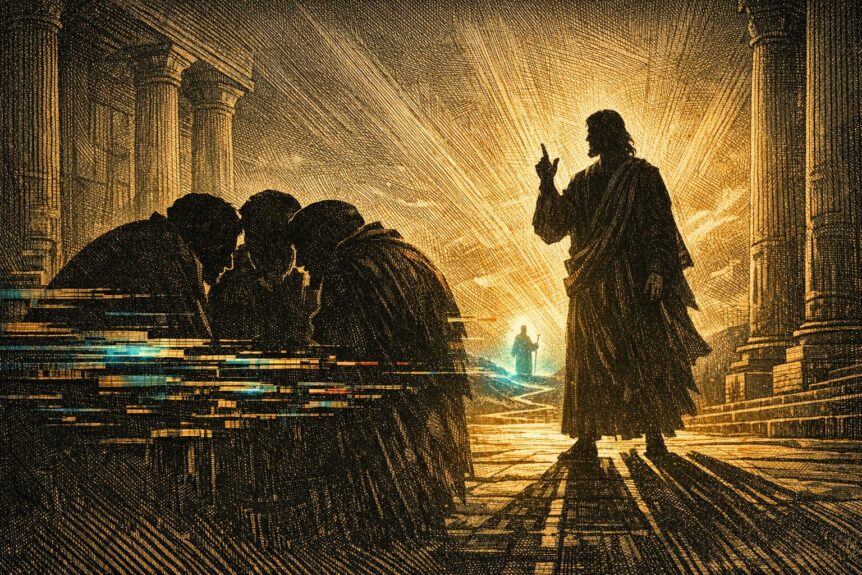
There is no way to win a battle of wits with the King of kings, but that doesn’t mean they won’t try. Jesus’ counter-question forces them to huddle. In the huddle, they don’t discuss possible truthful answers. They don’t consider whether John was a real prophet sent by God or weigh Jesus’ words on an honest scale. They huddle to craft a response that will dodge the issue. It is all just political posturing.
In their little huddle, they consider the two outcomes:
From heaven. To say John’s ministry is from heaven means it is given by God Himself. Therefore, if John’s message, ministry, and baptisms were from heaven, they clearly have a huge problem. Why? Because they have rejected his ministry! They don’t consider him a legitimate prophet. To them, John was nearly as annoying and disruptive as Jesus, and they both stole the crowd’s adoration. He also had the same credential problem that Jesus did… he didn’t have any! John was just a whacko Nazirite who lived in the wilderness.
Had they answered that way, at least they would have been honest with themselves, but they couldn’t say it out loud. Their pride wouldn’t let them affirm John. They couldn’t allow that feral wilderness prophet to receive the same acclaim they enjoyed. And they certainly wouldn’t allow their acceptance of John to lead to their acceptance of Jesus. Their presuppositions and hardened hearts wouldn’t allow it. Their pride wouldn’t allow Jesus to have the satisfaction of saying, “Why didn’t you believe it, then?”
No, this answer is firmly off the table.
From humans. The only other option is that John’s ministry was man-made. Maybe he gained popularity simply through attraction, charisma, and good marketing. Since he was proclaiming heavenly realities (like repentance and the Messiah’s coming) without hearing from God, he was falsely representing God. If this is true, then they are justified in rejecting him. If John wasn’t commissioned by God but claimed he was, he would be a false prophet and should be called out as one. We would do the same in the church today. Anyone who claims to speak on God’s behalf but speaks only from their own will is a danger to the body of Christ and should be rightly rejected.
This may have been what they believed, but they could not say it publicly. Why? Because the crowd does believe it. They adore John and hold him in high esteem as God’s messenger. They are the ones in the debate audience wearing campaign hats, buttons, and T-shirts. They are all in on team John all the way!
There is no way these scribes, elders, and chief priests can call John a false prophet. They need the crowd’s love and support and are already losing authority and clout with them. Twice in a row, Mark says these leaders were afraid of the crowd. On the one hand, we’ve seen past efforts to maintain their status and authority, but this moment is more life-threatening than Mark lets on. Luke’s account says the leaders feared the crowd would stone them for admitting that John’s ministry was simply of human origin. They love being loved by the masses, but they love breathing even more.
No… this answer is also definitively off the table.
This is an incredibly ironic, gotcha moment. Their initial questions were meant to trap Jesus in His own words, to shame and discredit Him, and, hopefully, to catch Him in a blasphemous claim. In doing so, they would have the evidence they needed to take Him out. Now, the tables have completely turned!
This is the sort of thing Solomon warned the wicked about long ago:
Proverbs 26:27 CSB
27 The one who digs a pit will fall into it, and whoever rolls a stone— it will come back on him.
With a single question, Jesus puts them in the exact same situation, but He does so with integrity and a clean heart. Though many of us want to cheer on a wonderfully executed intellectual gut-punch, we can’t miss the truth being magnified in this ironic moment. Not only is Jesus more authoritative in this situation, but He is in complete control of it. He is sovereign. These wicked leaders want His death, and they will have it soon enough, but not on their terms or timetable. Jesus will determine the time when they charge Him with blasphemy that leads to the cross… and He will do so by answering their question directly and plainly. The cross is coming, but not yet. For now, it isn’t His time.
What is praiseworthy about this passage is who Jesus is: sovereign, wise, discerning, and authoritative. He is truly the rightful ruler of God’s kingdom. But we must also have eyes to see what keeps these leaders from embracing what we see. These men are arrogant and lust for power. Their pride is in their position of power. They grow jealous when the crowd flocks to Jesus instead of them. They allow public opinion to sway their discernment and decisions, fearing the loss of their support. Therefore, they reject Jesus.
Scripture, however, says we should pursue the opposite.
Proverbs 9:10 CSB
10 “The fear of the Lord is the beginning of wisdom, and the knowledge of the Holy One is understanding.
Proverbs 16:18 CSB
18 Pride comes before destruction, and an arrogant spirit before a fall.
Pride and the fear of man keep us from submitting to Jesus. So, before we move on – isn’t that us too, sometimes? We know the true answer. We just don’t want to be wrong or pay the social cost of saying it out loud.
IV – The Shutdown (v. 33)
Being wedged between pride and fear, knowing they can’t affirm either option, they take the coward’s way out. When they break out of their huddle, they shrug with a side-eye glance at the eager crowd and simply say, “We don’t know.”
This is the political non-answer we all recognize. It’s the calculated “no comment” that isn’t neutral at all. They had something to hide, so they stayed silent to minimize the damage.
Now, Jesus has them right where He wants them. Knowing their intent, He simply replied, “Neither will I tell you by what authority I do these things.”
If you won’t answer me, I won’t answer you. This isn’t avoidance. It was the deal they made at the beginning. They came to trap Him, but He let them fall into it. They came asking the question, but He will leave with the definitive statement. They came trying to display authority, but Jesus shows everyone He had it all along.
As I said at the beginning, this is groundwork being laid… the foundation for the entire next chapter. With Jesus’ authority established and Israel’s leaders’ political posturing exposed, He will now continue to expose them.
- First, he will compare them to the wicked vineyard tenants who kill the master’s son
- Then the Pharisees ask Him about paying taxes to Caesar
- Then the Sadducees ask about the Resurrection, which they don’t believe in
- Then the Scribes ask Him about the greatest commandment
Amazingly, all three groups take turns trying to regain their authority and to trap Jesus again. After effortlessly disarming them once again, Jesus takes back the reins, asking them about the Messiah, warning them about false intentions, and then points to one lonely widow who epitomizes what faith and trust in Him look like.
So you see, this passage isn’t just a satisfying ‘gotcha’ moment for Mark’s readers. It is Jesus establishing His authority over the Sanhedrin’s representative members, His sovereignty over the timing of His arrest, and His wise rule over God’s kingdom. He is the rightful ruler, not these corrupted ones. They stand condemned, and He will expose them for who they really are.
🔥 Application:
As we come to a close, I want to ask you a simple question.
“What keeps you from seeing Jesus as King and acknowledging His authority?”
Remember, pride and the fear of man keep us from submitting to Jesus. And here’s the uncomfortable part. Those men huddled that day because the truth would have cost them something. It will cost you something too.
Maybe you’ve never bent the knee to Jesus, and if you’re honest, it’s not really the arguments holding you back. It’s what you’d have to lose. Your way of living. What certain people would think of you. Your own sense that you’ve got this figured out. Those leaders had that same gift sitting right in front of them, and pride was more precious to them than the truth. Don’t let it be more precious to you. Repent. Fear the Lord instead of fearing what everyone else thinks, and receive the life He’s offering.
And if you already follow Him, don’t assume you’re exempt from this type of huddle. It shows up smaller for us. The choice we make because of what someone might think. The one area of life we’ve told God to stay out of. If there’s a sin you’re circling tonight and you won’t name it because naming it costs you something, stop huddling. Say it to Him honestly. That’s exactly where His mercy is waiting.
Maybe today you’re just worn out, running on empty, and this all sounds like one more thing to try harder at. It isn’t. The same Jesus who stood sovereign over a room of men plotting His murder is sovereign over whatever is burdening you right now. You can trust Him with it.
Or maybe nothing is in crisis. You’re coasting, comfortable, and you haven’t needed Jesus for anything in a while. Then hear the Sanhedrin’s warning as yours. It is entirely possible to sit remarkably close to the King and still refuse Him the throne of your heart.
Here’s what should shatter our pride entirely: the same Jesus, who was too wise and sovereign to fall into wicked men’s trap in chapter eleven, will allow another trap to ensnare Him just a few chapters later, and this time He won’t defend Himself. He goes to the cross precisely because of the pride and fear of man we’ve recognized in ourselves. So, when I encourage you to kneel before the King, I’m not asking you to submit to mere power. I’m urging you to kneel before the One who held all authority but chose to die for those plotting against Him. That is the King worth sacrificing your reputation for.
FAQs
1. Why did the religious leaders challenge Jesus’ authority?
Jesus had cleansed the temple and openly taught the people, confronting the leaders’ corrupted use of power. Their question was not neutral. They wanted to discredit Him publicly and gather grounds to remove Him.
2. Was Jesus avoiding their question?
No. Jesus gave them a clear condition: if they answered His question about John’s baptism, He would answer theirs. His question exposed whether they were willing to deal honestly with God’s revealed truth.
3. Why did Jesus ask about John the Baptist?
John’s ministry pointed directly to Jesus. If the leaders admitted John was sent from heaven, they would have to explain why they rejected John’s testimony and refused to believe in the One John announced.
4. Why was saying “We don’t know” such a serious response?
Their answer was not humble uncertainty. It was calculated evasion. They knew the consequences of speaking honestly, so they chose self-protection over truth.
5. Is fear of man really that dangerous?
Yes. Fear of people can make us hide sin, soften truth, avoid obedience, and protect our reputation at the expense of faithfulness to Christ. Scripture calls us to fear the Lord, who alone is worthy of our ultimate allegiance.
6. Does this passage mean Christians should never consider public consequences?
No. Wisdom considers consequences, but believers must never let public opinion become their final authority. The leaders’ sin was allowing self-preservation and the crowd’s approval to govern their response to truth.
7. How does this passage point us to the cross?
Jesus refused to be trapped on the leaders’ timetable, yet He would soon willingly give Himself over to death. The King who could not be outmaneuvered chose to go to the cross for proud and fearful sinners.
8. What should I do if pride or fear is keeping me from obeying Jesus?
Stop hiding and bring it honestly before the Lord. Repent of the desire to protect yourself, fear God above people, and trust that Christ’s mercy meets you where confession and obedience begin.