
Highlight Reel
Sermon Summary
In Mark 11, Jesus uses a fig tree and a corrupted temple to reveal a sobering truth: it is possible to look spiritually alive while being empty at the root. The temple was full of activity but lacked true worship, justice, and prayer. In response, Jesus calls His disciples away from empty religion and into a life of real faith—marked by dependence on God, persistent prayer, and genuine forgiveness. Real faith doesn’t produce appearances; it produces fruit.
Sermon Audio
Shareable Quote graphics


Sermon Text
No Faith, No Fruit
Nate Roten / Mark / Judgment; Faith / Mark 11:12–25 / August 9, 2026
Main Idea
Real faith will always make us fruitful for God’s kingdom.
Fig Sandwich
Today begins with a strange scene: Jesus walks up to a fig tree, finds no fruit on it, and curses it to death, even though Mark tells us flat out it wasn’t even fig season. If a tree can’t be blamed for not having fruit when it’s not fruit season, why does Jesus curse it?
If you stop right there, you’d walk away thinking Jesus lost His temper at a tree that never had a chance… that He’s being unreasonable, maybe even petty. But Mark doesn’t want you to stop right there. He’s teaching us something specific by taking one story and wrapping it around another, like a sandwich, so that the middle layer tells you how to read the outside. It’s been a while since we’ve dug into one of these Markan sandwiches, but this one might be the most important yet because underneath this strange little scene with the tree, Jesus is asking you and me a vital question: Are you actually bearing fruit, or do you just look like you are?
- Top layer – Cursing of the fig tree
- Middle – Cleansing the Temple
- Bottom layer – The withered fig tree
This scene opens the day after Jesus went to the Temple the night before to take a look around and assess its condition.
To understand what Jesus encountered, imagine entering the temple complex during Passover, one of the busiest weeks of the year. The first area you entered was the Court of the Gentiles: a vast open-air courtyard of roughly thirty-five acres, surrounded by magnificent, covered walkways and towering stone columns. It was the only part of the temple where Gentiles could come near to worship Israel’s God. But during Passover, this space would have been crowded with tens of thousands of pilgrims and filled with the activity of the sacrificial system.
Imagine yourself standing there: Merchants call out to passing pilgrims as sheep bleat and tug at their ropes. Cattle shift their weight and press against one another. Doves flutter in stacked cages. Money changers sit behind tables covered with coins, exchanging travelers’ foreign currency for the approved silver used to pay the temple tax. You hear animals, bargaining voices, coins striking tables, and people pressing through the crowd. The smell of livestock fills the courtyard, mingling with the smoke of sacrifices rising from deeper within the temple complex. What had been set apart as a place where the nations could draw near to God had taken on the noise and atmosphere of an enormous and crowded religious marketplace. This was the scene Jesus had quietly inspected the previous evening, and it was the scene to which he now returned. As we jump in, hold onto this: fruit is the evidence of faith. Where there’s no faith, there will be no fruit.
Passage
Mark 11:12–25 CSB
12 The next day when they went out from Bethany, he was hungry. 13 Seeing in the distance a fig tree with leaves, he went to find out if there was anything on it. When he came to it, he found nothing but leaves; for it was not the season for figs. 14 He said to it, “May no one ever eat fruit from you again!” And his disciples heard it. 15 They came to Jerusalem, and he went into the temple and began to throw out those buying and selling. He overturned the tables of the money changers and the chairs of those selling doves, 16 and would not permit anyone to carry goods through the temple. 17 He was teaching them: “Is it not written, My house will be called a house of prayer for all nations? But you have made it a den of thieves!” 18 The chief priests and the scribes heard it and started looking for a way to kill him. For they were afraid of him, because the whole crowd was astonished by his teaching. 19 Whenever evening came, they would go out of the city. 20 Early in the morning, as they were passing by, they saw the fig tree withered from the roots up. 21 Then Peter remembered and said to him, “Rabbi, look! The fig tree that you cursed has withered.” 22 Jesus replied to them, “Have faith in God. 23 Truly I tell you, if anyone says to this mountain, ‘Be lifted up and thrown into the sea,’ and does not doubt in his heart, but believes that what he says will happen, it will be done for him. 24 Therefore I tell you, everything you pray and ask for—believe that you have received it and it will be yours. 25 And whenever you stand praying, if you have anything against anyone, forgive him, so that your Father in heaven will also forgive you your wrongdoing.”
I – Curse the Fig Tree (vv. 12-14)
From Bethany to Jerusalem, Jesus stays in Bethany, and the next morning He heads back toward Jerusalem. As He and His disciples walk along the road, about a mile or two away, Jesus spots a fig tree. Mark explains that Jesus is hungry, so He approaches the tree expecting to find fruit to satisfy that hunger. When He gets close, He sees the tree’s leaves but no figs, because it’s not the season for figs. Interestingly, despite it not being fig season, Jesus curses the tree for lacking fruit. Mark emphasizes that the disciples heard Jesus’s words, though they don’t interact with him right now.
The curse. Since few of us are farmers or agricultural experts, it’s helpful to understand what the tree looked like so we can compare it to Jesus’ expectations. Mark mentions that it was “not the season for figs,” indicating that the mature fig harvest had not yet started. The main crop typically ripens later in summer and fall. However, a tree with lush green leaves might lead someone to expect edible fruit. Fig trees often develop small green knobs (early, immature figs called paggim) around the same time as, or even before, their leaves appear. These immature figs aren’t the sweet, ripe fruits of the later harvest, but they are edible. So, even though Jesus wouldn’t have expected the tree to be full of ripe figs, its abundant foliage could have led him to check for any early fruit.
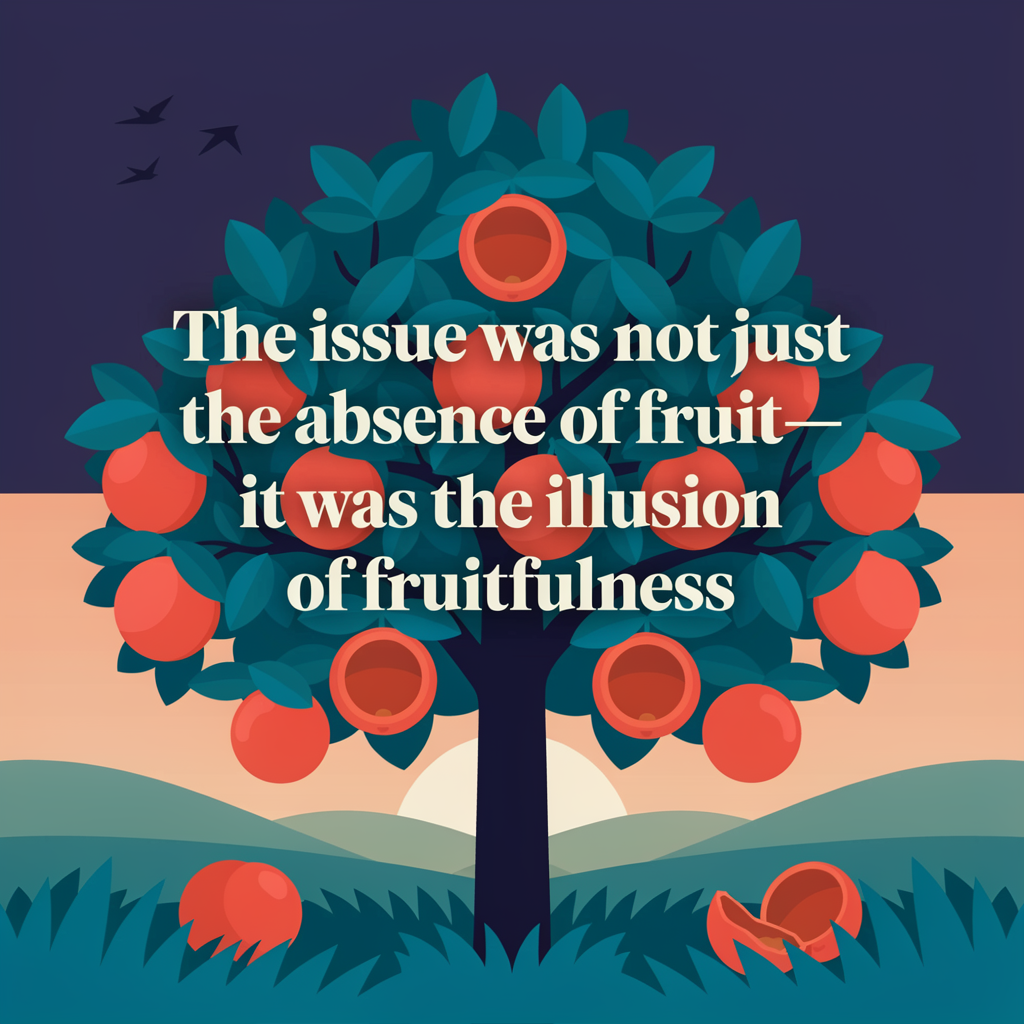
Therefore, Jesus was not expecting mature fruit to appear out of season. From a distance, the tree’s lush foliage suggested fruitfulness. However, upon closer inspection, Jesus found only leaves, indicating that the tree lacked the early fruit its leaves had suggested it should have. The issue was not just the absence of ripe figs; it was that the tree exhibited outward signs of fruitfulness without producing any fruit. Hold onto that, because by the end of this passage, Jesus is going to tell us exactly what ensures fruitfulness, and it’s not effort. It’s faith.
The Temple connection. What connects it? It is the cleansing of the temple. What Jesus is doing to this fig tree connects to the life of the temple and what the temple represents. Clearly, it’s defiled. Last week we saw the prophecy from Malachi that spoke to the purpose of the Messiah coming to cleanse like a launderer’s bleach. And so, we see this take place here at the temple. This understanding should lead us to ask another question. What does the temple represent? It was the center of Jewish life because it is God’s house. All of life revolves around devotion to and worship of the one true God who provides for His people and forgives their sin.
That is the initial connection we need to make. What Jesus is doing by pronouncing a curse on this fig tree, which appears fruitful but bears no fruit, is the key to interpreting this Mark sandwich.
II – Cleansing the Temple (vv. 15-19)
Now, the Lord has returned once more to His bustling temple. He is no longer observing passively; it’s obvious what is happening. Usually, a full house is cause for celebration, but when human greed outweighs divine devotion, God would prefer to see the seats emptied.
The purpose of cleansing. Jesus called the Temple a house of prayer for all nations. This isn’t just a designation Jesus is making up on the spot. It comes from Isa. 56:7.
Isaiah 56:7 CSB
7 I will bring them to my holy mountain and let them rejoice in my house of prayer. Their burnt offerings and sacrifices will be acceptable on my altar, for my house will be called a house of prayer for all nations.”
This sets the expectations for what should be happening here and by whom. We see His presence in a visible way throughout the Old Testament, either resting on the temple and the people rejoice, or departing from the temple and the people mourn. God’s people are supposed to come to the temple to pray, worship, and praise their merciful, compassionate, holy God. And all of this is not limited solely to God’s people but extends to all nations who want to worship the God of Israel. Those who are not of Israel come to the temple and worship in the court of the Gentiles. And this is most likely the exact place where all the vendors and money changers are setting up their profit centers, which is preventing them from coming to do what God wants them to do. Now, the people’s prayer and praise have been replaced by profiteering.
The core issue. Now notice that Jesus isn’t mad at the basic service of exchanging money or selling animals. Both of those services were legitimate. Pilgrims traveling from all over the Roman world needed local currency exchanged for the temple shekel. Think of it like the currency exchange booth at an international airport. And pilgrims needed animals for sacrifice. These are real services.
So what’s Jesus actually angry about? Location and exploitation. When you travel, you should exchange currency outside of the airport, because their exchange rate is a rip-off. You’ll get a better rate in town. This entire marketplace has set up shop in the one courtyard where Gentiles (the nations Isaiah promised would come and worship) were supposed to have room to draw near to God. And Mark drops one small detail that tells you who’s getting squeezed the hardest: doves. Doves were the sacrificial offering for the poor… the ones who couldn’t afford a lamb. Jesus’ own parents offered doves for Him at this temple. So when the vendors crowd out the Court of the Gentiles and charge whatever they want for doves, the very people the temple was supposed to welcome (the outsider and the poor) are the ones being shoved out and squeezed the hardest.
That’s the anger of God in the flesh. Not at services, but at corrupted hearts that exploit others for financial gain… for transactions that have replaced worship… and doing so in the very place to connect with God. Now God in the flesh has entered his temple, and he will not remain silent while worship is burdened by commerce and the vulnerable are placed at risk of exploitation.
Isaiah 56 looks forward to God’s approaching salvation. Foreigners and eunuchs, people who might assume that they have no place among God’s covenant people, are specifically welcomed. God promises to bring them to His holy mountain, accept their worship, and give them joy in His house because: “My house will be called a house of prayer for all nations.”
The chapter then turns sharply, condemning Israel’s leaders as blind, selfish watchmen who have failed to care for God’s people. Thus, Isaiah 56 combines God’s welcome of outsiders with His rebuke of unfaithful spiritual leaders. The rebuke would have been abundantly clear to any discerning Jew. He is confronting Israel’s failure to fulfill its mission to draw the nations toward the worship of God. They bear leaves, but not fruit.
The robbers. This quotation from Jesus is also not random. It comes from Jeremiah 7:11
Jeremiah 7:11 CSB
11 Has this house, which bears my name, become a den of robbers in your view? Yes, I too have seen it. This is the Lord’s declaration.
Jeremiah 7 comes from Jeremiah’s temple sermon, delivered shortly before Jerusalem’s destruction by Babylon. The people believed that the temple’s presence guaranteed their safety. They could oppress foreigners, orphans, and widows, shed innocent blood, practice idolatry, and then enter the temple believing they were safe from judgment.
Jeremiah asks whether the temple has become “a den of robbers.” A den is not where robbers typically commit their crimes. It is a hiding place they retreat to afterward, believing they are safe. The people were treating the temple as a religious cover for lives of injustice and rebellion. Jeremiah therefore reminded them of Shiloh, an earlier sanctuary God had allowed to be destroyed and warned that Jerusalem’s temple could suffer the same fate if they don’t repent.
When Jesus quotes Jeremiah, he issues the same warning. The temple’s beauty, sacrifices, and religious activity will not protect it from judgment. Jesus’ action is therefore more than a reform effort. It is a prophetic sign that the temple stands under divine judgment, anticipating Jesus’ prediction of its destruction, just as God said would happen in Jeremiah.
Therefore, Jesus would not allow them to continue doing business. He overturned the money changers’ tables so they could no longer process and count money. He also overturned the chairs of at least the people selling doves, leaving them no place to sit and do business. He disrupted the entire chain of commerce so His purpose could not be misunderstood. This is not the place to come and make a profit. This is a place to connect with God.
The Reactions. The crowd was astonished. If this happened today, people would pull out their phones, and it would instantly go viral. Jesus was driving out the merchants, overturning the money changers’ tables, and preventing people from carrying merchandise through the temple courts. But he was not merely causing a disruption. He was teaching the people what should have been happening there all along: “My house will be called a house of prayer for all nations.”
The crowd’s astonishment was therefore directed not only at what Jesus did but also at the authority with which He explained it. He did not seek permission from the temple authorities. He entered the temple as though it were His (because it is), confronted what it had become, and declared what God designed it to be.
The chief priests and scribes reacted very differently. Mark tells us that they began looking for a way to destroy Jesus because they feared him, given that the whole crowd was astonished by his teaching. Jesus’ authority was becoming increasingly public, and their own authority was being challenged. The more the people listened to him, the more threatened the religious leaders became.
The irony is staggering. These were the men entrusted with guarding Israel’s worship and directing the people to God. Yet when God’s promised King entered his temple and confronted its corruption, they did not repent. Instead, they plotted His death. The One who came to purify the temple was rejected by the very leaders who were supposed to keep it holy.
As a result, Jesus and His disciples could no longer safely stay in Jerusalem. The final part of verse 19 appears to summarize nightly events throughout that week, rather than describing a specific day. The chief priests and scribes’ desire to kill Him compelled them to leave the city each evening.
I know that is a lot, so let’s quickly recap. When Jesus speaks, He combines two prophetic warnings. From Isaiah 56, he declares what the temple was meant to be: a house of prayer for all nations, a place where even foreigners and outsiders could draw near to God. In Jeremiah 7, He declares what it had become: a den of thieves, where corrupt religious people believed they were safe while continuing in injustice and disobedience. And both passages warn what will happen… their sanctuary will be destroyed, and they will be banished from God’s presence.
That helps us understand why Mark places this scene within the story of the fig tree. The temple displayed all the outward signs of religious fruitfulness: magnificent architecture, constant sacrifices, crowded festivals, and endless activity. But when Jesus came seeking the fruit of prayer, justice, repentance, and a welcome for the nations, He found nothing. Just as Jeremiah had warned that Shiloah and Solomon’s temple would not protect an unrepentant people, Jesus now warns that Herod’s temple will not shelter them from God’s judgment.
God is not impressed with religious activities that do not engage the heart. He doesn’t track the same metrics we do. This is a gut check for you and me to ensure we are producing fruit, not just leaves.
III – The Withered Fig Tree (vv. 20-25)
Peter notices. Peter makes the connection between what Jesus said the day before, when the disciples were listening and heard His words, and the reality of those words and how they affected the life of this fig tree. And this is almost a bit of comedic relief because Peter is talking to Jesus… as if Jesus didn’t realize what He was doing. He says, “Rabbi, look, the fig tree that You cursed has withered.”
New Covenant Action. Now, what’s interesting is how Jesus replies to Peter. We can look at this story and how Mark crafted it to help us understand what Jesus was doing with the fig tree.
The fig tree represents unfruitful and unfaithful Israel. They have had ample time to bear fruit for God’s kingdom, yet they refuse to. Therefore, God has pronounced judgment on them. Notice that the fig tree did not wither from the top down but from the roots up. The root is now dead, and a plant that dies at the roots is toast. It is over.
However, when dealing with the disciples, Jesus refocuses. Instead of unpacking the judgment over Israel, He encourages the disciples to do the very thing that would prevent such destruction from happening to them. The old covenant is ending, and God’s presence is departing from the Temple. Moving forward, every believer will be a temple where God the Spirit dwells. These disciples (minus Judas) will be the ones to carry the kingdom to the known world, so Jesus asks them to do what He has been asking of them this entire time: have faith.
Faith influences all our actions. But what exactly is faith? Based on what we’ve observed in Mark, it is:
- a dependence on Jesus
- child-like trust in His provision and ability
- grounded in a knowledge of who Jesus is
- rooted in His will
- choosing to believe in God’s promises and not in our current circumstances
- God-exalting and self-denying
This is the key to being fruitful rather than fruitless. A branch of an apple tree doesn’t produce fruit by trying harder to make apples. It produces fruit because it’s attached to the trunk that gives it life.
It is all about being connected to the vine, as Jesus says in John 15. If we know we need Him… if we know we can do nothing apart from Him… if we know we can trust Him… if we know He is the fulfillment of our deepest longings… then we will remain in Him.
Prayer. That naturally affects our prayer life. We begin to believe He can move any barrier, even the impossible ones. That is the point of the mountain analogy. Jesus wasn’t expecting us to uproot literal mountains in faith. That is simply hyperbolic language… a way to express unwavering trust that God can do the impossible when we ask Him to do those impossible things in our lives according to His will. Therefore, strong faith keeps us rooted and fruitful in a strong abiding relationship with God.
Forgiveness. Secondly, it moves us to forgive… keeping us rooted and fruitful in strong relationships with others. Notice how the call to forgive blooms from your prayerful relationship with God. As we recognize how much we have been forgiven by our Heavenly Father, our ability and desire to forgive others increase. The two are intimately connected. And the result is a greater unity that bears more fruit corporately.
As New Testament believers, our focus isn’t on destruction; it is on faith. And real faith will always make us fruitful for God’s kingdom.
For Jesus’ disciples, this was a wake-up call. God’s desire is for all nations to come to Him, and the nation of Israel was meant to be a fruitful fig tree for all to come and be fed. Yet despite their appearance of fruitfulness, they weren’t producing any real fruit, and they hadn’t for a very long time. Their unfruitfulness stemmed from an utter lack of faith. Now the Lord of the Temple had come and judged them. From that moment on, the roots were cursed, and within just a few decades, the whole plant would wither and die. The devastation of Israel and the physical Temple would be complete.
But that was Israel, not the New Testament church.
So we’re safe, right? We can close our Bibles, feel a little bad for Jerusalem, and move on with our week?
Well, not so fast…
🔥 Application: Are you fruitful or only appear to be?
We are called to faith and life, not death and destruction. However, we should not look at the withered fig tree, point backward to Jerusalem, and assume this warning has nothing to say to us. The temple had leaves. It had impressive buildings, crowded festivals, constant sacrifices, respected leaders, and endless religious activity. Yet when Jesus came looking for fruit, He found none.
Let me ask you what Jesus was really asking them: not “do you look alive,” but “are you alive?” Because the church can grow leaves too. You can be here every Sunday, know your Bible, serve on a team, sing every word with your hands raised… and still be prayerless, unforgiving, and dry at the root. That’s not a Jerusalem problem. That’s a heart problem. And it’s exactly the one Jesus is standing in front of right now, waiting to see what He finds.
Jesus points His disciples toward a different kind of life: “Have faith in God.” This is not faith in faith, nor is it confidence that God will fulfill every desire we name. It is a settled dependence on the character, power, promises, and will of God. It is the kind of faith that draws near to God in prayer, believing He is present, attentive, powerful, and good.
So, ask yourself:
- Is prayer my first response or my last resort?
- What mountain have I stopped bringing before God?
- Whose offense am I still rehearsing?
- Are the people closest to me experiencing greater patience, gentleness, and grace?
Real faith produces real fruit. That fruit does not earn our salvation, but it reveals that our roots are alive. So have faith in God. Draw near to Him in prayer. Trust Him with the impossible. Forgive as you have been forgiven.
Remain in Christ and let His life bear fruit through you.
FAQs
1. Why did Jesus curse the fig tree if it wasn’t fig season?
The tree had leaves, which normally indicated early edible fruit. It gave the appearance of fruitfulness but had none. Jesus uses it as a living parable of spiritual hypocrisy—outward signs without inward reality.
2. Was Jesus acting in anger or being unreasonable?
No. This was a deliberate prophetic act, not a loss of control. Like Old Testament prophets, Jesus used a physical sign to reveal spiritual truth and pronounce judgment.
3. What was wrong with buying and selling in the temple?
The services themselves were legitimate. The problem was corruption and placement—exploiting worshipers, especially the poor, and crowding out the space meant for the nations to seek God.
4. What does “den of robbers” really mean?
It’s not just a place where sin happens—it’s a place where people hide, thinking they’re safe. The temple had become a false refuge for unrepentant hearts.
5. Is this passage mainly about judgment or about faith?
Both. The fig tree and temple show real judgment on fruitless religion, but Jesus turns to His disciples and emphasizes faith as the way to true, lasting fruitfulness.
6. Does “moving mountains” mean we can accomplish anything if we believe enough?
No. Jesus is using vivid language to describe trust in God’s power according to His will. Faith is not control over outcomes—it is confidence in God’s ability and goodness.
7. Why does Jesus connect prayer and forgiveness?
Because a heart that truly knows God’s grace will extend grace to others. Unforgiveness chokes spiritual life, while forgiveness reflects and sustains it.
8. How do I know if I’m bearing fruit or just showing leaves?
Look beyond activity. Are you growing in prayer, repentance, dependence on Christ, and love for others? Fruit shows up in transformed desires, not just external behavior.